Dedications: My four late friends Rory, Stan, Bryan, Jeff - shine on you crazy diamonds, they would have blogged too. Then theres Garry from Brisbane, Franco in Milan, Mike now in S.F. / my '60s-'80s gang: Ned & Joseph in Ireland; in England: Frank, Des, Guy, Clive, Joe & Joe, Ian, Ivan, Nick, David, Les, Stewart, the 3 Michaels / Catriona, Sally, Monica, Jean, Ella, Anne, Candie / and now: Daryl in N.Y., Jerry, John, Colin, Martin and Donal.
Showing posts with label Wendy Hiller. Show all posts

Friday, 21 August 2015

My very favourite film


Take the usual ingredients: a wilful heroine, an unconventional leading man, supporting characters we like and want to see more of, mix in the mystical highlands of Scotland, add in some Scottish castles, Scottish dances and songs, and the result is perfection. 
"Yes, but money isn't everything" ... That is probably the key line in I KNOW WHERE I'M GOING - Powell & Pressburger's timeless romantic fantasy from 1945 (the year I was born). The very independent Joan Webster who wants to marry a rich man travels up to the highlands on her way to the remote island of Kiloran which the millionaire has rented, but a storm forces her to stay on the mainland, at Erraig the house of Catriona (whose husband is away in the Far East, and children at boarding school), the war must be still on. Also staying is a friend of Catriona's Torquil whom Joan realises she is falling for, hence her desire to get away to the island. Navy officer Torquil [who is the real Laird of Kiloran] realising her dangerous plan to go out to sea in the storm helps her but the storm defeats them and the weary travellers arrive back at the house where Catriona puts Joan to bed in her own room with a roaring fire. (how wonderful it seems now to have real fires in bedrooms!). Catriona soon puts Joan to rights as Joan thinks that all these highland people are poor because they have no money so why doesn't Catriona sell her house Erraig, and their neighbour Mrs Crozier could sell her estate Achnacroish and Torquil could sell Kiloran - Catriona thinks about it and then says decisively "yes, but money isn't everything".  
The early scenes are marvellous too, at that fancy restaurant with Joan and her father and her trip by train to the Highlands - this was the real age of rail travel with sleeping compartments and attentive stewards. 
The next morning sees the storm abated, Joan has come to her senses as she sits on the table and says "I can't do a thing with my hair" and wonders where her wedding dress is (it was lost in the storm) to which Torquil replies "a mermaid will get married in it". The boat from Kiloran finally arrives to collect her, but will she have a change of heart? .... enter 3 pipers and the most perfect ending imaginable.

There is also that lovely detour to the Castle of Sorne to visit some snobby neighbours whom the pompous millionaire thinks are the only people worth knowing locally - it is the most perfect location with that high window seat (and young Petula Clark is the daughter) and then there is that lovely interlude at Achnacroish with Rebecca Crozier (Nancy Price) who sees Joan's worth at once and we have the highland dancing as the magic works on Joan. Torquil who is also there explains "highland economics" to Joan - letting Kiloran for three years means he can live there for six - and the millionaire installing a swimming pool means that "money spent is money earned" for the local workmen whom they travel with on the bus. The highlands scenes are marvellously shot, as we visit Tobermoreyand the Western Isles Hotel, and the Isle of Mull. 
These are just some moments from this lovely film, which grows on one at each viewing. The cast are all superb: Wendy Hiller as Joan, Roger Livesey (that voice!) as Torquil (he was not actually at the highland locations due to being in a play in London - his scenes are interiors, with a stand-in for location shots), Nancy Price as Mrs Crozier and that very individual actress Pamela Brown as Catriona, the resourceful woman managing on her own, in that perfect 1940s house, while her husband and children are away (she was Powell's lover at the time and until her death aged 58 in 1975) - her entry here with her dogs and gun and a rabbit presents her like Diana the huntress - as she says "if I don't shoot this rabbit then I don't eat"! She and Torquil are old friends and she soon realises the attraction between him and Joan. Hiller is delightful too as Joan who is used to getting her own way (as set out in the breezy introduction). The climax with the ruined castle and that curse and the highland tune are also just right. I also like the great photography with those great black and white images [like WHISKEY GALORE that other great film shot in Scotland in the '40s]. A film to cherish then, it may well be my favourite film of all. Like THE QUIET MAN or THE SEARCHERS it's admirers are legion and devoted, just like for Powell's others like BLACK NARCISSUSA MATTER OF LIFE AND DEATH and THE RED SHOES all of which I also love dearly.

Monday, 15 December 2014

Another ship of fools ....

Based on the true story of a ship carrying German-Jewish refugees which was sent to Havana in 1939 by the Nazis but was denied permission to land anywhere. The ship was eventually obliged to return to Germany, where certain death awaited its passengers. This terrible outcome had been cynically anticipated by the Nazis when granting permission for the voyage in the first place.

The 1970s was that era of all-star disaster movies: the US studios gave us EARTHQUAKE, THE POSEIDON ADVENTURE, AIRPLANE 75 and all the rest, while in England TV mogul Sir Lew Grade assembled several all star packages, some of which were amusingly awful like our favourite THE CASSANDRA CROSSING (Sophia! Ava! Ingrid Thulin! Alida Valli! Burt Lancaster! John Philip Law! and more) and others like ESCAPE TO ATHENA was just silly, but VOYAGE OF THE DAMNED in 1976 was meant to be a serious drama but it is so crammed with names that one just sits there bemused by it all - "look, there's Julie Harris talking to Wendy Hiller" - but a lot of them have nothing to do and some barely get a look in: 
James Mason, Katharine Ross as a prostitute, Orson pops in a scene or two, as does Ben Gazzara, Helmut Griem reprises his evil Nazi (a la CABARET and Visconti's THE DAMNED), Malcolm McDowell, playing nice for once, is the young steward having a romance with Lynn Frederick (the last Mrs Peter Sellers), her parents are Lee Grant (who goes over the top spectacularly as the berserk mother cutting her hair in the concentration camp style) and Sam Wanamaker. Other well known faces here are Nehemiah Persoff and Maria Schell (also barely seen), while Jonathan Pryce is one of the persecuted refugees hoping for a new life. 

Topping the bill are Faye Dunaway and Oscar Werner (his final role) - Faye as an embittered wife displays her haughty glamour and gets to wear a monacle and strut around while her husband, Werner, practically reprising his role in SHIP OF FOOLS plays an esteemed Jewish surgeon. The captain of the "St Louis" is none other than Max Von Sydow. It should be a grim drama but the all-star cast and plodding direction of Stuart Rosenberg render it interesting for all the wrong reasons. Kramer's 1965 plodder SHIP OF FOOLS, which we caught and reviewed a year or so ago (Simone Signoret label), did it all much better. 

THE SHOES OF THE FISHERMAN in 1969 was also an all-star spectacular, helmed by the reliable Michael Anderson - one of several that year (BATTLE OF BRITAIN, OH WHAT A LOVELY WAR) - from a novel about the first Russian pope and how he tackles world poverty, from a novel by Morris West - which is another long, if entertaining, plod to see now, but at least it employed Anthony Quinn as the pope, Laurence Olivier as a wily Russian official, Oscar Werner again as another doomed priest, Gielgud as another ailing pope, and many, many more. 

Saturday, 13 September 2014

Separate Tables, 1958

Terence Rattigan's 1954 play SEPARATE TABLES is a Fifties time capsule now, capturing as it does that genteel Bournemouth hotel with its residents at their separate tables ... the play is in two acts, with the main two leads playing different characters in each act, the other residents stay the same. In the original production it was Eric Porter and Margaret Leighton. But the Hecht-Hill-Lancaster production team when they made the popular 1958 film in Hollywood, combined them both into one continuous narrative, thus 4 stars were required for the main 4 characters, who are now Burt and Rita Hayworth, and David Niven and Deborah Kerr. This required a lot of dexterous pruning of the original script, which Rattigan himself did with John Gay and an uncredited John Michael Hayes. 
In the theatre when played as two acts, the acts are 18 months apart time-wise, but in the film we are in the continuous timeframe of the first act. This means a lot of the young couple (Rod Taylor and Audrey Dalton, below right) has been removed, and new material inserted, like scenes between Sybil and Mrs Shankland (Kerr and Hayworth) (who do not meet in the two separate act orginal).
The young couple stay as we see them in the first act - but in the second act of the play (18 months later) they are now married with a baby, which takes up all the mother's time - she sides with dragon-lady Mrs Railton-Bell to get the bogus Major, who has been exposed as a fake and a pesterer of women at the cinema, expelled from the hotel. Her husband does not agree and sides with the other residents. It makes for more interesting drama, but all that has to go for the film. 

There is a lot more of Miss Cooper, the hotel manageress, too in the play, but Wendy Hiller managed to scoop Best Supporting Actress for her role in the film. Niven of course won the Best Actor, but it seems a blustering fake performance, but then he is playing a blustering fake. Kerr is marvellous as the downtrodden Sybil, who finally stands up to her bully of a mother - Gladys Cooper being very malevolent here, as she was to Bette Davis in NOW VOYAGER. Hayworth and Lancaster add the Hollywood gloss and are perfectly adequate. The film is one of 1958's big enduring ones, up there with I WANT TO LIVE!, THE DEFIANT ONESTHE BIG COUNTRY, THE VIKINGS, SOUTH PACIFIC, AUNTIE MAME etc. 

I have seen a few other productions - John Schlesinger directed that 1983 television film, long unavailable, which goes back to the two act structure, with Julie Christie and Alan Bates (ther fourth teaming) playing both sets of leads, with Claire Bloom perfect as Miss Cooper, and Irene Worth, a monstrous suburban bully, as Mrs Railton Bell. Liz Smith shines too as the racing-mad spinster and Brian Deacon (from THE TRIPLE ECHO) as the young husband. - as per my fuller review, at Rattigan/Bates/Christie labels, which also goes into another version of Rattigan's work ...

I have now seen a BBC 'Play of the Month'  production of the play from 1970 with Porter and Geraldine McEwan in the lead roles. It is perfectly satisfying but a bit low-key. It is part of the BBC Terence Rattigan boxset (a nice companion to the Noel Coward boxset, again with interesting productions which I must return to), which also includes part of another version I saw on stage in the 70s, with John Mills and Jill Bennett. (As we mentioned previously, Rattigan's original text had the major pestering men in the cinema, but that would never have played back in the Fifties... and certainly not in the film, which suggests there is a future for the Major and Sybil).  

I also saw Rattigan himself at the BFI giving an entertaining talk also in the early 70s. The 1958 film though, directed by Delbert Mann, is the version most people know and like, even though it does not do full justice to the play and Rattigan's plea for tolerance for those who are 'different'. 

Tuesday, 6 May 2014

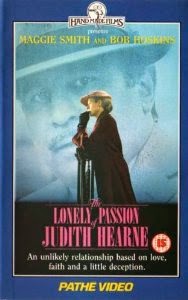
The Lonely Passion of Judith Hearne

Now for one of the greatest female performances on celluloid - up there with the very best. Maggie Smith is totally mesmerising and heart-breaking in Jack Clayton's 1987 THE LONELY PASSION OF JUDITH HEARNE where her every mood and gesture captures perfectliy the bleak existance of Miss Hearne in that Dublin of the early '50s. Let's just look at the vhs cassette blurb (there isn't a good dvd issue and what there is fetches silly money, so I had to re-connect my vhs player to play it). 

Two-time Academy Award winner Maggie Smith is Judith, a naive, abandoned spinster struggling to maintain her fragile dignity in a succession of shoddy Dublin boarding houses. Bob Hoskins is the younger man who enters her life with the apparent promise of love and companionship. But Judith's carefully constructed fantasy is shattered when her supposed suitor reveals his true motives. Falling back on the trusted escape routes of religion and alconhol only increases her desperation. Now Judith must face her "lonely passions" and in conquering them, summon up the spiritual courage to carry on. Or: A middle-aged spinster scrapes by giving piano lessons in the Dublin of the 1950s. She makes a sad last bid for love with a fellow resident of her rundown boarding house, who imagines she has the money to bankroll the business he hopes to open.

Taken from a highly-regarded novel by Brian Moore which was actually set in Belfast, but Dublin seems more appropriate here, Jack Clayton and scriptwriter Peter Nelson fashion this sad tale which stays with one, I am still moved by it today. Clayton of course has been great with actresses: Signoret in ROOM AT THE TOP, Kerr in THE INNOCENTS, Bancroft in THE PUMPKIN EATER (where Maggie Smith had that small eye-catching role...). Smith is in her element here, as the lady of slender means, whether settling into her new room, or later turning to drink, and then fearing she is losing her religion which keeps her going as she turns on the church and the priest trying to calm her. We see her life in the flashbacks, at the beck and call of her demanding aunt - the great Wendy Hiller (I KNOW WHERE I'M GOING) and being tolerated by relations like Prunella Scales (Mapp in MAPP AND LUCIA, Sybil in FAWLTY TOWERS). The boarding house is run by the great Marie Kean whom we like a lot (THE GIRL WITH GREEN EYES, I WAS HAPPY HERE, RYAN'S DAUGHTER, BARRY LYNDON, THE DEAD, THE IRISH R.M.).  We also observe the intrigues of the other boarders ...

Judith gives piano lessons, and discusses New York with Bob Hoskins who has returned from America, a man looking for money to fund his business ventures, as he takes Judith to the cinema (SAMSON AND DELILAH!) and she wants him to escort her to church - having a man by her side at mass is important to her. Once it all comes crashing down Judith hits the bottle and loses her students, spends all her savings and has a breakdown and slowly recovers, but what is she going to do now?  It is certainly heart-breaking and downbeat but also so human and mesmirising. I had thought THE PRIME OF MISS JEAN BRODIE was Smith's greatest role, but I am now sure its this unsparing portrait of a lonely spinster, one of the greatest performances I have seen. Everyone is superlative here and the period detail seems exactly right too. George Delerue did the haunting score - it its produced by George Harrison's Handmade Films company. One to keep and return to then.  I have had to order the book too - it was long mooted as a project for Deborah Kerr (who would have been fine here too in a good late role for her) and John Huston, instead we have Clayton's with a great actress at her peak. Smith then, after A PRIVATE FUNCTION and A ROOM WITH A VIEW and before Alan Bennett's TALKING HEADS (on TV again next week here for Bennett's 80th birthday tributes, but I have the dvd set) could do no wrong, either in these deeply intense roles or her camp, wrist-flapping comedy turns in CALIFORNIA SUITE, MURDER BY DEATH or EVIL UNDER THE SUN. She also tackled another serious role in 1972, but it did not quite come off ...

LOVE AND PAIN AND THE WHOLE DAMN THING. After Liza Minnelli in THE STERILE CUCKOO (or POOKIE) in 1969 and Jane Fonda as Bree in KLUTE, 1971, Alan J Pakula was THE director for actresses in fascinating films, and it is Maggie Smith’s turn here in 1972. At the time Smith could do no wrong after her MISS BRODIE hit, and stage successes at the National Theatre (HEDDA GABLER directed by Ingmar Bergman, THE BEAU’S STRATAGEM - both of which I saw twice, we saw her on the stage a lot in those 70s years) so why not an oddball romantic comedy, scripted by Alvin Sargent and directed by Alan J Pakula? 
The film though proved too oddball and I have never had a chance to re-see it until now (thanks, tim) … Timothy Bottoms (big after THE LAST PICTURE SHOW but not particularly charismatic) is the repressed young guy on holiday in Spain who wants to get away from his family of over-achievers, and she is the 37 year old repressed spinster – who may have a fatal disease. Both are kindred spirits and lonely souls, but it is rather excruciating watching them finally get together, with slapkstick scenes which do not work at all, like her being trapped in an outdoor toilet and getting toilet paper wrapped all around her legs …. At least the real Spain looks ideal here, well 40 years ago … finally, it does not end, but mercifully just stops. 
Dame Maggie has of course provided for her pension with the HARRY POTTER films and her enjoyable turns in DOWNTON ABBEY (via GOSFORD PARK), though we loathe her 'old folk' films like MARIGOLD HOTEL (there is a second one soon) and QUARTET - as per my reviews at Smith label.
Next: a great actor: Albert Finney in Huston's UNDER THE VOLCANO.

Wednesday, 24 July 2013

Summer and smoke ... and toys in the attic

Perfect for this sultry heatwave (with a long cool glass with clinking ice cubes to hand), SUMMER AND SMOKE is a return to that florid Deep South genteel world of Tennessee Williams. This is another florid tale of unrequited love, as Miss Alma yearns for local rake Doctor Laurence Harvey. We liked Geraldine Page a lot recently as Alexandra Del Lago in 1962's SWEET BIRD OF YOUTH, (review below - Page, Williams labels), here she has a very contrasting role, but was Oscar-nominated both years '61 and '62 for her Alma and Alexandra.

Since childhood, spinster Alma Winemiller has loved handsome young Dr. John Buchanan, Jr.. But John has fallen hard for Rosa Zacharias, the town's sultry vamp, and descends into a seamy nightlife while ignoring Alma's dreams of romance and possible marriage.

SUMMER AND SMOKE takes place in 1916 rural Mississippi - 'Miss Alma' is the spinster daughter who feels she is becoming an old maid before her time, burdened as she is with caring for her unbalance mother, spiteful Una Merkel, and her stuffy minister father. Even as a child she had a crush on next door neighbour, wild boy John Buchanan - now back and running around town with local sexpot Rita Moreno, as they take in cock-fights and the like. Alma's genteel airs cause the locals to make fun of her as she sings on the bandstand with the local band and teaches voice lessons. Alma isn't just a repressed spinster - as with Hannah Jelkes in NIGHT OF THE IGUANA there is a whole lot more to her. Page shades her perfectly capturing the longing and loneliness, buiilding to that terrific monologue and climax. Williams is at his poetic best here even if the play is not one of his top notch ones. Harvey as usual is as one note as ever as once again one of his female co-stars dominates the screen. Pamela Tiffin also scores, as does Lee Patrick, and Earl Holliman as a traveling salesman  in that final scene with Page. It nicely captures that period detail (as in Kazan's EAST OF EDEN) and stifling small town life, nicely directed by Peter Glenville (BECKET), and scored by Elmer Bernstein. It is rather long at over two hours as the dissolute doctor reforms and of course gets engaged to nice girl Pamela Tiffin, an ex-pupil of Alma's, while Alma now hangs around parks in the middle of the night and goes off to explore the nightlife with that travelling salesman - the first of many perhaps. How coded-gay is that!

Alma is one of his great heroines like Alexandra, Blanche, Hannah and Maxine, Mrs Stone, or Maggie the Cat. Fascinating see this and THIS PROPERTY IS CONDEMNED and SWEET BIRD OF YOUTH again recently. I still have THE FUGITIVE KIND and BABY DOLL to see, not sure if I want to return to THE ROSE TATTOO though ...

More Southern Fried American Gothic in TOYS IN THE ATTIC, a 1963 film by George Roy Hill from a play, not by Tennessee as it seemed, but Lillian Hellman. Filmed in black and white, the cast is the thing here. Geraldine Page and Wendy Hiller as unmarried sisters living in New Orleans welcoming home their ne'er-do-well brother, who arrives bearing gifts and ill-gotten cash. It's an overheated piece of would be-Gothic melodrama. Hiller and Page are excellent, trading niceties which quickly turn to hurtful revelations and stinging truths, but Dean Martin seems out of place as their brother. Maybe we are too used to seeing Dean coasting to take him seriously here, he seems too old too for Yvette Mimieux, as his new young wife - she looks particularly lovely here. Page and Hiller are the real show here.

Its another Southern family then with hidden secrets, but lacks the poetic quality of Williams' dialogue. Gene Tierney is also to hand as Martin's mother-in-law, good to see the more mature Tierney again - LAURA and LEAVE HER TO HEAVEN will always be choice '40s treats for us. Martin and Mimieux seem wildly miscast though - its surely a Montgomery Clift role. 

Among other Page performances I have but not seen yet is her role in the 1967 Disney film THE HAPPIEST MILLIONAIRE which I must have a look at, hardly my fare, but the cast includes both Page and Dame Gladys Cooper. Her 1969 shocker WHATEVER HAPPENED TO AUNT ALICE? (yes, its an Aldrich production) is only available now for very silly money, but I just saw the trailer (on its Amazon page) where she and Ruth Gordon are both in their element. We will have to return to her imposing role in Clint's THE BEGUILED too, and Schlesinger's DAY OF THE LOCUST. The 1964 DEAR HEART seems a lost movie here though. She and Julie Harris are wonderful though in Coppola's YOU'RE A BIG BOY NOW, as per review, 1966 label.
Like her great friend Julie Harris, Geraldine Page also knew James Dean

Saturday, 21 July 2012

1940s British favourites

One more look at British movies - those 1940s classics I have discovered (being a child of the '50s) and cherished over the years ... BLACK NARCISSUS may even overtake BLOW-UP as my favourite film of all time, and I KNOW WHERE I'M GOING is one I have to see regularly too (just to spend time with Wendy Hiller, Pamela Brown, Roger Livesey, Nancy Price), and one can look at Lean's GREAT EXPECTATIONS any time and still be amazed by that amazing black and white photography ....and I simply love THIS HAPPY BREED, and the amazing sets for Michael Powell's A MATTER OF LIFE AND DEATH and THE RED SHOES. Lean's 1948 THE PASSIONATE FRIENDS has been a recent discovery too, a stunning melodrama the equal of BRIEF ENCOUNTER. More on these at labels below ...
Wendy Hiller and that great Scottish castle interior
That British '40s certainly belonged to Powell & Pressburger, David Lean, Carol Reed - and also those Ealing films like SARABAND FOR DEAD LOVERS, WHISKEY GALORE, KIND HEARTS & CORONETS, IT ALWAYS RAINS ON SUNDAY, as well as those early '40s war efforts like 2,000 WOMEN and of course IN WHICH WE SERVE. BLITHE SPIRIT is still magical too, and of course the Gainsboroughs and those Anna Neagle films - even now one gets a delirious thrill from super tosh like MADONNA OF THE SEVEN MOONS or CARAVAN - the heyday of Stewart Granger and James Mason, as well as Ann Todd, Celia Johnson, Flora Robson and that enchanting young Joan Greenwood, among others.  All nicely complementing the American noirs and musicals of the period and all those vehicles for Davis, Crawford, Stanwyck, Hepburn - with or without Tracy. 
Bickering relations in THIS HAPPY BREED
James Mason - ODD MAN OUT
That marvellous beach (Barra in Scotland) in WHISKEY GALORE
 Soon: More People We Like: Peter Finch, Alan Bates, David Warner, Flora Robson.

Thursday, 3 March 2011

"Yes, but money isn't everything.."


That is probably the key line in I KNOW WHERE I'M GOING - Powell & Pressburger's timeless romantic fantasy from 1945 (the year I was born). The very independent Joan Webster who wants to marry a rich man travels up to the highlands on her way to the remote island of Kiloran which the millionaire has rented, but a storm forces her to stay on the mainland, at the house of Catriona (whose husband is away in the Far East, and children at boarding school), the war must be still on. Also staying is a friend of Catriona's Torquil whom Joan realises she is falling for, hence her desire to get away to the island. Navy officer Torquil [who is the real Laird of Kiloran] realising her dangerous plan to go out to sea in the storm helps her but the storm defeats them and the weary travellers arrive back at the house where Catriona puts Joan to bed in her own room with a roaring fire. (how wonderful it seems now to have real fires in bedrooms!). Catriona soon puts Joan to rights as Joan thinks that all these highland people are poor because they have no money so why doesn't Catriona sell her house Erraig, and their neighbour Mrs Crozier could sell her estate Achnacroish and Torquil could sell Kiloran - Catriona thinks about it and then says decisively "yes, but money isn't everything".


The next morning sees the storm abated, Joan has come to her senses as she sits on the table and says "I can't do a thing with my hair" and wonders where her wedding dress is (it was lost in the storm) to which Torquil replies "a mermaid will get married in it". The boat from Kiloran finally arrives to collect her, but will she have a change of heart? .... enter 3 pipers and the most perfect ending imaginable.

There is also that lovely detour to the Castle of Sorne to visit some snobby neighbours whom the pompous millionaire thinks are the only people worth knowing locally - it is the most perfect location with that high window seat (and young Petula Clark is the daughter) and then there is that lovely interlude at Achnacroish with Rebecca Crozier (Nancy Price) who sees Joan's worth at once and we have the highland dancing as the magic works on Joan. Torquil who is also there explains "highland economics" to Joan - letting Kiloran for three years means he can live there for six - and the millionaire installing a swimming pool means that "money spent is money earned" for the local workmen whom they travel with on the bus.

These are just some moments from this lovely film, which grows on one at each viewing. The cast are all superb: Wendy Hiller as Joan, Roger Livesey as Torquil (he was not actually at the highland locations due to being in a play in London - his scenes are interiors, with a stand-in for location shots), Nancy Price as Mrs Crozier and that very individual actress Pamela Brown as Catriona, the resourceful woman managing on her own while her husband and children are away (she was Powell's lover at the time and until her death aged 58 in 1975) - her entry here with her dogs and gun and a brace of rabbits presents her like Diana the huntress - as she says "if I don't shoot this rabbit then I don't eat"! She and Torquil are old friends and she soon realises the attraction between him and Joan. Hiller is delightful too as Joan who is used to getting her own way (as set out in the breezy introduction). The climax with the ruined castle and that curse and the highland tune are also just right. I also like the great photography with those great black and white images [like WHISKEY GALORE that other great film shot in Scotland in the '40s]. A film to cherish then, it may well be my favourite film of all. Like THE QUIET MAN or THE SEARCHERS it's admirers are legion and devoted, just like for Powell's others like BLACK NARCISSUS, A MATTER OF LIFE AND DEATH and THE RED SHOES all of which I also love dearly.