Dedications: My four late friends Rory, Stan, Bryan, Jeff - shine on you crazy diamonds, they would have blogged too. Then theres Garry from Brisbane, Franco in Milan, Mike now in S.F. / my '60s-'80s gang: Ned & Joseph in Ireland; in England: Frank, Des, Guy, Clive, Joe & Joe, Ian, Ivan, Nick, David, Les, Stewart, the 3 Michaels / Catriona, Sally, Monica, Jean, Ella, Anne, Candie / and now: Daryl in N.Y., Jerry, John, Colin, Martin and Donal.
Showing posts with label Diana Dors. Show all posts

Tuesday, 9 August 2016

4 British classics ....

As mentioned we moved house back in May, downsizing to an apartment 10 floors up, with great views. So we have been re-sorting and getting settled ok. A box of dvds though seems to have gone astray, maybe thrown out by mistake ..... I have had to re-buy several I had to have, but at least they are very cheap now. 
There were 4 essential British classics I had to have back:

THE BLUE LAMP - the 1949 thriller with a young Dirk Bogarde in his break-out role as the spiv with a gun in grim postwar London - its still terrific now, with great location filming. This is the one where PC Dixon of Dock Green (Jack Warner) gets shot by Dirk, but was later resurrected for that long-running TV series, which I remember seeing when new in London in the '60s.

POOL OF LONDON - a museum piece from 1951 showing the busy docks of London around London Bridge and surrounding bombsites after the war - its all different now of course with the new City Hall by London Bridge, ships can't moor there any more. A sterling British cast of the time headed by Bonar Colleano and Earl Cameron  as sailors on leave getting involved with crime and robbery, and there's that early inter-racial romance ....

SAPPHIRE - a fascinating re-view now from 1959, with the murder of that girl whose body is found on Hampstead Heath, as we follow detectives Nigel Patrick and Michael Craig as they discover that the girl, Sapphire, was passing for white - we follow the investigation through the London night clubs and to that ordindary suburban family. Yvonne Mitchell is marvellous as ever here. Those gals passing for white just can't resist those bongo drums, as detective Michael Craig realises in that seedy Notting Hill clip-joint ....

VICTIM - London in 1961 with those homosexuals being blackmailed, as we see all sections of society from titled toffs to grubby bedsits, taking in the famous Salisbury (gay then) pub, and the bookshops around Charing Cross Road, as barrister Melville Farr (Bogarde again) determines to find the blackmailers who have caused the death of the young man (Peter McEnery) he had been seeing, to the consteration of his wife Sylvia Syms, who does not understand ....
It was only after ordering them I realised all four are of course directed by Basil Dearden (killed in a car crash in 1971 aged 60) - one of the great directors of British films, but not as lauded as the Schlesingers, Loseys or Richardsons were. 

Other British classics of that post-war era, which I like a lot, and are reviewed here, at British/London  labels include IT ALWAYS RAINS ON SUNDAY, HOLIDAY CAMP (both 1947), and  DANCE HALL from 1950. The early '50s also provided those enjoyable entertainments like TURN THE KEY SOFTLY, THE WEAK AND THE WICKED, THE GOOD DIE YOUNG, IT STARTED IN PARADISE (with Kay Kendall in a small role before hits like SIMON AND LAURA). Then there's those enjoyable Rank romps like AN ALLIGATOR NAMED DAISY, THE SPANISH GARDENER, CAMPBELL'S KINGDOM, DANGEROUS EXILE, PASSPORT TO SHAME and more, keeping the likes of Dirk Bogarde, Glynis Johns, Joan Collns, Yvonne Mitchell, Stanley Baker Michael Craig, Laurence Harvey, Diana Dors, Belinda Lee busy ...
So British cinema in the 1950s was very productive too, the Forties may have been the golden era of David Lean, Michael Powell, Carol Reed, Anthony Asquith, and the Sixties to early Seventies saw the new crowd of Tony Richardson, John Schlesinger, Joseph Losey, Richard Lester, Clive Donner etc. before the Trash merchants took over. 
The Fifties also saw that British War Era as they re-fought World War II keeping Dirk in uniform, along with Richard Todd, Kenneth More, John Mills, Jack Hawkins, Peter Finch, Stanley Baker, Michael Redgrave etc: THE SEA SHALL NOT HAVE THEM, THE CRUEL SEA, SEA OF SAND, DUNKIRK, THE DAM BUSTERS, REACH FOR THE SKY, THE MALTA STORY, APPOINTMENT IN LONDON, THEY WHO DARE, ILL MET BY MOONLIGHT, BATTLE OF THE RIVER PLATE, YANGSTE INCIDENT etc. 

Thursday, 4 June 2015

London in the movies, again

London's BFI is starting a three-part series LONDON ON FILM in July - roll out all the usual suspects: the models in BLOW-UP (above) - Antonioni's classic is included of course, it may be nice to go back and see it on the big screen again. 
Also favourites of mine like POOL OF LONDON in 1950, SAPPHIRE in 1959 - both of these feature Earl Cameron, one of the first black actors to feature in British films of the 1950s. Another one I have already booked for is THE HEART WITHIN, a B-movie from 1957 which I had not heard of, where Earl is on the run from some drug smugglers,aided by a teenage David Hemmings - it will be interesting to see David here, a decade before BLOW-UP, its interesting now catching his early performances (SOME PEOPLE, TWO LEFT FEET, WEST 11, PLAY IT COOL, THE SYSTEM etc as per Hemmings label.).

The BFI says: 
Young David Hemmings in 
THE HEART WITHIN
London is one of the great cinematic cities. The city that emerges from our 200-film, three-month season, is at once historic and imaginary, deeply familiar and utterly impossible. London is currently transforming before our eyes, so in July we start with a century of film-making that captures changes to the city across the decades. In our first monthly spotlight on one corner of the city, we visit Soho - once the city's vibrant alternative heart, now at risk of losing its edge. In August we meet endlessly diverse Londoners: spivs and city slickers, upper class and underclass, high culture and subculture. In September we visit the reimagined city, a place of song and dance or dystopian nightmare. Welcome to London on Film.

Well, bring it on. July includes screenings of HUE AND CRY, NIGHT AND THE CITY, POOL OF LONDON and SAPPHIRE, BUNNY LAKE IS MISSING, FOUR IN THE MORNING, BLOW-UP, THE LONDON NOBODY KNOWS, PERFORMANCE (with James Fox in discussion with producer Sandy Lieberson); S.W.A.L.K (or MELODY), Hitch's FRENZY, an extended run of THE LONG GOOD FRIDAY (which somehow I never saw), and a SOHO SEX CLUB NIGHT featurng documentaries on the 'West End Jungle" and "Get 'Em Off" on the strip clubs, and "Vanishing Soho", THE SMALL WORLD OF SAMMY LEE and Belinda Lee's 1957 charmer MIRACLE IN SOHO. 
More on these at London label, and see London-A for my main feature on London in The Movies, done back in 2010. 

Lets hope they also get around to more post-war London in THE BLUE LAMP, DANCE HALL and IT ALWAYS RAINS ON SUNDAY, and the Fifties sleaze of the strip club era in EXPRESSO BONGO, TOO HOT TO HANDLE, PEEPING TOM, PASSPORT TO SHAME as well as Sixties London in SMASHING TIME, THE WORLD TEN TIMES OVER, WEST 11, A PLACE TO GO, SATURDAY NIGHT OUT, , TWO LEFT FEET, BITTER HARVEST, DARLING, MORGAN, and into the '70s London of SUNDAY BLOODY SUNDAY and more, like those Trash Classics DORIAN GRAY and GOODBYE GEMINI, both 1970, as well as those '70s London thrillers like HENNESSEY, THE SQUEEZE etc - see 1970s label .... 

I am in Soho myself next week, meeting friends for drinks and checking out some shops including that Vintage Magazine Store, hopefully before the developers take over completely! 

Friday, 15 August 2014

Summer girls

A summer treat from 1959, when Diana Dors and Belinda Lee were radiant .... poor Belinda, she only had 2 more years ...

Monday, 31 March 2014

Snapshots of Britain

Kay and Bonar at the DANCE HALL
HOLIDAY CAMP - 1947
DANCE HALL - 1950
PLAY IT COOL - 1962
SOME PEOPLE - 1962

Ken Annakin's HOLIDAY CAMP in 1947 is post-war England in aspic, with working-class families going on holiday to the new holiday camps as the new age of leisure dawned after the war, its almost a historical document of that era. Flora Robson has a great role here as the lonely spinster yearning for her love lost in the war, only to discover he is the holiday camp announcer but is now blind, and happily married and does not remember her. Esma Cannon (later in the CARRY ONs) as her twittery friend fares less well, as she falls prey to Dennis Price's murdering conman. The Huggett family (from the radio) are enjoying themselves, led by father Jack Warner and mum Kathleen Harrison, with daughter Hazel Court, Jimmy Hanley and Diana Dors as well as Patricia Roc also pop up. Below: Mr and Mrs Huggett get used to being on holiday, Dennis Price with murder in mind, and Dame Flora - noble as ever. 
Its an enjoyable time capsule now, as is:

DANCE HALL - Charles Crichton's 1950 portrait of 4 working class girls who work in the local factory and let off steam at the Saturday night dance (the Chiswick Palais). This is a roll-call of ‘50s British showbiz with a very varied cast here: the girls are young Petula Clark, Natasha Perry, Jane Hylton and the rising Diana Dors. Its a fairly grim look at working class life, but lots of fun too. Donald Houston and Bonar Colleano are among the men they attract, Kay Kendall pops in for a minute, as do Eunice Gayson and Dandy Nichols, Sydney Tafler is the dance hall manager and dear old Gladys Henson is Petula's mum who gives her an awfully old-fashioned dress to wear at the dance contest! Dors is great fun as the good-natured blonde with an eye for a hunky fella! Parry is torn between stolid Houston and wide boy Colleano, while Hylton remains a spinster. 
10 years later SATURDAY NIGHT AND SUNDAY MORNING would be a new male-dominated update on working class life, as the '60s dawned, but this 1950 version is just as pleasing and relevant now. This and HOLIDAY CAMP are as essentially '40s and early '50s British as IT ALWAYS RAINS ON SUNDAY, POOL OF LONDON, THE BLUE LAMP, HUNTED etc. - those movies where the likes of Jack Warner and Jimmy Hanley were bobbies on the beat or dependable guys next door, and Canadian Bonar Colleano (of the circus family, he died in a car crash in 1958, aged 34) was the not to be trusted wide boy or American G.I. in England, and young Bogarde was a spiv with a gun before graduating to war hero roles.
Factory girls
Diana lets rip on the dance floor


PLAY IT COOL. A hopelessly square 1962 British musical showing the pop scene at the time, showcasing pop idol of the time Billy Fury in his movie debut. We liked Billy then, an authentic rocker with a great look and voice (“Halfway to Paradise”) who died too young, aged 43 in 1983. 
He and his jolly gang (Michael Anderson Jr, Keith Hamshere, Jeremy Bulloch, and a very young David Hemmings) are en route to Gatwick Airport when they decide to help out a runaway heiress (don’t laugh, this isn’t the 1930s) – Dennis Price plays her oily father and others roped in include Mr Showbiz: Lionel Blair and his dancers. 
Statue of Billy in Liverpool
There is a twist number, the twist was big at the time – and American Bobby Vee gets to sing, as does Helen Shapiro, the school girl singer of the time (I was an early teen then, and loved her songs). Michael Winner directs and keeps it all moving. This pop scene though, along with the Cliff Richard films (THE YOUNG ONES, SUMMER HOLIDAY) and those earlier Tommy Steele, Frankie Vaughan, Adam Faith ones,  was swept away the next year, when The Beatles exploded in 1963, and 1964’s A HARD DAY’S NIGHT showed how to make a pop movie which also captured the moment perfectly.

SOME PEOPLE – more pop from 1962. I remember this one vividly, being 16 at the time. This is a lively look at teenagers in a suburban city – Bristol – with a lead role for Kenneth More as the well-meaning choirmaster with that church hall where the kids can play their instruments. It features the then up and coming Ray Brooks (THE KNACK) and a gormless David Hemmings (4 years before Antonioni made him an icon of the 60s in BLOW-UP), Anneke Wills who wears her jeans in the bath to shrink them, Angela Douglas (who married More). 
David Hemmings, centre
The bored teenagers are only interested in motorbikes and music and are convinced society has no use for them, but are hardly rebels without a cause. Kenny More soon gets them playing – this was all part of the Duke of Edinburgh Awards Scheme, which features here. The music is catchy though and it all looks nice in colour. Clive Donner – another under-rated 60s director – helms it, he also directed the Hemmings starrer ALFRED THE GREAT in 1969, after his like WHAT’S NEW PUSSYCAT? and THE CARETAKER, and that other look at teenagers in a suburban city HERE WE GO ROUND THE MULBERRY BUSH in swinging '67. What is interesting here is the contrast between the options for teenagers in 1962 (in pre-Beatles England) and 5 years later, at the start of the hippie and psychedelic era in 1967 in HERE WE GO ROUND THE MULBERRY BUSH ... it was a different world for them then!

More early '60s British movies:

TWICE ROUND THE DAFFODILS. This 1962 comedy, adapted from a play, is a CARRY ON in all but name, produced by the regular team Peter Rogers and Gerald Thomas. Of interest now mainly for that supporting cast of familiar faces. We join 4 patients who arrive at a hospital for tuberculosis patients (they are still allowed to smoke though!) – RAF type Donald Sinden with an eye for the ladies, funny man Lance Percival, boorish Wesh Donald Houston who is in denial and refuses to accept he is ill – one wants to reach for the mute button every time he starts ranting, and young Andrew Ray. Already on the ward are Ronald Lewis and snobby Kenneth Williams whose only visitor is his dowdy sister Joan Sims. Head nurse is Juliet Mills, and others include nurse Jill Ireland, Sheila Hancock as a loyal girlfriend,. Nanette Newman as the glamorous one who has found someone else with a sports car. The patients are getting better when they can walk twice around the daffodil patch … a slight amusement, matinee fodder perhaps, which shows that the 1960s had yet to begin at Pinewood. 

THE VERY EDGE. This long forgotten 1963 thriller has suddenly been re-discovered – the BFI are screening it in April, but thanks to a fellow correspondent here I have got a ‘screener’. It’s a taut thriller (filmed in Ireland), a Raymond Stross production starring his wife Anne Heywood again as the happy housewife, looking after her husband Richard Todd and her ideal early ‘60s home, who is stalked by a deranged stranger – young Jeremy Brett, terrific here. He follows her around the supermarket and attacks her in her home causing her to miscarry her child. Worried policeman Jack Hedley notes the stranger will be back. Our worried couple move home, but its no use. 
Brett soon has her in his power again as she tries to fight back. We end up on the roof as our brave heroine has to outwit him before help arrives. Add in Nicole Maurey as Todd’s super-efficient secretary with a yen for him, as his and his wife’s marriage falls apart and tension is maintained to the very end. A routine thriller perhaps, but certainly watchable now. With Pauline Delaney, Gwen Watford, Maurice Denham, Barbara Mullen and Patrick Magee, and ably directed by journeyman Cyril Frankel.We liked Heywood recently in that revived I WANT WHAT I WANT from 1972 - Heywood label - where she is a transexual ...

Wednesday, 23 October 2013

3 by Losey, 2 Doll's Houses & 1 Severed Head

DON GIOVANNI - the 1979 film of Mozart's opera by Joseph Losey - subject of many posts here, as per label: THE SERVANT, BLIND DATE, my cult favourite MODESTY BLAISE, ACCIDENT, etc. One of the most individual American directors who had settled in England in the 1950s ...
Screen adapatation of Mozart's greatest opera. Don Giovanni, the infamous womanizer, makes one conquest after another until the ghost of Donna Anna's father, the Commendatore, (whom Giovanni killed) makes his appearance. He offers Giovanni one last chance to repent for his multitudinious improprieties. He will not change his ways So, he is sucked down into hell by evil spirits. High drama, hysterical comedy, magnificent music!
First thing to say is it looks - and sounds - marvellous ! The baroque visual style of Losey would seem the ideal choice for filming Mozart's opera. I must say I did not know this opera before, being more of a MAGIC FLUTE and COSI FAN TUTTE person, or Bizet's CARMEN or Puccini's TURANDOT. It looks sensational filmed at those locations around the Palladian Veneto of Venice (though apparantly it is set in Seville!), in those period costumes. The cast is pretty sensational too - Ruggero Raimondi as the seductive and sinister libertine Don, and Kiri Te Kanawa as Donna Elvira (above), plus delightful Theresa Berganza. The sublime music is performed by the Paris Opera, conducted by Lorin Maazel.
My favourite opera film before this was Ingmar Bergman's delightful 1975 THE MAGIC FLUTE, but Losey runs him a close second. Is the Mozart opera an attack on the aristocracy and its immoral behaviour? We are on the eve of the French Revolution and Mozart was a freemason ...whatever, it is all as gloriously visual as AMADEUS. Masterful opera singers, stupendous sets and costumes, the magnificent setting of a 16th century estate, Mozart's music and Losey's direction of it  all makes this opera film a triumph, and one to relish again.

STEAMING, 1985. Vanessa Redgrave, Sarah Miles and Diana Dors star in Losey's film of Nell Dunn's feminist comedy play. 
As the manager of the council's women-only steam baths, Vi (Diana) finds herself acting as den mother to the walking wounded who come to the baths - including 2 middle-class ladies - abandoned wife Nancy (Redgrave) and ex-hippie now lawyer  Sarah (Miles). There is also older Brenda Bruce and her mentally challenged daughter. The baths is a place where they can escape the world - and their men - as they talk about their humdrum lives, vicious boyfriends, money worries and dead end jobs. Then the Council want to close it down and build a new leisure centre, as these type of communal baths are now obsolete, and it does frankly look like it has seen better days. The girls get together and fight back and succeed in keeping it open .... a fantasy ending I am sure. The feisty Josie  (Patti Love) is the one with the abusive boyfriend and she is often bruised .... Love played the part on the stage and still seems to be playing to the back of the gallery, as she seems far too loud compared to the others. During one long monologue one begins to wish for her to shut up. 
Losey and Sarah Miles
Brenda Bruce & Diana
Vanessa and Bruce stay covered up, Sarah strips off frequently as do the other women in the background. Dors is marvellous here, in her last role, like Losey she had cancer too ... it is a quiet, odd film for Losey to bow out with, scripted by his wife Patricia, after that tremendous opera DON GIOVANNI and those Bogarde, Baker, Burton classics from his great era the '60s and '70s. Nell Dunn also wrote those '60s classics UP THE JUNCTION and POOR COW.Sarah Miles of course was back with Losey 21 years after THE SERVANT, which it was good to see back on a cinema screen earlier this year - (Miles, Losey, Bogarde, Fox labels).
One Losey I have not seen is his 1974 THE ROMANTIC ENGLISHWOMAN where Glenda and Helmut also strip off .... (below). 
A DOLL'S HOUSE, 1973 had two versions of Ibsen's A DOLL'S HOUSE, which suddenly became a feminist tract then, as Nora slams that door and walks out on her husband ... 
Nora Helmer has years earlier committed a forgery in order to save the life of her authoritarian husband Torvald. Now she is being blackmailed lives in fear of her husband's finding out and of the shame such a revelation would bring to his career. But when the truth comes out, Nora is shocked to learn where she really stands in her husband's esteem. 

Fonda & Seyrig
The Losey version, by David Mercer, re-structures the play, making more of the subsidiary characters Kristina and Krogstad (Delphine Seyrig and Edward Fox), with Jane Fonda as Nora and David Warner as Torvald, and Trevor Howard as Dr Rank, that ailing doctor. Anna Wing is the faithful servant/nurse (before she became that matriarch Lou Beale in tv series EASTENDERS).  It looks great, filmed in Norway, but Fonda's overall manner is too contemporary for a 19th Century wife - whereas she was incredible as Bree Daniels in KLUTE two years earlier. Film critic Alexander Walker mused that it was like Torvald had an American babysitter in the house. Losey's version though was not widely seen at the time, and is an interesting contrast with the other version ... it starts with an invented scene between Nora and Kristina, out having coffee by the lakeside and Nora discussing her forthcoming marriage to Torvald and they part affectionately, but the film retains the moment where in the next scene, Nora does not recognise Kirstina when she turns up at her house 10 years later at the start of the play!   (I saw Losey in 1970 with the Burtons, as per Losey label).

A DOLL'S HOUSE, the Claire Bloom version, as directed by Patrick Garland and produced by Bloom's husband of the time, Hilyard Elkins, is the more traditional reading of the play, as scripted by Christopher Hampton, and is overall the better and more engrossing film. This too has a great cast: Bloom is terrific as Nora, a part she was playing on stage then, with Anthony Hopkins as the uncomprehending husband, Ralph Richardson is a terrific Dr Rank, aware of his impending mortality; Anna Massey is Kristina, and Edith Evans has a few glorious moments as the nurse and servant. Nora here realizing that her marriage to Torvald (Hopkins) is a sham, that he only wants his wife to be his little "squirrel" and not meddle in their family affairs, she has to be cunning and seductive to deceive him; he will not let her have any money of her own as she will only let it run through her fingers. 
She gets more and more desperate to keep that forgery she is being blackmailed about, secret from him, and then witnesses his fury and fear when it is found out as the facade of their happy marriage crumbles. She sees he is no longer the man she loved and is prepared to leave him and that home ... Denholm Elliott is the rather seedy, sleazy yet pitiable blackmailer, while Hopkins captures all of the pompous, arrogant and authoritarian husband's manner, oblivious of his insensitivity to his wife's feelings and needs.  It was of course quite shocking back then for a wife to walk out on her husband and children, but seems to have struck a chord with feminists back in the '70s. This is the more engrossing production.

A SEVERED HEAD. 1970 British comedy based on Iris Murdoch's novel and hit play.

Antonia, the pampered wife of Martin an upper class wine merchant, tells her husband that she is in love with their best friend, the psychiatrist Palmer Anderson, and she wants a divorce. Palmer and Antonia want to deal with the situation in a civilized way, by remaining friends with Martin. Meanwhile Martin tries to keep his mistress, Georgie Hands, a secret, but Palmer's sister, Honor Klein, who taught Georgie at Oxford, tells Palmer and Antonia about her. Furthermore, Honor introduces Georgie to Martin's womanizing brother, Alexander. This is just the beginning of the various liaisons .... 
This is frankly a rather tiresome, dated comedy, but the 1970 look of it all looks rather seductive now. The cast is the thing here, with Lee Remick and Attenborough very droll - they were also in the film of that other hit play, Orton's LOOT, that year - I must get back and re-see that, Remick is a scream as the devious Irish nurse, with that accent!  Claire Bloom is also fascinating here. Directed by Dick Clement (OTLEY, THE LIKELY LADS). (Lee Remick was living in London then, I met her that year 1970 at her BFI appearance - as per NFT, Remick labels).

Soon: Brush Up Your Shakespeare: All those HAMLETs and THE MERCHANT OF VENICE ... plus more Ibsen with Ingrid Bergman's HEDDA GABLER, a BBC production from 1965. 

Saturday, 22 June 2013

More '40s/'50s British bad girls ...

PASSPORT TO SHAME & GOOD TIME GIRL .. We reported on the Italian WHITE SLAVE TRADE, an early Loren from 1952 recently, see below ... here's the British view in 1958, a white slavery expose,  - but first a delicious slice of '40s moralising ...

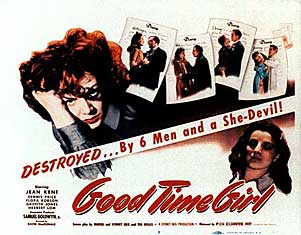
GOOD TIME GIRL. This essentially British post-war (1947) lurid melodrama is a rich treat now. Told as a cautionary tale by social worker Flora Robson to wayward teenager Diana Dors, it tells the story of Gwen, a nice girl initally who goes bad, it reads like one of those Hollywood movies starring Lana Turner or Susan Hayward in which they go spectacularly bad - and then pay and pay for it. MADAME X or I WANT TO LIVE have nothing on Jean Kent, 27 here playing a 16 year old. 
Dame Flora & Diana
Kent had a long career, her best role maybe as the unfaithful wife in the 1951 film of Rattigan's THE BROWNING VERSION, and in those Gainsborough dramas like CARAVAN and MADONNA OF THE SEVEN MOONS). Here she is at the BFI in 2011 when she was 90. ... 
http://www.silversirens.co.uk/jean-kent/jean-kent-introduce-caravan-the-bfi-t127/

Gwen is from a poor home with a downtrodden mother and violent father,  she likes nice things like that brooch she borrows and gets caught returning. After a final beating from her father on being fired from a job in a pawn shop, she runs away and gets an apartment in London. Soon she is working as hat-check girl in Herbert Lom's jazz nightclub. Among the men pestering her is Peter Glenville (who later turned director of films like BECKET). Poor Gwen is soon on a descent into a world of booze and sleazy men. She ends up in a reform school after being framed for a robbery, despite fairly nice guy Dennis Price trying to help her. Now she has to be really tough, as she tangles with head girl Roberta (Jill Balcon - so obviously Daniel Day Lewis's mother, with that profile...). Everything goes wrong as she escapes and falls in with more bad company, back with Herbert Lom and his new nightclub in louche Brighton. Soon she is running around with a local gang, and then with 2 GI's on the make who will stop at nothing, including murder .... as poor Gwen is framed again and dragged off for a longer sojurn inside. Suitably warned off a life of crime, young Diana heeds Dame Flora's advice, and heads for home. Boy, how they must have enjoyed that back then ...
Reform school girls
Jean Kent is terrific and totally believable as the willful teenager and party girl. She's as good as any tough girl in any Hollywood film. Supporting cast offers a few great roles here: Griffith Jones, Herbert Lom as the nightclub owner; Bonar Colleano, Beatrice Varley is good as the hapless mother, and Amy Vaness (the spiteful mother-in-law in THIS HAPPY BREED) as the landlady.  Its a delicious panorama of 1940s British moviemaking, as directed by David McDonald, and written by Ted Willis and Muriel Box, and it should be as well-known as BRIGHTON ROCK or IT ALWAYS RAINS ON SUNDAY (see 1940s label). 

PASSPORT TO SHAME. Totally lurid 1958 melodrama about the evils of prostitution in London, this is a delirious trash classic now. A decade on from GOOD TIME GIRL Herbert Lom has graduated to the role of Nick Biaggi, the local Mr Big, a super-pimp controlling his street girls, as aided by the wonderful Brenda de Banzie. Among their girls is Diana Dors again, now in her late '50s prime, a day-glo blonde poured into some amazing costumes - it seems she did not follow Dame Flora's advice after all; street girls surely didn't look this good? Diana is Vicki, a good-natured girl whose kid sister fell foul of Biaggi and his cohorts as she bides her time to take her revenge on them.  Enter Odile Versois, as a very naive French girl Malou who is soon in Biaggi's grip after going through a fake wedding with a taxi driver in trouble - Eddie Constantine.  Odile is rather homely, Mylene Demongeot may have been a better choice ...
Highlights include Malou's drug-induced dream or nightmare, and all the taxi-drivers (Joan Sims is the radio controller) going to the rescue of Malou from the swish residence of Herbert, who is soon dangling on the roof as a fire takes control ... 
Another Dors treat?
the firemen attempt a rescue, will our hero Eddie reach Herbert first? Lets just say there is a happy ending for our two couples - yes Vicki finds a regular guy who will love her too - leaving poor Brenda to wail on the street as the money flies around her. This is simply a genuine British Trash Classic, as helmed by the prolific Alvin Rakoff, and has to be seen to be believed. The other couple being married (left, above) when Malou and Eddie turn up are only the young Michael Caine and Anne Reid - before she went into CORONATION STREET as Ken Barlow's first wife, soon to be electrocuted, and now one of our senior actresses.