Dedications: My four late friends Rory, Stan, Bryan, Jeff - shine on you crazy diamonds, they would have blogged too. Then theres Garry from Brisbane, Franco in Milan, Mike now in S.F. / my '60s-'80s gang: Ned & Joseph in Ireland; in England: Frank, Des, Guy, Clive, Joe & Joe, Ian, Ivan, Nick, David, Les, Stewart, the 3 Michaels / Catriona, Sally, Monica, Jean, Ella, Anne, Candie / and now: Daryl in N.Y., Jerry, John, Colin, Martin and Donal.
Showing posts with label Maximilian Schell. Show all posts

Wednesday, 24 September 2014

Julia ? On the Beach ? The Arrangement ?

This week I am looking at and revaluating some "prestige" films that were  big in their day,  but do they still stand up now ? JULIA, ON THE BEACH, THE ARRANGEMENT.

JULIA was one of those hits from 1977 which we all went to at the time, and have been rather forgotten about since - THE TURNING POINT was another one - I will return to that later, when I have re-seen it. 

Looking at JULIA now it screams "prestige cinema" but it sees to have been has been debunked - just how much of it is true? Did Lillian Hellman make it all up? - its part of her memoir "Pentimento". It does all seem rather phoney now. Every scene is designed to be impressive, starting with the older Hellmann fishing in her boat at dawn, then that perfect period beach shack she shares with writer Dashiell Hammett (Jason Robards, to the manner born) as they fry fish on the beach - Cape Cod presumably. It is 1934 as we see from the calendar on the wall - the time of the Great Depression and Roosevelt's New Deal. Hellmann is also a writer (after her success with the play THE CHILDREN'S HOUR), but with writer's block as we see her grappling with that old typewriter. Jane Fonda is actually ideal here, in her 70s prime, like a young Katharine Hepburn. The fastidious Fred Zinnemann carefully fashions it all - I like his other great movies like FROM HERE TO ETERNITY, THE NUN'S STORY, THE SUNDOWNERS and he always gets superior perforances from his actors, and so it is here ....

Then the plot begins - we get flashbacks to her youth with her great friend Julia, with her wealthy grandmother Cathleen Nesbitt, and then their years at Oxford - all golden spires, and Vanessa Redgrave radiant as Julia striding around in her tweeds  while declaiming the brave new future to come ... but then of course the War intervenes .... and Julia devotes her life to fighting fascism, putting her life in danger ...

The central scene has Lillian meeting Julia in a restaurant, but they have to be very careful in case they are being watched. Julia is now on crutches .... and has a mission for Lillian to smuggle money (in her hat!)  As a thriller though its rather suspense-less. Max Schell appears as Julia's friend Johann, and the young Meryl Streep has that minute appearance. There is that train journey - will Lillian get the money throiugh safely?. But then the plot goes haywire, and suddenly Julia is dead. Lillian goes to see the body in a suburban funeral parlour (with Maurice Denham) and tries to find the baby Julia supposedly had.   

It is all still watchable, but I think we have to take it with a large pinch of salt. Redgrave and Robards both won Best Supporting Oscars here and it was nominated for a slew of other including best picture and director. It was Zinnemann's last big success (he did just one more), great score by Georges Delerue, and lensed by Douglas Slocombe. Fonda of course is a far prettier Hellman. 

ON THE BEACH
I really cannot find much to say about ON THE BEACH, that big one from 1959 by Stanley Kramer from the Nevil Shute novel. Shute's novels usually featured big ideas: aviation in NO HIGHWAY IN THE SKY, war in A TOWN LIKE ALICE and only the end of the world in ON THE BEACH. Kramer like Kazan, was big in the 50s and early 60s, with those self-important movies on big themes, like THE DEFIANT ONES, INHERIT THE WIND, JUDGEMENT AT NUREMBURG (with their great star turns) and this one set in Australia. Even Gregory Peck and Ava Gardner cannot make it sing as the ponderous affair also drags down Fred Astaire and Tony Perkins as the young naval husband. It is actually set in 1964 as atomic war wipes out humanity in the northern hemisphere; 
one American submarine finds temporary safe haven in Australia, where life-as-usual covers growing despair, as they wait for the radiation to reach them. The only interesting sequence is the submarine returning to San Francisco to investigate a tapping noise (which turns out to be a trapped blind cord), but where is everybody as there is no sign of dead bodies?. Did everyone just vaporise? The end coda couldn't be more in your face: that slogan "There is still time, brother"! That must have wowed them in 1959 as The Cold War escalated, it was one of the main films of that great year - but it simply does not stand the test of time and is a colossal bore now. One simply wants to fast-forward through most of it. 

THE ARRANGEMENT. Elia Kazan of course had his great decade in the 1950s, but like a lot of other once important directors may have felt left behind by the late sixties. THE ARRANGEMENT is from his own novel and it is all just too much as Kazan throws everything at us. Kirk Douglas is the business executive sick of the rat race his life as become as he deliberately crashes his car in that grim traffic scene. Deborah Kerr, getting rather matronly by then, is his worried steely wife doing all she can to help him rehabilitate himself, as he keeps flashing back to his exciting mistress Gwen - Faye Dunaway at the height of her glossy '60s glamour - who keeps taunting him about what he could have been. 
She does have that memorable line: "The screwing I'm getting is not worth the screwing I am getting". But it is all too much and too overwrought as Kirk fixates on his old Greek father Richard Boone and his nude frolics at the beach with Gwen ...
Eddie is a very rich man who has everything he wants; money, family, success, but a car crash causes him to reevaluate the life he leads. Searching for the happiness he lost, he remembers his one-time lover, Gwen, even as his wife conspires to take his fortune...
Like AMERICAN BEAUTY, Kazan's story looks anew at The American Dream and finds it wanting; looking at it now it is not as bad as some reviews said at the time, there's lots of interesting ideas here, but Kazan throws it all at us without being able to streamline it.  Right: Dunaway and Kazan.

Monday, 17 February 2014

More '60s: Sophia and Max, and Greg and Joan, again

An interesting photo I got sent today .... Sophia Loren and Maximilian Schell in 1961 - it looks like it was taken at Sardi's restaurant, with those sketches on the wall. Both had won best actor and best actress Oscars that year, when Hollywood was celebrating international cinema. Previously Anna Magnani had won in 1955 and Simone Signoret in 1959, but by the early '60s the international movie was certainly on the rise. Canny producer Carlo Ponti soon had both stars in his next De Sica film, the little-seen now and rather ponderous 1962 drama THE CONDEMNED OF ALTONA, its certainly a fascinating re-view now though, as per Schell, Loren labels. 

The following year Max and Sophia were in Hollywood (she had not attended the 1961 ceremony as she was sure she would not win) to present to the next winners, so Sophia presented Gregory Peck with his, and Maximilian presented the Best Actress, but not to winner Anne Bancroft, but to Joan Crawford who had graciously accepted for her. This meant that Joan looking glamorous was photographed with the winners holding an oscar too - 
while nominated Bette Davis who had lost, was left fuming backstage. Joan looks great here and Max looks like her hot date for the night ... we like this photo, which we have posted here before. Peck returned the favour, presenting Sophia with her second, the lifetime achievement one, in 1993 - as per Peck label.

Here's another new one: Sophia with director and artist Jean Negulesco at an exhibition of his drawings in Greece in 1956 - they had just finished BOY ON A DOLPHIN where the director had done several sketches of her - as per Negulesco label.

Sunday, 9 February 2014

1970 rarity: First Love

As IMDb puts it:
Based on Ivan Turgeyev's novella, FIRST LOVE is about two young lovers in czarist Russia. One is a 21-year-old woman, the other a young man of sixteen. Things take a tragic turn as the girl (Dominique Sanda as Sanaida) falls in love with the boy's father (Maximilian Schell). The film, Schell's first as director, was nominated for Best Foreign Language Film in 1970's Academy Awards
Two icons of '70's international cinema -- Dominique Sanda and  John Moulder-Brown -- play wonderfully off each other in this lovingly rendered tale of youth, love and the loss of innocence. 
The photography by none other the great Sven Nykvist so of course it all looks terrific, shot in Hungary, with that right kind of period look.  Schell assembes an interesting polyglot cast, apart from the two young leads and himself, theres Italy's Valentina Cortese and English character actress Dandy Nichols, playing posher than usual here, plus Richard Warwick from IF... and BUMBO, as well as playwright John Osborne (Schell had performed in his A PATRIOT FOR ME in 1969. Like Lumet's THE SEA GULL (below) it too plays out at a languid pace as we experience those lazy days on the country estate, which, with the house, look marvellous to our eyes now.
Anjelica Huston in a magazine feature on her favourite books, has this to say about FIRST LOVE: "A hauntingly beautiful novella that Turgenev partly based on his own experience. In it, two men describe their first passions, inspiring the third, Vladimir, to quietly write his story down".

FIRST LOVE - I saw it at a sole London Film Festival screening back then - has not been available for years, so its good to see it back in circulation now. It too has that early 70s look, when international and youth culture movies were all the rage.
 Moulder-Brown was also effective that year in Skolimovski's DEEP END, a favourite here, and 1972's KING QUEEN KNAVE (Moulder-Brown label), as well as appearing in Visconti's LUDWIG in '72 as well as VAMPIRE CIRCUS!. He still looks great now, as per the extras on the DEEP END Blu-ray, but does not seem to do much, though IMDb lists 66 credits with him working until recently, like James Fox he was a child actor.
John Osborne, left; Dominique Sanda, centre; Richard Warwick, right.

Sanda, was for a period, the face of the new European cinema, with so many fascinating roles in such a short time: Bresson's A GENTLE CREATURE, FIRST LOVE, memorable as Anna Quadri in  Bertolucci's THE CONFORMIST - that chilling murder in the woods, and that sensual tango - in 1970, as well as Micol in De Sica's THE GARDEN OF THE FINZI-CONTINI'S, (see Sanda, De Sica labels) and in Bertolucci's 1900 in '76, as well as Demy's UN CHAMBRE EN VILLE (A ROOM IN TOWN) in 1982, and is still working now. She has been luckier than that other lauded discovery, the late Maria Schneider (RIP label).
Schell died last week, aged 83, as per RIP below.

Saturday, 1 February 2014

Greek tragedy, Turkish delight - a Melina double-bill.

I came across Rex Reed's 1967 article on Melina Mercouri, when sorting out books in the garage, and just have to share this opening paragraph: "Years from now, when we're all dead and gone, they'll still be talking about Melina Mercouri. They'll talk, because in an age full of plastic people, she was the real thing." Melina was on Broadway at the time, in a musical ILLYA DARLING, based on her hit film NEVER ON SUNDAY.
 
PHAEDRA, 1962 is a retelling of the Greek myth of Phaedra. In modern Greece, Alexis's father, an extremely wealthy shipping magnate, marries the younger, fiery Phaedra. When Alexis meets his stepmother, sparks fly and the two begin an affair. What will the Fates bring this family? Alexis's roadster and the music of Bach figure in the conclusion. 

NEVER ON SUNDAY was that great surprise hit of 1960, as European cinema was getting more popular and outside of the arthouses, that song and the music of Mikis Theodorakis swept the world. (I still have the soundtrack EP with Melina singing the theme song). Jules Dassin and Melina Mercouri were hot, after their previous films like STELLA and LA LOI in 1959. They next turned to Greek tragedy and Euripides:  PHAEDRA, instead of Elektra, Antigone or Medea. Its a brilliantly shot drama with great black and white images as the relentless Phaedra sacrifics all for the love of her stepson Alexis. 
It starts with shipping magnate Thanos (Raf Vallone) celebrating the launch of his latest vessel, the "Phaedra", then he unwisely sends his wife Phaedra to London to bring back his son - Perkins. They meet at the British Museum, by the Elgin Marbles (which Mercouri when a later MP campaigned tirelessly to have returned to Greece); she thows an expensive ring into the Thames as the price to pay and soon they are having a passionate affair in Paris. 
Back in Greece Thanos has plans to link his son with the daughter of a friendly rival thus making the the most powerful family in Greece, but Phaedra is burning up with passion which will not be thwarted, to the alarm of her faithful servant .... The sybolism is laid on as the Aston Martin car which Alexis loves and has been bribed with arrives in Greece in a big box - the natives bless themselves and say it looks like a coffin. The young people go dancing, and Alexis begs Phaedra to leave him alone.  Then disaster strikes - the "Phaedra" has sunk with loss of life of crew. Phaedra chooses this moment to arrive at Thanos's office as they are announcing the names of the dead, to tell her husband that she loves Alexis and there will be no marriage .... The Greek tragedy ending is clear - Thanos beats up his son who drives off in that car, which soon plunges over a cliff, as Phaedra, assisted by her servant, prepares to take her own life. The images are stunning - Phaedra all in white with a white turban and dark glasses, pushing her way through the wailing relatives of the dead, all in black. She has a great Dior wardrobe too.

Mercouri is a fascinating presence, like Moreau (they were both in THE VICTORS, 1963) or Signoret, able to look radiant or haggard at will. Pauline Kael has referred to her "drag queen baritone" and she does seem to have an unusual voice to suit a larger than life persona. She and Dassin continued making films, like PROMISE AT DAWN and A DREAM OF PASSION which were certainly interesting. She died in 1994 aged 73 after her later years in the Greek Parliament.  I remember an afternoon with her in 1968, that revolutionary year, when I was 22 and attending a march in Trafalgar Square about aid for Biafra in Africa. Melina was leading the march and looked splendid in a long red dress with lots of gold chains. 10.30 PM SUMMER in 1966 is rather a lulu, but quite enjoyable, a version of Duras with the intriguing threesome of Peter Finch, Melina and Romy Schneider, and considered quite daring at the time. (Review at Melina, Romy, Peter labels). During the '60s she was one of the great European ladies, along with Anouk Aimee, Monica Vitti, Romy Schneider, Liv Ullmann, Stephane Audran, Ingrid Thulin, Loren, Lollobrigida, Cardinale etc. Irene Papas of course was other great Greek actress, pity they were never cast together ...

Perkins too after PSYCHO had some good years in Europe, mainly for Welles' THE TRIAL (with Moreau, Schneider, Martinelli), GOODBYE AGAIN (Perkins label) in Paris in '61 from Francoise Sagan, with Ingrid Bergman and Yves Montand was popular, and teamed with Loren again in the thriller FIVE MILES TO MIDNIGHT in '62, and with Bardot in THE RAVISHING IDIOT in 1964. PHAEDRA in Greece in '62 seems to have been unseen for a long time, but its certainly fascinating now; Kael also commented that the film's flaw is how could anyone believe Phaedra would leave Raf Vallone for boyish Tony Perkins ...

TOPKAPI is a bright, dazzling, colourful comedy thriller, from Eric Ambler, which was a big hit in 1964, and won Peter Ustinov a best supporting actor award. Its set in Istanbul and is about a daring jewel robbery. Dassin recreates his great RIFIFI robbery again, as the gang prepare to steal a priceless dagger from the Topkapi Museum - will they get away with it? 
Fun and thrills abond in equal measure, as Melina and Maximilan Schell recruit down on his luck Ustinov, as well as that other great scene-stealer Robert Morley. Melina's friend Despo from NEVER ON SUNDAY, is amusing here too as the lady-friend of Ustinov in the early scenes, Its a light-hearted caper taking in the sights of Istanbul, including those oiled wrestlers. I remember sitting through it twice when it opened in 1964, when I was 18.

Thursday, 17 January 2013

Pope Joan

POPE JOAN was little seen in 1972 and has never appeared here since, I was always curious about it but that has now been taken care of by a German issued dvd. Well, there's trash of all kinds: the higher trash, the lower trash, delirious trash, classy trash and boring trash. JOAN falls into the latter camp, tedium reigns supreme here as glum (very) Liv Ullmann plays the supposed female pope. This is based on the medieval legend of Pope Joan, who was made Pope for a brief period around 855 A.D. Although it is questionable that Pope Joan really did exist, this movie presents her existence as fact, but is a very unimaginative telling of the legend.  The film though is typical of the sort of international co-productions made 40 years ago in the late '60s/early 70s.

It was shot I believe in Romania and looks it, what scuppers the latter part of the film, when we are supposed to be in Rome it is so obviously some central European backwater and looks nothing like the Eternal City (or even Constantinople). The Dark Ages is a fascinating period of history, when Christianity was probably at its zenith and the general population were terrified of hell and damnation and plagues, the age of those great cathedrals, as fascinating as the medieval world or the renaissance. Some great movies have captured this: Ingmar Bergman's THE SEVENTH SEAL, rousing adventures like THE VIKINGS and EL CID, or the wit of THE LION IN WINTER or Zeffirelli's sumptuous BROTHER SUN SISTER MOON (with Alec Guinness as a very wily pope), or BECKET or any version of THE HUNCHBACK OF NOTRE DAME (I like the '50s Quinn-Lollobrigida one). POPE JOAN by comparison looks cheaply made but here the cast is the thing. Ullmann - so great in her European films - didn't really translate in her English efforts or the films were just not that good - I have her 40 CARATS to see soon too, and of course everybody laughed at LOST HORIZON (Bette Midler: "I never miss a Liv Ullmann musical"), her other one with Peter Finch THE ABDICATION also emptied cinemas and has also vanished from view, whereas we all always have room for PERSONA or AUTUMN SONATA or her other major titles.

The brutality of the age is captured vividly when the convent orphan Joan has taken refuge in is sacked, and the mother superior (Olivia De Havilland) is crucified upside down and nice Lesley-Anne Down slain brutally ... Joan and monk Maximilian Schell make their escape and wander around that grubby Europe before Joan's gift for reading the bible gets them noticed by the church. In no time she is made a cardinal and assistant to the kindly old pope Trevor Howard who names him/her (oh, she hacked off her hair and has been posing as a male) as his successor, so soon she is indeed Pope. Then Franco Nero re-enters, having caught her eye earlier at the convent ... how soon before he suspects her secret?  We don't really see them get together much but it seems Joan is heavily pregnant which she can hide under her pope's vestments, but it was rather foolish of her to go out among the peasants just as she goes into labour, and the superstitious people tear her to shreds ...
Everyone seems to accept Liv as a male and she certainly looks glum enough. The interesting cast is made up of several thespians of the time - there is even a young Nigel Havers and the last performance of David Farrar (Mr Dean in BLACK NARCISSUS) but I did not spot them among dependables like Andre Morrell, Richard Pearson, Jeremy Kemp, George Innes, Peter Arne, Patrick Magee. Produced by Kurt Unger and directed by old hand Michael Anderson, well used to handling large casts in movies I like like AROUND THE WORLD IN 80 DAYS, SHAKE HANDS WITH THE DEVIL, OPERATION CROSSBOW, and Gary Cooper's final two, among others. The dvd has interesting later interviews with Ullmann, Schell, Anderson and writer John Briley. There is also a 2009 version of POPE JOAN but for me one was enough. 

Friday, 1 June 2012

Cinderella, Italian style ...

Italian week: 3 - Sophia Loren trio, rarities by Francesco Rosi, Vittorio De Sica, Alessandro Blasetti
Sophia escapes from the barrel
Three Sophia Loren rarities, which have never played in London as far as I am aware since I arrived here in 1964 - particularly surprising regarding C'ERA UNA VOLTA (MORE THAN A MIRACLE or CINDERELLA ITALIAN STYLE!) as surely Loren and Sharif were big box office in 1967. This is a very realistic fairy tale (unlike Demy's DONKEY SKIN, a recent post here, see below) by Francesco Rosi (SALVATORE GUILIANO, LUCKY LUCIANO etc), and co-scripted by Tonino Guerra; with marvellous widescreen compositions and set in a wonderfully colorful countryside where prince Omar Sharif seems more at home taming his wild horse than seeking a bride as urged by his mother Dolores Del Rio, looking splendidly regal here. Also splendidly regal is peasant girl Sophia - she really was looking her best here after her mid-'60s hits like ARABESQUE - as she as the prince are drawn to each other. 

Cue monks who can fly,  other saints in the air (we can see the wires holding them) and those cackling old witches, as well as a mountain of eggs hatching out little chicks. Sophia is accused of being a witch too and is put in a barrel which rolls away to the sea and she is rescued from it by some children. Then we have the seven princesses at the palace who have to win the prince by winning the dish-washing competition - our peasant cinderella is doing fine until the plates mysteriously start to break .... leaving one scheming princess the winner. Sophia though is advised by a flying monk as to how she was cheated and she returns, leading to the inevitable happy ending. This is an Italian only dvd, no English sub-titles but they are not necessary.
This is truly delightful stuff and a vivid feast for the eye with those marvellous compositions, and again, did Sophia ever look better?

1962's THE CONDEMNED OF ALTONA is very different fare. What surprised me is how much I was engrossed by it as  had imagined it would be very tedious if not boring,. It is hardly that. The first 10 minutes is all Fredric March as Gerlach, a wealthy industrialist in Hamburg who is being told he has inoperable cancer - he bargains for 6 months more and returns to survey his empire at the Hamburg docks, and then summons his son Werner (Robert Wagner) and his actress wife Joanna (Sophia) to his country estate at Altona. He wants the son to take over the business but Werner is reluctant to give up his lawyer practice. There was another son Franz who died in the war .... This could all be heavy going but De Sica and Loren know how to engage an audience and retain our interest. The credentials though are top notch: the play by Sartre, music by Shostakovich, an excerpt from Brecht's "Arturo Ui".

Gradually though the family secrets begin to unravel as Joanna sees who Gerlach's daughter Leni (Francoise Prevost) visits at night - the Nazi son Franz is hidden in the attic - or is he hiding from the world, as he imagines the destruction of Germany after the war. Joanna, at first appalled, begins to have meetings with Franz (1961's other Oscar winner, Maximilian Schell), who then escapes the house and goes out to see the new Germany for himself and we see his wonder at the successful Germany of the '60s as people stare and laugh at his Nazi uniform.
This was the era of course, 15 or 16 years after the war, when the guilt about what happened was still very vivid and discussed. I was a teenager at the time and remember those books by the likes of Hugh Trevor Roper and Lord Russell of Liverpool (now its Anthony Beevor and Max Hastings). The sombre drama (scripted by Abby [JUDGEMENT AT NUREMBURG] Mann) plays out with the risible scene where Franz wanders into a production of the Brecht play with Joanna on stage. The ending is highly dramatic too when Franz deliberately plunges to his death from a dockside crane taking his father with him ...
One wonders what audiences at the time made of this, it must have been hard going in the cinema and surely must not be what audiences were expecting from the latest Loren-De Sica effort. March is terrific as usual as the dying patriarch expediating his guilt at the crimes of the Nazi son and that concentration camp nearby. The film of course was not a success at the time and hardly seen since, but is certainly a fascinating oddity now.

1955's LUCKY TO BE A WOMAN (La Fortuna di Essere Donna)  is I think Loren's last Italian film before she went off to those American productions made in Europe (THE PRIDE AND THE PASSION, BOY ON A DOLPHIN, LEGEND OF THE LOST) which I liked so much at the time ... This is a breezy, inconsequential, but likeable comedy about a photographer, played by Marcello Mastroianni (his 3rd with Loren) who snaps a Roman beauty thus launching her on a successful career as a model, thus attracting the attention of wealthy Charles Boyer. Elisa Cegani is marvellous as Boyer's long-suffereing wife who gets her revenge in a delicious restaurant scene (rather like Dolores Gray with Greg Peck in DESIGNING WOMAN, 1957). Again, no English subtitles in this Italian only dvd, but they hardly matter. Like TOO BAD SHE'S BAD (also by Blasetti the previous year 1954) and WOMAN OF THE RIVER (as per my previous Loren posts on these favourites of mine) this is enjoyable stuff from before Sophia went international ....now where can I get SCANDAL IN SORRENTO, also 1955 ?

Wednesday, 25 May 2011

Festival in Cannes


FESTIVAL IN CANNES. This Henry Jaglom film from 2001 seemed rather appropriate at the moment, so I pulled it out of the “to see sometime” pile. It is like Altman-lite as we dip in and out of various people at Cannes - the story is silly, there seems to be no script as they seem to improvise a lot, are the characters real or fake? Anouk Aimee is Millie Marquand a mature French actress looking for a good role. Greta Scacchi is another actress who has written a script which she wants to direct with a good role for Millie, while Ron Silver is the hot-shot producer (who is financially overstretched) who also needs Millie to cement the deal for a big movie he is putting together where Tom Hanks will only commit if Millie plays the small role of his mother. So which will Millie choose? Advising her is her ex-husband Maximilian Schell, who wants to direct the film. Then there is Kaz (Zack Norman) who comes across as a major creep but says he is a producer with a $3 million to spend – but is he really? Both the men hit on various women (that is what producers do, right?) as everyone tries to hustle a deal. Anouk and Max Schell seem bemused by it all and play along gamely – nice to see her on screen again, as alluring as ever. Scacchi also seems to be improvising a lot and seems very amused by it all (though the very idea of Anouk Aimee as Tom Hanks's mother...!).


Shot at the 1999 Festival others who pop up include Peter Bogdanovich, and Faye Dunaway with her son Liam, all it seems keen to be on camera. An amusing trifle then, with a very nice poster and some Charles Trenet and Piaf on the soundtrack. Altman fans should like it – the end credits include an apology to Tom Hanks! [Scacchi is currently playing Bette Davis on stage in London in "Bette and Joan", to good reviews – I am seeing it before it closes in June].

Friday, 26 November 2010

Fantasy double bill: Lizard / Ashes

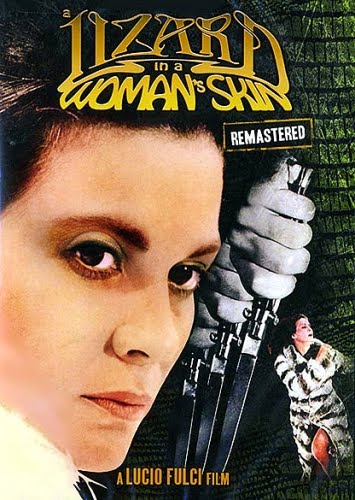
LIZARD IN A WOMAN'S SKIN from 1971 is another of those steamy Italian giallo thrillers with heightened drama and piling on the exotica, by stalwart Lucio Fulci. I liked those two I saw a while back: SHORT NIGHT OF THE GLASS DOLLS with Jean Sorel and Ingrid Thulin and Barbara Bach, which was stunningly done and involving, and Sorel again with Carroll Baker in one of theirs, A QUIET PLACE FOR A KILL in 1970.

This one is all about Florinda Bolkan - that stunning Brazilian who came to prominence in Visconti's THE DAMNED in '69 and was the lead in De Sica's A BRIEF VACATION, as well as her Lola Montez in Dick Lester's ROYAL FLASH in '75 (see previous post....). Here she is Carol who is having very realistic dreams or nightmares where she is involved with the sex crazed lesbian who lives next door - cue lots of girl on girl action which takes a violent twist when the said neighbour is found stabbed to death, with Carol's fur coat and scarf nearby .... in Carol's nightmares she is the guilty party who then realises after the stabbing that she is being watched by two hippies who are out of their minds on acid.... What is real and what is fantasy or nightmare? Is Carol being set up? Carol dreamed the killing, and there are her prints all over the place. She claims she didn't kill her, but then who? Can Carol's father find out and put the blame? Will the police detectives solve the crime, which could be a set-up. There are several striking sequences such as Carol fighting her way through a crowded train corridor when suddenly all the other people on the train are naked....


Fulci takes the viewer on a convoluted journey through Carol's psyche, with the various endless corridors, winding staircases and labyrinthine buildings through which she finds herself being pursued (whether by actual physical forces or her own subconscious) reflecting her confused and deeply convoluted mental anguish.

The supporting cast is similarly excellent, combining famous British faces - an older Stanley Baker as the investigating policeman and QUO VADIS's Leo Genn (that dependable English actor) as her wealthy father, and as her husband giallo regular Jean Sorel who really has not too much to do here. The sets are opulent and there is that chase through the deserted Alexandra Palace, which features a bat attack clearly influenced by Hitchcock's THE BIRDS. Other London locations are well used too, and there is the usual Morricone score. The ending is quite a revelation....

What I actually enjoyed more was the 1965 British thriller RETURN FROM THE ASHES, a long unseen item, by stalwart J. Lee Thompson, shot in Panavision monochrome by Christopher Challis with a good score by Johnny Darkworth (who also did those scores for THE SERVANT and MODESTY BLAISE among others). This is an involving thriller heading by Ingrid Thulin terrific as ever as the woman returning to Paris from the concentration camps - we first see her on a crowded train unaware of her surroundings as an annoying child falls from the train, her tattoo visible on her arm. She books into a cheap hotel in Paris and even her old work colleague Herbert Lom does not initially recognise her. Before the war she had married an opportunistic chess player Maximilian Schell but is he really carrying on with her tease of a step-daughter Samantha Eggar?


It turns out that Thulin is now a very wealthy woman and Eggar and Max want to get their hands on it. Sam spots Thulin in the street and realises they could use her to pose as her mother, whom they believe died in the camps, to get their hands on the money. Ingrid goes along with this, not telling them who she really is. The plot twists and turns, with a very good bathroom scene, until final retribution. It is actually very enjoyable and the 3 leads excel. Highly recommended - if you can find it!