Dedications: My four late friends Rory, Stan, Bryan, Jeff - shine on you crazy diamonds, they would have blogged too. Then theres Garry from Brisbane, Franco in Milan, Mike now in S.F. / my '60s-'80s gang: Ned & Joseph in Ireland; in England: Frank, Des, Guy, Clive, Joe & Joe, Ian, Ivan, Nick, David, Les, Stewart, the 3 Michaels / Catriona, Sally, Monica, Jean, Ella, Anne, Candie / and now: Daryl in N.Y., Jerry, John, Colin, Martin and Donal.
Showing posts with label Ruth Gordon. Show all posts

Wednesday, 6 August 2014

Dirk update ...

Two new Dirk Bogarde rarities have surfaced:  his 1952 thriller THE GENTLE GUNMAN has been rescued from the archives by our Film4 channel who have screened it several times in recent weeks, and is on dvd, and a 1966 American television production of Coward's BLITHE SPIRIT is on YouTube, along with a raft of other Bogarde clips and interviews.

THE GENTLE GUNMAN, 1952. This turned up on tv and proved totally engrossing. Directed by Basil Dearden (in his prolific era)  in 1952 from a play by Roger MacDougal, and featuring Bogarde and John Mills as two Irish brothers divided by their IRA loyalties. No wonder this never appeared anywhere here during the last 50 years …. I had not realised Bogarde and Mills had been teamed before their 1960 oddity THE SINGER NOT THE SONG. THE GENTLE GUNMAN now seems as relevant for its time as BOYS IN BROWNPOOL OF LONDON, THE BLUE LAMP or HUNTED. (reviews at Bogarde label).

Bogarde is the young hothead being used by the IRA (buffoons Jack McGowran and Liam Redmond) to plant a bomb in a suitcase in a crowded London underground station full of people sleeping for the night (its 1941 in wartime). This is the nightmare scenario for all us commuters, but luckily brother Mills is at hand to grab the suitcase and throw it into the tunnel before it goes off …. Bogarde is tailed back to their lodgings where McGowran and Redmond are caught. Back in Ireland the IRA bigshot Robert Beatty is not pleased, as suffering mother Barbara Mullen (later immortalised as Janet in DR FINLAY’S CASEBOOK) sees her other youngest son also fall into the IRA clutches. Doctor Joseph Tomelty and Englishman Gilbert Harding discuss the pros and cons of the Irish question and the justification of terrorist acts, as the wounded youngest brother is brought in, followed by the gang members including trigger-happy Eddie Byrne. There is another shoot-out in a crowded street, a daring rescue by Mills of the IRA chaps on their way to prison, and finally Mills is about to be executed by his compatriots when …..
exciting stuff then and it all looks great with moody black and white photography and all those men in raincoats and hats with their shooters to hand. A definite curiosity now, as the terrorists are presented as thugs or amiable buffoons unable to change the status quo as their senseless actions cause harm to innocent people without achieving anything but causing more suffering and hate. The Irish “Troubles” is not an easy subject for the movies (SHAKE HANDS WITH THE DEVIL is another fascinating melodramatic attempt in 1959, but Carol Reed ‘s ODD MAN OUT is the classic here). 

Coward's BLITHE SPIRIT never goes away for long. We love the David Lean 1945 film with Rex Harrison at his sublime best, and it has just been on in London again with Dame Angela Lansbury as Madame Arcati, at a mere 88. This production on YouTube  
is a 1966 one where Dirk has a stab at it, fascinating to see now, as he was friends with Harrison and of course Kay Kendall (who would have been a perfect Elvira, if she had lived, she died in 1959, as per my posts on her, at label). 
Here it is Rosemary Harris, and the current wife is Rachel Roberts - Rex's wife after Kay. Rachel seems a little too working class for the milieu here, but the day is saved as Madame Arcati is no less than Ruth Gordon !  Its certainly an odd enjoyable version. Dirk also did another American tv item, LITTLE MOON OF ALBAN in 1964, with my favourite Julie Harris, I wonder if that is available ...  Also on YouTube is Dirk as guest-panellist on a 1960 edition of WHATS MY LINE, which I presume he had to do when promoting SONG WITHOUT END in New York, bet he hated doing that ... https://www.youtube.com/watch?v=D50Ed-mJTEc
There is also that fascinating documentary Dirk narrates and appears in on that missing 1937 Von Sternberg production of I CLAUDIUS, which I had not seen since the BBC ran it back in the late '60s:
https://www.youtube.com/watch?v=NUbt0sweIjI

Thursday, 17 July 2014

Harold, Maude & Vivian ...

Self-destructive and needy but wealthy teenager Harold is obsessed with death and spends his leisure time attending funerals, simulating suicides trying to get the attention of his indifferent, snobbish and egocentric mother. When Harold meets the anarchic seventy-nine-year-old Maude at a funeral, they become friends. Meanwhile, his mother enlists him in a dating service and tries to force him to join the army. On the day of Maude's eightieth birthday, Harold proposes to her but he finds the truth about life at the end of hers. 

Finally up from the vaults, Hal Ashby's HAROLD AND MAUDE, a cult film if ever there was one (it and SOMETHING FOR EVERYONE (reviewed here at Lansbury, York, gay interest labels) were our big cult favourites back in that pre-video world of the early '70s - one had to catch them during their brief runs whenever they turned up), it is now though back on dvd and Blu-ray to entrance a new generation.
Its a deliciously morbid tale (written by Colin Higgins) of a suicidally obsessed young man (Bud Cort) who strikes up a relationship with that odd old lady he keeps seeing at funerals of strangers they both go to. Factor in Vivian Pickles as his mother with all those dates (like Sunshine Dore) she arranges for him, laugh as she fills in the questionnaire .... more on her soon! 
With its spine-tingling Cat Stevens sountrack and great images, Ashby's enduring weirdie continues to delight us now. I also recently got Ashby's 1970 THE LANDLORD, another cult item that captures that era perfectly, we will be re-seeing and reviewing it before too long.... Ashby's biggest hit was COMING HOME in 1978 (but I never wanted to see his BEING THERE in 1980). He died in 1988. Writer Colin Higgins also wrote and directed NINE TO FIVE and FOUL PLAY (before dying of Aids aged 47 in 1988).


Bud Cort had an odd appearance and an odd career and is still working now, he was often used by Robert Altman. Ruth Gordon of course is that hollywood veteran actress and writer, in films as far back as Garbo's TWO FACED WOMAN in 1941, but scored as those odd old ladies in INSIDE DAISY CLOVER, ROSEMARY'S BABY, LORD LOVE A DUCK and of course HAROLD AND MAUDE.

People We Like: Vivian Pickles.

Vivian is an amazing Britsh actress, as unique as Kay Kendall or Joan Greenwood, or Alison Steadman or Imelda Staunton or Brenda Blethyn now  - Vivian too has a unique voice and manner. Harold's preoccupied mother may be her best screen role. In her 80s now, she was in a recent BIRDS OF A FEATHER tv comedy series, and was a stunning Mary Queen of Scots opposite Glenda Jackson's ELIZABETH R, she also had that cameo in Scheslinger's SUNDAY BLOODY SUNDAY in 1971, and I remember her in BBC series of VILE BODIES. She was Mrs Bennett in a 1967 PRIDE AND PREJUDICE and was Isadora Duncan in Ken Russell's 1966 film on Duncan in a long career of interesting choices.

Thursday, 3 January 2013

Rosemary's Baby

Our London National Film Theatre is also showing a season of Polanski films in January and February. I shall be going to see one of my favourites, his 1967 DANCE OF THE VAMPIRES (or THE FEARLESS VAMPIRE KILLERS - see Polanski, Horror labels) there as its ideal on the big screen with those scope compositions and I always enjoy it so much, so endlessly inventive and amusing with the gay and Jewish vampires and that castle we roam around; as luck would have it ROSEMARY'S BABY was screened on tv here last night.  I had not seen this landmark horror film since its release back in 1968 ... where Roman (whom I passed in the Kings Road Chelsea once) after his British hit REPULSION and that cult classic CUL-DE-SAC moved next to New York and the film of Ira Levin's novel.

With its inspired casting, terrific design (Richard Sylbert), camerawork (William Fraker), and score (by Polanski regular Komeda), the director's first American film is an exemplary thriller about a woman believing herself impregnated by the Devil in the guise of her husband. Crucial to its success - commercial as well as artistic - is the ambiguity as to whether her fears about Satanism in Manhattan are grounded in reality or the paranoia of the mother-to-be ...

It is still a marvellous movie, Mia Farrow and John Cassavetes as her actor husband who gets that lucky break, are both ideal - and Ruth Gordon is again simply marvellous as neighbour Minnie ... the film was made at just the right time, when the old Hollywood was changing, it is a landmark film of its era, up there with BONNIE AND CLYDE, IN THE HEAT OF THE NIGHT, MIDNIGHT COWBOY .... the old studios and production codes were breaking down and more realistic films could be made with those interesting new performers and directors - as per my reviews at 60s label.  
One can see the film as a study of an isolated woman's descent into madness as she worries about her unborn child. We slowly begin to realise that the hysterical ravings of the heroine could be true .... later horror films like THE OMEN had to ramp up the shocks, but Polanski here paces everything we see perfectly (as with his classic CHINATOWN), what though happened to that other girl who had been taken up by the Castevets and ends up splattered on the sidewalk ?
Mia Farrow has hardly ever been better (I liked her in DEATH ON THE NILE too) it is a towering performance - like Catherine Denueve (right) in Polanski's '65 REPULSION, or Faye Dunaway in CHINATOWN, as per recent review); Cassavetes is ideal as the opportunist husband and Ruth, with her herbal drinks, does a dry run for her HAROLD AND MAUDE, young Charles Grodin scores too. The Dakota apartment block too is the perfect background.  Now I really must get around to watching those dvds of Polanski's THE TENANT (with favourites Isabelle Adjani, Shelley Winters, Jo Van Fleet, Lila Kedrova in that weird Paris apartment block) and also that neat Colin Firth thriller set in Buenos Aires APARTMENT ZERO ...

Sunday, 28 October 2012

'60s comedy: The Loved One / Lord Love A Duck

Finally, Tony Richardsons's THE LOVED ONE - MGM's 1965 comedy "with something to offend everyone" that I never caught until now and I saw it on a Spanish dvd with Spanish sub-titles I could not remove. Fascinating stuff though - it may have opened briefly here in London at the time (it was reviewed in "Films & Filming" magazine) and then shoved out on release for a week,. but I somehow never saw it and it has never surfaced since as it seems MGM either forgot about it or locked it away.

Newly arrived in Hollywood from England, Dennis Barlow finds he has to arrange his uncle's interment at the highly-organised and very profitable Whispering Glades funeral parlour. His fancy is caught by one of their cosmeticians, Aimee Thanatogenos. But he has three problems - the strict rules of owner Blessed Reverand Glenworthy, the rivalry of embalmer Mr Joyboy, and the shame of now working himself at The Happy Hunting Ground pets' memorial home.

Richardson after the "kitchen sink" dramatics of LOOK BACK IN ANGER, A TASTE OF HONEY, THE LONELINESS OF THE LONG DISTANCE RUNNER had that enormous success with TOM JONES in 1963 which (as per my previous post on him - that book on the Redgraves, Trash label, and the "Hollywood UK" tv series, TV label) gave him carte blanche for his next films. THE LOVED ONE has an impeccible pedigree: a Martin Ransohoff production, from Evelyn Waugh's novel satirising the American way of death, scripted by Terry Southern and Christopher Isherwood. Richardson, who despite being married to Vanessa Redgrave, was also gay or bi, juices it up with a great cast of cameos:
James Coburn, Roddy McDowell, Margaret Leighton, Dana Andrews, Tab Hunter as tour guide, Liberace as a casket salesman. We follow naive Englishman Robert Morse arriving in L A and staying with his actor uncle, John Gielgud (quietly hilarious), who is part of the English colony. We also get Robert Morley, Jonathan Winters in 2 roles and Rod Steiger does another outrageous turn as chief embalmer Mr Joyboy, looking after his grotesque elderly mother. Anjanette Comer is startlingly odd as the love intererst, the first lady embalmer with her unfinished home in 'the slide area'. If you are disturbed or offended by the funeral business, death in general, dead pets, or slightly veiled hints at necrophilia then you might want to give this one a miss. It is though a fascinating oddity now, and probably ahead of its time, as black comedy is much more acceptable now.

LORD LOVE A DUCK, 1966 - where writer George Axelrod treats one social sacred cow after another with amused disdain, skewering religion, motherhood, education, and matrimony, in gleaming monochrome images. Axelrod of course wrote plays like THE SEVEN YEAR ITCH and WILL SUCCESS SPOIL ROCK HUNTER, as well as scripting THE MANCHURIAN CANDIDATE and BREAKFAST AT TIFFANYS, HOW TO MURDER YOUR WIFE among others, LORD LOVE A DUCK is his first as  director. Another under-rated '60s comedy then, this 1966 production was treated as a second feature here in the UK and also vanished without trace. I remember "Sight & Sound" raving about it though, particularly that scene where Tuesday Weld gets her father to buy her all those cashmere sweaters, its dizzylingly funny as she recites the names of the colours: 'Peach Put-On', 'Periwinkle Pussycat' etc, its a scene most actresses of her era just could not carry off . The following commentators describe it much better than I can:

Andrew Sarris in "The Village Voice" said:
"Tuesday Weld is Nabokov’s grown-up nymphet come to life in a cavalcade of cashmere sweaters, and closer to Nabokov’s original conception that Sue Lyon could ever be".

John Landis
"George Axelrod’s unclassifiable satire is one of the oddest Hollywood movies, which over the years has engendered passionate support and derision. For some it’s an incisively bizarre portrait of sixties America, for others it’s a sloppily made, undisciplined mess (with more boom mikes visible in full frame than even Play It Again Sam). However, nothing can dim the luster of the incredibly perverse scene where Tuesday Weld’s horny dad (Max Showalter) practically ejaculates while watching his sexy daughter try on sweaters."

Geoff Andrew (London):
"Axelrod’s patchy but often brilliant first attempt at direction: a kooky fantasy, very funny in its satire of contemporary teen morals and mores. McDowall plays a high school student of enormous IQ and fabulous powers, which he exercises in order to grant a pretty co-ed (Weld) her every heart’s desire, starting with the thirteen cashmere sweaters she requires to join an exclusive sorority, and ending with a husband whom he obligingly murders to leave her free to realise her true dream of movie stardom. Whereupon, realising he did it all for love, he ends up in the booby-hatch, happily dictating his memoirs. Taking in some delicious side-swipes at the ‘Beach Blanket’ cycle, Axelrod reveals much the same penchant (and talent) for cartoon-style sight gags as Tashlin, and coaxes a marvellous trio of variations on the American female from Tuesday Weld, Lola Albright and Ruth Gordon. Daniel Fapp’s stunningly cool, clear monochrome camerawork is also a distinct plus."
and Pauline Kael:
"This satire on teenage culture, modern education, psychoanalysis, and what have you was the best American comedy of its year, and yet it’s mostly terrible. The picture is bright and inventive, but it’s also a hate letter to America that selects the easiest, most grotesque targets and keeps screaming at us to enjoy how funny-awful everything is. Finally we’re preached at for our tiny minds and our family spray deodorants. Tuesday Weld has a wonderful blank, childlike quality as a Los Angeles high-school student who lusts after cashmere sweaters and wants everybody to love her. The director, George Axelrod, drew upon the novel Candy, which he beat to the movie post, as well as WHAT’S NEW, PUSSYCAT? and the Richard Lester movies; there is eating à la TOM JONES and there are other tidbits from all over, even from NIGHTS OF CABIRIA. Roddy McDowall plays a genie; Lola Albright is spectacularly effective as Tuesday’s cocktail-waitress mother; and Ruth Gordon does her special brand of dementia."

Quite a zany mid-60s double feature then - Tuesday is delightful and Lola Albright and Ruth Gordon are indeed formidable - and Martin West (above) as Tuesday's husband Roddy keeps trying to bump off, is eye-catching too. 

Friday, 4 May 2012

"You're gonna hear from me..."

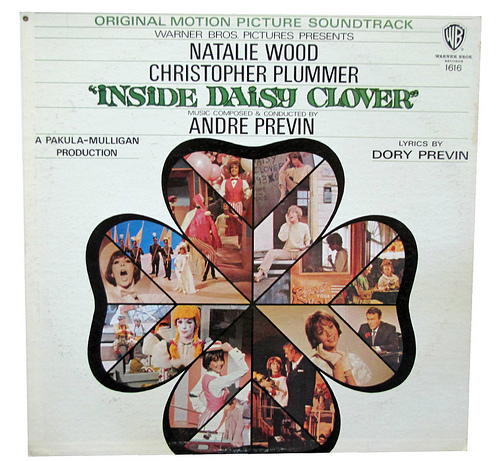
I had not seen INSIDE DAISY CLOVER since I saw it on release back in early 1966 and again its from a book I loved as a teenager, which became a very flawed film which is fascinating to see now (like that curious Julie Andrews musical STAR!, see post below). Natalie Wood was a huge star then - one of the few child stars who grew up successfully in the movies (she played the daughter of Maureen O'Hara, Bette Davis, Margaret Sullavan, Claudette Colbert and others and she was the perfect 50s teenager with Jimmy Dean in REBEL WITHOUT A CAUSE, and of course so iconic as Debbie in THE SEARCHERS, then Warners teamed her with teen heart-throb Tab Hunter in 2 films, she dated Elvis, married Robert Wagner  ... she was MARJORIE MORNINGSTAR in '58 and then the early '60s saw her in Kazan's SPLENDOUR IN THE GRASS with Beatty, GYPSY (one of my favourite musicals) and WEST SIDE STORY.  We liked her a lot in LOVE WITH THE PROPER STRANGER with McQueen in Robert Mulligan's 1963 charmer (another one to re-see soon), and Mulligan also directs INSIDE DAISY CLOVER, where Nat at 27 plays 15 year old Daisy, the foul-mouthed teenager in 1936 Hollywood, living with her mother The Dealer in a rundown shack at Venice beach, and near the Santa Monica pier where Daisy runs a movie star photo stall.

She wants to be a singer and records her voice and sends it to the Raymond Swan studio ... so far so good...but the question is:  Where is everybody? The movie looks deserted as there is hardly anybody in it apart from the principals. When Daisy is summoned to the studio the only people there are Swan (Christopher Plummer - his next role after SOUND OF MUSIC) and his glacial wife Melora (Katharine Bard), and that silent assistant Roddy McDowall. There is no real period detail or feel for the 1930s. Daisy looks like a 50s or 60s kid with that haircut.  Suddenly she is a huge star and we hear (and hear, and hear..) her song "Your're Gonna Hear From Me" (music and lyrics by The Previns - Andre and Dory).The '30s clips of Gable & Lombard, Bogart, Power etc at Daisy's premiere do not fit in at all with the look of the rest of the film ...

Her tomboyish Daisy—an overnight singing sensation in mid-thirties Hollywood— soon hates her Hollywood existance and doesn’t seem to understand anything that is said to her, and the pace gets so s-l-o-w than one wants to reach for the fast-forward button - the director Robert Mulligan can’t quite find the rhythm, either. The studio takes over her life as her mother is put in a home and her selfish greedy older sister whom she despises is made her guardian. Then there is the young Robert Redford, playing alcoholic bisexual star Wade Lewis. He looks terrific in that striped top he wears and it is poignant now seeing him and Daisy clamoring onto his yacht and going sailing ... after he sweeps Daisy off and marries her and she wakes up alone the next morning. She soon finds out from Melora, also carrying a crush for Wade, that he "can never resist a pretty boy" and is off with the latest number.

After her breakdown Daisy ends up with a nurse in a house on the beach, as her next film remains uncompleted, to Swan's fury: as he says "You don't cost me money, you make it" and reminds her that there are more out there like her... after a protracted attempt at suicide (which goes on and on...) with the gas oven, Daisy regains her freedom by leaving the gas on to blow up the house as she walks away and the film freezes. It is already over 2 hours long by then ... so there was no way they could continue the story with, as in the novel, Daisy moving to New York and making new friends and reinventing herself as a cabaret lounge singer, with another great song "I wonder what became of me?" - that would have been the really interesting bit.

So the look and period feel of the film seems all wrong, there seems to be nobody at the studios in those peak movie years of the 1930s, Natalie though gives it her all even if maybe too old for the part. It is scripted by Gavin Lambert from his novel, and he became good friends with Natalie (who died aged 43 in 1981), writing a good biography on her, (before he died himself in 2005 aged 80; he also wrote a good book ON CUKOR and other novels and books on Hollywood, as well as the screenplays for THE ROMAN SPRING OF MRS STONE and SONS AND LOVERS among others) and editing "Sight & Sound" during the '50s.

Whatever the similarities to Judy Garland (child star, breakdowns, involvements with gay or bi guys, a New York comeback), there are certainly allusions or references to Cukor's A STAR IS BORN: the scene where Wade wipes her makeup off, and she is madeup to look like a kid (just like Judy was), and when they run away to get married, and the malicious hack at the studio - Jack Carson there, McDowell here. Natalie too gets an intense emotional scene as here she breaks down in the recording booth .... Ruth Gordon is perfect as the Dealer (just like she was in ROSEMARY'S BABY and HAROLD AND MAUDE) and 1966 too was Redford's year what with THE CHASE and his other one with Natalie THIS PROPERTY IS CONDEMNED, Sidney Pollack's film of a minor Tennessee Williams, which I have been meaning to rescue from the "pending pile".
PS: I have now rescued the original novel by Lambert (from a box in the garage) and was surprised to see that it is set in the 1950s! - Daisy's diary begins in 1951 and continues into 1952 and it is 1957 when she leaves Hollywood for New York - so why on earth did they take it back to the 1930s, Lambert wrote the script so must have gone along with what Pakula/Mulligan wanted, but Natalie had the '50s look in spades, that was her era - they made no attempt to give her a 1930s look or make the film look set in the 1930s.Wade in the novel is surely based on James Dean - Redford makes him look too wholesome!