Dedications: My four late friends Rory, Stan, Bryan, Jeff - shine on you crazy diamonds, they would have blogged too. Then theres Garry from Brisbane, Franco in Milan, Mike now in S.F. / my '60s-'80s gang: Ned & Joseph in Ireland; in England: Frank, Des, Guy, Clive, Joe & Joe, Ian, Ivan, Nick, David, Les, Stewart, the 3 Michaels / Catriona, Sally, Monica, Jean, Ella, Anne, Candie / and now: Daryl in N.Y., Jerry, John, Colin, Martin and Donal.
Showing posts with label Oscar Wilde. Show all posts

Sunday, 9 October 2016

Two Bosie's ....

Interesting for us theatre folk to see two actors who have played Lord Alfred Douglas in David Hare's THE JUDAS KISS, together in a new revival of Tom Stoppard's TRAVESTIES, currently a sell-out at London's Menier Chocolate Factory, hopefully it will get a west end transfer. The witty play features wordplay on Oscar Wilde and dialogue from his THE IMPORTANCE OF BEING EARNEST
Tom Hollander was Bosie in the 1998 original production, with Liam Neeson, as Oscar, which I enjoyed back then, Tom was a very petulant Bosie, as was Freddie Fox in the Rupert Everett version a couple of years ago, which was brilliant too (more on that at Oscar, Rupert labels). They must have had a lot to talk about the part ... Busy year for young Fox - that recent CUCUMBER and PRIDE, and also Romeo this summer in that recent ROMEO AND JULIET, reviewed recently (Shakespeare label). Tom of course also also been very busy with THE NIGHT MANGER and DR THORNE,

Monday, 30 May 2016

Theatre news 2: Oscar hits Broadway

I was surprised to see that recent revival of David Hare's THE JUDAS KISS about Oscar Wilde, which we enjoyed and wrote about a bit back in 2012, has now arrived on Broadway, with Rupert Everett once again getting rave reviews for his great performance as Oscar - surely the best part of his later career. That London production which I saw initially at the Hampstread Theatre was also the debut of Ben Hardy - recently in EASTENDERS, the BBC soap and he is now Angel in the latest X-MEN. Rupert is also now in dastardly mode in the new BBC series THE MUSKETEERS, which is an enjoyable romp.

I was drawn to THE JUDAS KISS as I had seen the original production a decade or more ago, with Liam Neeson and Tom Hollander as that very petulant Bosie. The Everett re-boot had a successful London west end run too before going on tour, my pal Martin saw it in Dublin.
Here is Rupert writing for The New York Times on Oscar and the play's genesis this time round,
and the paper' review:

More on Oscar (and Peter Finch's portrayal of him) and Rupert at labels.

Wednesday, 23 December 2015

1960s: Armchair Theatre

A new old IMPORTANCE OF BEING EARNEST

The blurb for Volume 4 of dvd pack (4 disks containing 12 plays and reasonably priced) of ARMCHAIR THEATRE says: "Pioneering, immensely influential and often challenging, ARMCHAIR THEATRE was (English) ITV's flagship drama anthology series. Bringing high-quality drama to the viewing public (back in the era when there were just two television channels and in black and white) the series easily demonstrated the network's potential to rival the BBC's drama output, with diverse and powerful plays showcasing some of Britain's most gifted writers and directors. This set comprises 12 plays featuring performances by some of the era's most celebrated and accomplished actors - including Susannah York, Colin Blakely, Ian Holm, Billie Whitelaw, Donald Pleasence, Terry-Thomas, Irene Handl, Patrick Macnee, Arthur Lowe and John Le Mesurier, among many others, including American import Carroll Baker (my pal Jerry will love this!). This volume includes early plays by both Jack Rosenthal, Ted Willis, Angus Wilson, Alun Owen, Len Deighton and John Hopkins, as well as Terry Southern." 

I just had to get this when I saw it included a production of Oscar's THE IMPORTANCE OF BEING EARNEST which I had not heard of before, from November 1964 (I was 18 then, new in London, in my bedsitter but with no television, so I missed it) with, for me, a dream cast to equal the 1952 Asquith film which of course had the definitive Lady Bracknell in Edith Evans, and with Joan Greenwood and Margaret Rutherford. 
Here in 1964 we have Pamela Brown (whom I like so much in I KNOW WHERE I'M GOING) who is a formidable Bracknell, with the fabulously camp Fenella Fielding (CARRY ON SCREAMING etc) as her daughter Gwendolyn and young Susannah York is a perfect Cecily. Then theres Irene Handl as Miss Prism and Wilfrid Brambell as the Canon. The boys are Patrick Macnee (THE AVENGERS) and Ian Carmichael. Perfect 1964 casting! and it all works a treat - they certainly do Oscar justice. Lovely art nouveau set too for Algernon's apartment. The script had to be tailored to fit a 90 minute slot, but the BBC did the same with their Oscar productions in that OSCAR WILDE COLLECTION, but al the lines we know and love are here ....
Susannah York also features in another play here. I may have to investigate the other 3 volumes as well!

Monday, 9 September 2013

People We Like: Peter Finch

I had been meaning to get around to featuring Peter Finch as a Person We Like .... here's an 'Appreciation' I wrote over at IMDB back in 2009 .... (still to do: David Warner, Peter McEnery, Flora Robson, Vivian Pickles).

“Despite being one of the finest actors of his generation, Peter Finch will be remembered as much for his reputation as a hard-drinking, hell-raising womaniser as for his performances on the screen”, begins Finch’s biography details on his imdb page. Finch is perhaps now best remembered for his barnstorming turn as Howard Beale “the mad prophet of the airwaves” in Sidney Lumet’s NETWORK, for which he won the best actor Oscar in 1977, the only one to be awarded posthumously – though that may change if, as predicted, Heath Ledger wins this year.


Finch was actually born in London in 1912 but moved to Australia where he gradually got into acting. Discovered by the Oliviers during their tour of Australia in 1948 he returned to London with them, under contract to Olivier. One of the pleasures of watching English movies of the '50s is seeing him working his way up to becoming one of the most interesting leading men around.

Early roles included the Sheriff in ROBIN HOOD AND HIS MERRIE MEN (’52) and the arch-villain in FATHER BROWN in 1954, Alec Guinness being the detective priest of the title. ELEPHANT WALK (left)  teamed him with Elizabeth Taylor, a replacement for Vivien Leigh who had began the film but had suffered a breakdown. Finch had inevitably become involved with Leigh, as he did with Kay Kendall [before she met Rex Harrison] with whom he appeared in the 1955 comedy SIMON AND LAURA, a still funny satire on a famous theatrical couple (shades of the Oliviers perhaps) venturing into a tv sit-com. Its so perfectly mid-50s Rank Organisation fare with those great supporting players of the time.

A TOWN LIKE ALICE
in 1956 cemented his reputation, as did war films like BATTLE OF THE RIVER PLATE, and films set in Australia like THE SHIRALEE (about an itinerant drover and his child). A childhood memory is being taken to see ROBBERY UNDER ARMS in 1958, almost a western about outlaws in the early days of Australia – exciting stuff.

THE NUN’S STORY in 1959 remains a timeless classic well-crafted by Zinnemann and was an enormous hit at the time, his role as Dr Fortunati being a perfect foil for Audrey Hepburn’s Sister Luke, as they work in the Congo hospital. Like Edith Evans’s mother superior it is a small but pivotal role.

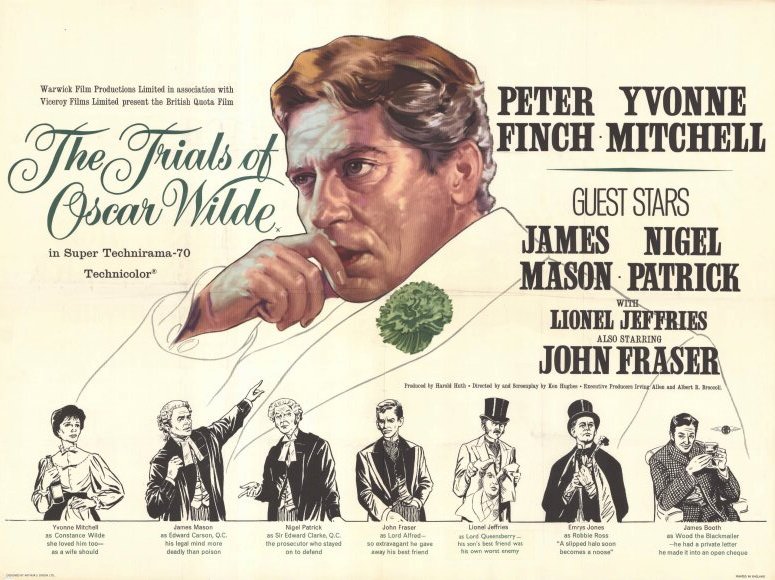
This was followed by perhaps his most important role at the time: Oscar in THE TRIALS OF OSCAR WILDE, a fascinating and intelligent working of the Wilde story and for a movie made in 1960 about as frank as it could be. Finch was a magnificent Wilde capturing the facets of the writer knowingly facing his destiny, and winning a BAFTA award. Yvonne Mitchell was the perfect Constance, and John Fraser as petulant a Bosie as Jude Law in the 90s Stephen Fry film. There was another version of the Wilde story made at the same time in 1960 with Robert Morley (playing Wilde as Robert Morley), but the Finch version directed by Ken Hughes won hands down, with handsome period detail. James Mason and Nigel Patrick shone as opposing barristers and Lionel Jeffries was a malevolent Marquis of Queensbury. The film still holds up perfectly today.

This was followed by another one set in Africa THE SINS OF RACHEL CADE in 1961 where Angie Dickinson is the missionary with a mission. Having seen this for the first time this week it was quite engrossing with Finch as ever providing solid support as the French Colonel. There was also an Alan Breck in a Disney KIDNAPPED, and a gritty English political film NO LOVE FOR JOHNNIE directed by Ralph Thomas with Finch as the labour politician compromising his values, the excellent cast included Billie Whitelaw and Stanley Holloway.

Some solid leading roles followed as Finch was breaking into American films, mostly set in Europe: I have not seen IN THE COOL OF THE DAY with Angela Lansbury and a young Jane Fonda, but I THANK A FOOL with Susan Hayward set partly in Liverpool and in Ireland is certainly an oddity where Hayward is a doctor convicted of a mercy killing by judge Finch who then hires her when she comes out of prison to look after his mentally disturbed wife, with inevitable results…

Two good ones followed: Jack Clayton’s THE PUMPKIN EATER in 1964 where he is Anne Bancroft’s husband growing exasperated with her constant child-bearing and involved with a young Maggie Smith. It was played intensely by all concerned, including James Mason as a very annoyed husband. Bancroft does a harrowing breakdown in Harrods store, and there is that delicious scene with her and Maggie Smith as Philpot, script by Harold Pinter and Penelope Mortimer, from her novel.

THE GIRL WITH GREEN EYES is a lyrical Woodfall film, also 1964, from Edna O’Brien’s novel where he is the mature man getting involved with young Rita Tushingham. For anyone Irish the early 60s Irish background is perfectly captured, Lynn Redgrave is her more out-going friend Baba and its all perfectly realised including that bittersweet ending when the girls leave on the ferry for a new life in England (as I did myself at that time).


THE FLIGHT OF THE PHOENIX was a solid Robert Aldrich film in 1965, then two more European ones: with Melina Mercouri and Romy Schneider in Dassin’s 10.30 PM SUMMER, trying to put Marguerite Duras’s world of the indolent rich travelling around Spain on screen (Pauline Kael was particularly rich on it..) and JUDITH (above) with Sophia Loren which should have been good but was so forgettable I cannot remember anything about it despite liking the 3 leads (Jack Hawkins was also involved).


FAR FROM THE MADDING CROWD was another popular and critical success in 1967 as Schlesinger captured Thomas Hardy with Julie Christie as Bathsheba (perhaps too modern to be a convincing Victorian), Alan Bates as Gabriel Oak and Terence Stamp as the dashing Captain Troy. Finch is Farmer Boldwood and the pastoral scene is idealised in Nicholas Roeg’s photography. It’s an enduring great version of a great book.
THE RED TENT in 1969 is another polyglot effort I have not seen, with Connery and Cardinale leading the international cast, and another Robert Aldrich – the little seen THE LEGEND OF LYLAH CLARE with Kim Novak – is an interesting oddity. I have not seen it but have just got a copy, so it should be fascinating viewing.
Then came SUNDAY BLOODY SUNDAY in 1971, Schlesinger’s enduring film about a particular slice of London society, the intelligentsia and how they spend their Sundays, as devised by writer Penelope Gilliatt. Finch excels himself as Dr Daniel Hirsch, the Jewish doctor in love with young artist Murray Head, as is Glenda Jackson in one of her most sympathetic roles as the career woman realising her romance is not going anywhere. Their backgrounds are carefully shown while we do not learn much about the young artist – in fact the puzzle is why would two such well rounded people bother with someone so shallow. Finch has a great scene at the all night chemist watching the addicts waiting for their fixes after meeting a previous pickup of his, Jon Finch, while Glenda grimaces as she drinks instant coffee made from the hot water tap and grinds cigarette ash into the carpet as she is left with the toucan. Finch who replaced Ian Bannen in the role should really have won every award going [as should have Bogarde the previous year for DEATH IN VENICE] if only for that speech to the camera at the end, but it was Gene Hackman’s year. IMDB has quite a lot on its making and that famous gay kiss in its material about the film. Like Losey's THE GO-BETWEEN it was one of the year's must-sees.
Some routine films followed: with Shelley Winters in the forgettable SOMETHING TO HIDE, with Glenda again in BEQUEST TO THE NATION (he is Nelson to her Lady Hamilton), Graham Greene’s ENGLAND MADE ME, and with Liv Ullmann in the little seen THE ABDICATION continuing the story of Queen Christina. He was with Ullmann again in the widely derided musical remake of LOST HORIZON in 1973 – again Pauline Kael was particularly amusing writing about it, and as Bette Midler said “I never miss a Liv Ullmann musical”. Filmed in Burbank for Ross Hunter it gave bland a whole new dimension.

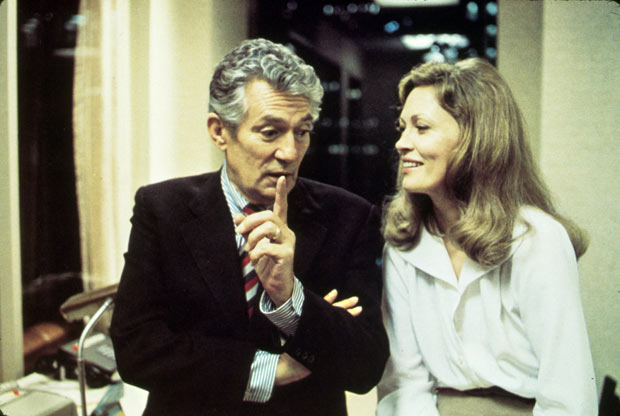
Then came NETWORK in 1976 with Finch as Howard Beale holding his own with William Holden and Faye Dunaway in this satire on television ratings by Paddy Chayefsky and directed by Lumet. An enduring key 70s film which Finch followed with a tv film RAID ON ENTEBBE. 1976 was really Robert De Niro’s breakthrough year with TAXI DRIVER, so the award nominations were particularly interesting that year. Finch of course was nominated but died suddenly in January 1977 - he was 65 and happily married for the third time - and was the best actor winner that year. His widow accepted the award on his behalf.


It’s a great career of highs and not many lows by one of the most charismatic leading men of his time. Like Dirk Bogarde and James Mason he certainly took risks others wouldn’t have and remains a fascinating figure. I would say THE NUN'S STORY, THE TRIALS OF OSCAR WILDE, SUNDAY BLOODY SUNDAY and NETWORK are his best work which will certainly endure. Finchie too got to work with a lot of ladies we like from Kay and Liz to Julie and Romy and Susan and Faye, Audrey, Sophia, Melina, and Dames Glenda and Bancroft ....

Thursday, 20 September 2012

Wilde at heart

  • Oscar goes touring: As per the report below, the Wilde play is now going on tour after its sell-out run in London. It should prove popular in Oscar's hometown Dublin, at the Gaiety Theatre for a week in October, followed by a week each at Bath, Brighton, Cambridge, Richmond - pity its not heading north - a friend in Liverpool would have liked to have caught it.... 

To the perfectly situated and sized Hampstead Theatre at Swiss Cottage, in London, for the new production of David Hare's play about Oscar Wilde THE JUDAS KISS - a matinee performance for this sold-out revival. Going to the theatre in the afternoon is rather nice, particularly when the modern theatre has cafe and bar facilities and pleasant outdoor seating areas, and is not so big that one is way back in the stalls - plus one is home by teatime without having to give up an evening and getting back late! Ideal. 

I was intrigued to see this production as I also saw the original 1998 one with Liam Neeson as Oscar and Tom Hollander as Lord Alfred Douglas, or Bosie - ably played here by Freddie Fox, actor son of Edward. Rupert Everett commands the stage as Oscar and captures that florid quality perfectly from the moment he sweeps in in Act One to spending most of Act Two sitting in a chair. The rest of the cast are perfect too, and are kept quite busy on stage as well as dressing and undressing - in fact Tom Colley (below, left) as Bosie's Italian friend is naked practically throughout.
Ben Hardy, that other young actor (now in EASTENDERS) is also naked at the start, as the young waiter, which certainly makes the audience sit up! Rupert, so amusing the other week in a re-run of MY BEST FRIEND'S WEDDING captures Wilde at these 2 key moments dealt with in the play. We first see him holed up at the Cadogan Hotel in 1895 before being arrested, as everyone tries to persuase him to flee to Europe, and the thoroughly unpleasant Bosie goes into drama queen mode.  Act 2 is 2 years later in Italy in 1897 as the ruined - both his health and financially, after 2 years hard labour in jail - Wilde contemplates his downfall and realises how Bosie has betrayed him, as he will not give up his family allowance and prepares to leave Wilde once again. Oscar achieves pure pathos here. Below: Freddie as Bosie with Tom Colley as the Italian.
Wilde of course lived on to November 1900 when he died aged 46 - his major works (apart from "De Profundis" were completed by the time he was 40). Bosie lived on to be 74 and died in 1945 - a bitter Narcissus indeed. If only Oscar too could have lived to his seventies, he would have been a star of radio and film and been rehabilitated as the wit and commentator he was and he would have been earning royalties again. His great tomb with its "Modernist Angel” sculpture (right) by Jacob Epstein has been cleaned and restored to its former glory at Pere Lechaise cemetry in Paris (I have been to it twice) and is that famous cemetry's most visited resting place, along with Jim Morrison's... 

Liam & Tom in 1998
The roles of Wilde and Douglas here are hugh with lots of dialogue - I felt for the actors having to do it all again that evening ... it is an engrossing thought-provoking play. Oscar was so much more than the grandiloquent poseur he is often remembered as. His ideas and philosophy resonate today as strongly as they ever did and his work has stood the test of time, living on as so much more than mere entertainment. Over a century after his death he remains one of the great Irish writers, a playwright of genius as well as a thinker and proponent of ideas who transformed his age. Hare's play shows him as a man in the grip of a passion he could not resist, who could not see the amoral and unworthy wastrel that was his nemesis, and so he brings disaster on himself. One can see too that Oscar could not be discreet as others (Robbie, the hotel staff here including that enterprising young waiter played by Ben Hardy) but had to immolate himself on the alter of his grand passion. Hare's rounded portrait of Wilde captures all this expertly.

The story of his wife Constance too is utterly tragic (as shown in that excellent well-received recent biography on her); she died 2 years before Oscar - I remember reading in one of the Wilde books how he visited her grave (in Genoa) and pondered at the sadness and waste of it all. He was then that haunted impoverished (but hopefully happy) outcast in Paris in 1900 as the new century (which would surely have embraced him) began. Instead he, as the legend goes, turned to the wall of that Paris hotel room with the hideous wall-paper and said "one of us has to go". Of his two sons - he was a devoted father too - one of them died in the First World War. We will always though have the plays, the novel, the fairy tales, the aphorisms, the wit that so entranced his audiences and friends like Lily Langtry, Sarah Bernhardt and the rest. The story of Oscar: the talent, the rise and fall - as per the plethora of books about him and that era [the reckless "feasting with panthers", his indiscretions at London hotels and assignations with youths like Alfonso Conway in Worthing, which didn't go down well in court] will continue to fascinate - and what great actress doesn't want to have a go at Lady Bracknell or Miss Prism or Mrs Cheveley?

Other Wildes: I like Peter Finch's in the 1960 film - which I will be returning to before too long. The Robert Morley one, also 1960, was just not in the same league. The 1997 Stephen Fry one was also screened again recently and was of course more explicit than they could have been in 1960, with Fry rather lightweight I thought, but Jude Law a perfect Bosie and a great supporting cast. Peter Egan was an amusing Oscar too in the '70s series on Lily Langtry. The BBC boxset on Wilde productions is well worth discovering too with perfect 1970s productions of the plays (casts include Gielguld, Margaret Leighton, Jeremy Brett) and a documentary on the man himself. Rupert Everett is a great Oscar too and deserves to be remembered come theatre awards season..

Friday, 9 April 2010

More British '50s rare pleasures...

Some more eclectic British films of the ‘50s before we zoom off to the ‘60s (and lots more ‘People We Like’)!

AN ALLIGATOR NAMED DAISY, a delicious 1955 Rank comedy starring Donald Sinden and Jeannie Carson, and Stephen Boyd [the essence of '50s beefcake here] teamed with Diana Dors – both of them going places. Sinden has to look after the alligator and chaos ensues. [This was a childhood favourite of mine and I bought the Donald Sinden box set purely for this still enjoyable comedy..]. James Robertson Justice, Richard Wattis, and - wonderfully - Margaret Rutherford (in one scene as a pet shop owner who can talk to the alligator) are all blissfully funny. Another by J Lee Thompson!

HOW TO MURDER A RICH UNCLE - a long-forgotten 1957 comedy, rather like a new Ealing production, featuring a ramshackle rich family now down on its luck, trying to bump off the rich uncle of the title, but killing each other insead. Its quirky and funny, directed by and starring Nigel Patrick, with Wendy Hiller and dear Katie Johnson of THE LADYKILLERS. Charles Coburn is the wealthy uncle whose relatives are dropping like flies around him...

WOMAN IN A DRESSING GOWN – one of several here featuring Yvonne Mitchell, this 1957 melodrama by Ted Willis and directed by the astonishingly versatile J Lee Thompson was a hit at the time. Mitchell is the slovenly wife, forever in that dressing gown, whose middle management husband Anthony Quayle is being lured away by bright young thing Sylvia Syms. It captures the mood of the late ‘50s with those modern new offices and the rising middle class. Carole Lesley, a starlet of the time, also features. Yvonne as usual makes it very compelling.

SAPPHIRE. Hardly ever seen now, this is a vivid childhood memory. Basil Dearden’s 1959 thriller is very colourful as it depicts late ‘50s Britain and the racial tensions of the time, with the arrival of those immigrants from Jamaica and Trinidad who were encouraged to move to England and better themselves, but were usually working on buses and trains. Sapphire is the girl found murdered on Hampstead Heath as detectives Nigel Patrick (dependable as ever) and Michael Craig look for clues. Yvonne Mitchell scores as the sister of Sapphire’s boyfriend, as it is revealed that the murdered girl was a half-caste who was passing as white. As in Dearden’s following VICTIM, attitudes are revealed among the suspects and its intriguingly worked out. A vivid scene set in a nightclub shows Craig’s reaction while watching a blond girl absorbed in the music as the owner tells the police that the girls passing for white always give themselves away when they hear that funky beat…. FLAME IN THE STREETS in 1961 is another set in this era as John Mills’ daughter (Sylvia Syms again) wants to marry an ordinary black man (not a Sidney Poitier superhero, as in Kramer's 1967 film) thus testing his liberal attitudes, while his wife, splendid Brenda de Banzie, is violently opposed to the union. This is also by Ted Willis.

THE TRIALS OF OSCAR WILDE is a fascinating and intelligent working of the Wilde story and for a movie made in 1960 about as frank as it could be. Peter Finch was a magnificent Wilde capturing the facets of the writer knowingly facing his destiny, and winning a BAFTA award. Yvonne Mitchell was the perfect Constance, and John Fraser as petulant a Bosie as Jude Law in the 90s Stephen Fry film. There was another version of the Wilde story made at the same time in 1960 by Gregory Ratoff with Robert Morley (playing Wilde as Robert Morley), but the Finch version directed by Ken Hughes won hands down, with handsome period detail and in scope and colour. James Mason and Nigel Patrick shone as opposing barristers and Lionel Jeffries was a malevolent if not insane Marquis of Queensbury. The film still holds up perfectly today. The Stephen Fry version may have been franker in 1997 but this one is just as good if not better and more nuanced.
Marketing Oscar in 1960: Click image to enlarge
The other version had the tagline: "Theirs was a relationship that the world could not, would not tolerate"!

CONSPIRACY OF HEARTS in 1960 from the Rank Organisation remains a superior tearjerker, where Lilli Palmer is the very elegant Mother Superior of a convent in Italy where the nuns save Jewish children from the Germans. Add in young Sylvia Syms, Yvonne Mitchell as the crotchety nun, David Kossoff as a rabbi and Albert Lieven and Peter Arne as dastardly Germans, plus Roland Lewis as a partisan. Experty put together by Ralph Thomas. Lilli is perfect as head nun squaring up to those Nazis.

NORTH WEST FRONTIER is a terrific adventure movie in scope and colour by J Lee Thompson in 1959 and it remains a television staple to this day as its screened at least once a year here in the UK. Thompson also made TIGER BAY that year as well as other ‘50s sterling titles like NO TREES IN THE STREET, YIELD TO THE NIGHT, THE WEAK AND WICKED, ICE COLD IN ALEX before going on to the likes of THE GUNS OF NAVARONE and CAPE FEAR. Here we are in India during the Victorian Raj era, Kenneth More has to guide a train through bandit country while protecting the young Prince whom a lot of people, including someone on the train, want to see dead. Lauren Bacall is the governess, Herbert Lom a shady character and Wilfrid Hyde White one of these decent English chaps. Its great fun to watch anytime.

UPSTAIRS AND DOWNSTAIRS – a very typical Rank Organisation comedy from 1960, with fascinating décor to see now, at the dawn of the new ’60s era. Michael Craig and Anne Heywood are the young marrieds who simply must have a domestic help to do their chores and look after their house. Their trials and tribulations make up the plot as they cope with bank robbers, a drunk Joan Hickson, Welsh girl Blodwyn (a hilarious young Joan Sims) who has never left Wales – Craig has a hilarious scene on a train with her – and Claudia Cardinale as a continental sexpot with men calling to the house at all times [5 years later Craig would be supporting Cardinale in Visconti’s SANDRA, of which more later]. French Mylene Demongeot plays the Swedish girl and its all jolly good fun and so typical of the era, also by Ralph Thomas.