Dedications: My four late friends Rory, Stan, Bryan, Jeff - shine on you crazy diamonds, they would have blogged too. Then theres Garry from Brisbane, Franco in Milan, Mike now in S.F. / my '60s-'80s gang: Ned & Joseph in Ireland; in England: Frank, Des, Guy, Clive, Joe & Joe, Ian, Ivan, Nick, David, Les, Stewart, the 3 Michaels / Catriona, Sally, Monica, Jean, Ella, Anne, Candie / and now: Daryl in N.Y., Jerry, John, Colin, Martin and Donal.
Showing posts with label Mary Astor. Show all posts

Sunday, 3 July 2016

Joan and sudden fear somewhere in the night ...

A 1950s Joan Crawford movie I had not seen: 1952's SUDDEN FEAR begins well but limp to an unstisfactory ending ..... I actually like Joan Crawford's 1950s output more than that of her main rival Bette Davis, who after the enormous success of 1950's ALL ABOUT EVE was soon back in routine programmers; well so was Joan of course but they were more fun that Bette's: TORCH SONG in 1953, JOHNNY GUITAR in '54 (the first film I saw, aged 8 as per reports on that, see label) and those campy lurid items like QUEEN BEE, FEMALE ON THE BEACH, AUTUMN LEAVES, THE STORY OF ESTHER COSTELLO up to her cameo in 1959 "as Amanda Farrow in THE BEST OF EVERYTHING - Bette too was cameo-ing in 1959 (two of them, a scene or two with Alec Guinness in THE SCAPEGOAT and coming on for the last five minutes as Catherine The Great in the otherwise turgid costumer JOHN PAUL JONES, hardly seen now. Of course 1962's WHATEVER HAPPENED TO BAY JANE? got them back in the limelight again ...). But back to Joan in 1952.where Woman's Picture meets Film Noir:

Actor Lester Blaine has all but landed the lead in Myra Hudson's new play when Myra vetoes him because, to her, he doesn't look like a "romantic leading man." On the train from New York to San Francisco, Blaine sets out to prove Myra wrong...by romancing her. Is he sincere, or does he have a dark ulterior motive? The answer brings on a game of cat and mouse; but who's the cat and who's the mouse? 
Myra is an essential Crawford role, the middle-aged wealthy woman looking for love and thinking she has found it. Palance is ideal with his odd looks, and add in Gloria Grahame at her bitchiest .... 
It plays like a delicious antique now: those early Dictaphone machines where Myra overhears the plot against her, her odd wardrobe of buttoned-up tops and showing her legs and nylons and high-heels as well as those long white gloves both ladies wear. The plot though as she counterplots against her attackers could have ended better ....... cue large close-ups of Joan agonising, suffering, suffering, suffering, yearning as she conveys the fear and rage at the duplicity of others ...... Directed by David Miller, but those empty streets of San Francisco do not look realistic. 

Now back a decade for another Noir thriller: Mankiewicz's SOMEWHERE IN THE NIGHT from 1941, his second feature as director. 
My friend Leon describes it thus:
Somewhere In the Night dates from 1946, the same year Mank's second directorial effort Dragonwyck was released and it's well up to snuff. A lot of 'amnesiac' films are, by definition, forgettable, but not this one. Mank assembled as tasty a supporting cast as had ever been shoehorned into one film ranging from Whit Bissell through Harry Morgan, Jeff Corey to the standout Josephine Hutchinson. Leading from the front are the slightly wooden John Hodiak - marriage to Ann Baxter didn't improve his acting -, newcomer Nancy Guild, Lloyd Nolan and Richard Conte and Mank keeps the balls spinning in the air leaving little time for awkward questions - like why would Conte - who'd got away with murder for three years, introduce Hodiak to a detective friend (Nolan) knowing that Hodiak was trying to get to to bottom of the very murder for which he, Conte, was responsible. This the kind of movie, popular at the time, in which a protagonist who is possibly a murderer is befriended by a girl/woman who's never met him before - for example Alad Ladd and Veronica Lake in The Blue Dahlia and/or in which a street-wise gal like Guild here, has to have the expressions 'private eye' and 'shamus' explained to her. None of this detracts from an enjoyable ride and it's one to add to your Blockbuster shopping list.
Leon was quite right, its a zippy intriguing little meller, essential for anyone keen on 1940s noir and Mankiewicz's style. Pleased I found it. 

John Hodiak (1914-1955) was an interesting guy, of Polish descent he was one of the second-tier actors who came to prominence during the early Forties - like Dana Andrews - when the big hitters were away during the war. He only lived to be 41 though, and had some big hits at the time, and even married Anne Baxter for several years (right). I saw him again the other day in Hitch's LIFEBOAT with Tallulah, and he is the male lead in the entertaining THE HARVEY GIRLS with Judy in 1946. We particularly like his DESERT FURY here, from 1947, one of the great camp Hollywood movies, where he and Wendall Corey are an intriguing pair, plus Lizabeth Scott and Mary Astor playing her mother, and a young Burt Lancaster - its a delirious 1940s concoction as per my review (Hodiak label). 

Coming up: A '60s Kim Novak double-bill, and then its off to THE RITZ in THE GAY METROPOLIS.

Tuesday, 10 November 2015

Another Bette double ...

We have spent a few lazy afternoons re-watching some Bette Davis classics. Is there a more weirdly enjoyable '40s melodrama than THE GREAT LIE?  which teamed with Wyler's THE LETTER made a marvellous double-bill. Of course NOW VOYAGER and OLD ACQUAINTANCE are delicious fun too, and may be the next double bill. (You can keep MR SKEFFINGTON). 

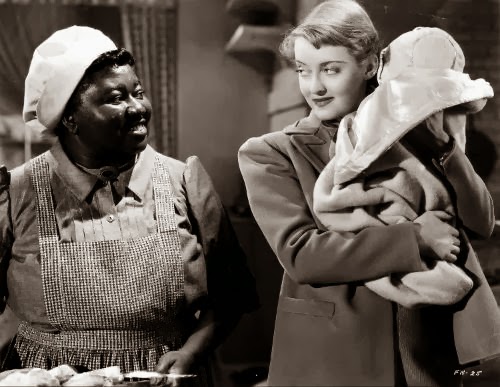
Bette worked well with a strong female co-star (Miriam Hopkins, Olivia, Joan Crawford, Geraldine Fitzgerald) and so it is with Mary Astor here. THE GREAT LIE is really Mary's film, the role of concert pianist Sandra Kovac was built up for her and she deservedly won the Best Supporting Actress Oscar, in that good year for her. (By 1944 she was playing the mother in MEET ME IN ST LOUIS). Sandra is one of the great bitch-on-wheels roles and Astor delivers in spades - she was re-united with Bette for that cameo in HUSH HUSH SWEET CHARLOTTE as Jewel Mayhew in 1965, where she is sadly aged - but she ramps up the glamour here as her impossible Sandra.
THE GREAT LIE is plush - Orry-Kelly did the costumes, Max Steiner the music and gay Edmund Goulding directs. This is one of the great smoking films - they smoke all the time, Sandra even smokes non-stop throughout her pregnancy.  Bette is nice Maggie who lives in Maryland - but her home seems like a Deep South plantation with all those trees and moss, where the white folk are ministered to by the happy singing coloured folk, led by Hattie McDaniel (outdoing her Mammy in GWTW!). Here, one dresses for dinner and rings for the black manservant to make some more mint juleps. 

Sandra and Pete elope but their marriage is invalid since she's not yet divorced. Sandra is, however, pregnant by Pete. Pete marries his former fiancée Maggie, then flies to South America where his plane crashes. Maggie pays Sandra to let her adopt Pete's baby. Pete returns "from the dead". Sandra and Maggie contend for Pete and the baby.

It begins with the aftermath of Sandra's marriage to Pete (George Brent - what did women see in him?), as they recover from a 3-day party, but Sandra got her dates wrong, her divorce from her first husband is not yet final, so they are not legally married. She has her concert tour and will not change the date for them to marry again and Pete is having doubts ..... he goes off to Maryland to see Maggie, the woman he really loves. Maggie wants him to pursue his aviation interests and soon they are indeed married for real. The on-going rivalry between Sandra and Maggie escalates and then Sandra finds she is pregnant with Pete's child, just as Pete goes missing on some mysterious government work, in Brazil.  
Maggie comes up with the idea of she taking Sandra's child which she can bring up as Pete's, so he could have Pete's name and money, while Sandra can continue her music career. Sandra agrees - she is not the maternal type - and the centre of the film shows the two of them holed up in Arizona waiting for the birth, as Sandra fumes and smokes, and Maggie strides around in jodhpurs waiting for the delivery .... 
then Pete is rescued and comes back, and thinks the child is his and Maggie's.  Sandra then decides she wants the baby back and Pete too, as his being alive changes everything. The scene is set for the climax as the two women battle over the child and Pete, who finally learns the truth - which will he choose? 

THE LETTER by comparison is serious drama, previously done by Jeanne Eagles in 1929 and I like Lee Remick' 1982 version where Leslie Crosbie is a right tease. Bette's version is much more duplicitous as she schemes to evade justice for shooting her lover, but this being the 1940s justice is waiting for her in that garden in the moonlight.   
The wife of a rubber plantation administrator shoots a man to death and claims it was self-defense. Her poise, graciousness and stoicism impress nearly everyone who meets her. Her husband is certainly without doubt; so is the district officer; while her lawyer's doubts may be a natural skepticism. But this is Singapore and the resentful natives will have no compunction about undermining this accused murderess. A letter in her hand turns up and may prove her undoing. 
Maugham's version of life in those steamy tropics still engrosses now. It may be Bette's defining role, along with Margo Channing of course  Those 'Bette Davis eyes' are dominant here, 
Soon: A Claudette Colbert double\; MIDNIGHT and THE PALM BEACH STORY.

Tuesday, 11 March 2014

Roman revels

Two more Ruth Roman movies from that busy year for her, 1951 - when she also played the female lead in Hitchcock's STRANGERS ON A TRAIN, probably her best remembered film. Ruth, as I have mentioned here before - see label - was a tough gal, who did lots of melodramas and routine actioners (ok, B-movies) in the '50s and into the '60s, having began in the '40s - she is in Bette's BEYOND THE FOREST, and thanks to my IMDb pal Jerry for a mid-'40s serial she is in: JUNGLE QUEEN - I am saving that one for "some snowy night in front of the fire" and I am the lookout for her 1955 take on Shakespeare: JOE MACBETH (with her as the mobster's Lady Macbeth), which I remember seeing as a kid.  Ruth should have been as big a name as those other tough gals like Susan Hayward, or Barbara Stanwyck - Ruth could have played a lot of Stanwyck '50s roles like CLASH BY NIGHT or BLOWING WILD (she is the good girl in that, while Barbara is the bad wife, they have a nice scene together), or even some of Joan Crawford's roles, or Lizabeth Scott's or Jan Sterling's, and of course we love her in 1966's LOVE HAS MANY FACES where she gives Lana  Turner a run for her money in that delirious soap/trash classic. Ruth (1922-1999) ended up in shows like MURDER SHE WROTE and KNOTS LANDING
TOMORROW IS ANOTHER DAY teams bad boy Steve Cochran with cheap dime-a-dance girl Ruth - looking very glam in a brassy blond wig (like Jane Russell's 'hostess' in wartime Hawaii in Trash Classic THE REVOLT OF MAMIE STOVER, Russell label). 
Here is the blurb:
What kind of future awaits a couple with a past? Ruth Roman and Steve Cochran in a film-noir gem.
A man who spent his formative years in prison for murder is released, and struggles to adjust to the outside world and escape his lurid past. He gets involved with a cheap dancehall girl, and when her protector is accidentally killed, they go on the lam together, getting jobs as farm labourers. 
But some fellow workers get wise to them. Steve Cochran conveys the loneliness of his character, freed for killing his brutal father when he was only 13, and now he's still a tentative, gawky pubescent operating inside a man's hulky frame. Lonesome, he visits a 10-cents-a-dance palace and falls for brassy, grasping Ruth Roman. But the sudden shooting of her police-bigwig boyfriend causes the ill-matched couple to hit the road, ending in a California migrant-worker camp. Directed by one Felix Feist.

This conjures up a world of diners, drab rooming houses, people on the move hitching lifts and riding on trains and cheap motels like the Shady Nook where our couple on the run hole up, before they join that settlement of farm workers and make friends and seem to have a whole new life, leaving their sordid pasts behind them. Ruth even lets her hair go natural to black. But Steve's photo turns up in a magazine and the neighbours have to decide whether to turn him in for the reward .... fate however intervenes, but the ending is uplifing as our newly free couple can start all over again. Though surely a good time girl like Ruth would hardly settle for living in a shack and working in the fields ?
Both Cochran and Roman are ideal, he is in his prime here, as magnetic as Brando's WILD ONE in his tee-shirt and jeans, at least Warners didn't insist he shave his chest, like William Holden had to for PICNIC! - he was also good with Anne Baxter (another dame who could be tough when called for) in CARNIVAL STORY in '54, and of course his best known film, as the lead in Antonioni's IL GRIDO in 1957 (review at Cochran/Antonioni labels), and we reviewed his last film MOZAMBIQUE a while back. (He died aged 48 in 1965 while sailing a yacht in the Pacific, a notorious Hollywood bad boy in the Erroll Flynn tradition...).
LIGHTNING STRIKES TWICE is a more routine meller, directed by the great King Vidor (the '56 WAR AND PEACE, RUBY GENTRY, DUEL IN THE SUN, SOLOMON AND SHEBA etc), with British actor Richard Todd, and sterling support from Mercedes McCambridge firing on all cylinders as usual (as in JOHNNY GUITAR!) and that seedy lothario Zachary Scott (in a similar role here to his in MILDRED PIERCE). This time Ruth is the touring actress recuperating in the desert small town and getting to know Todd who is on reprieve from murdering his wife and facing a re-trial. Mercedes is the possessive woman who was on the jury, so it has all the elements for a romantic murder mystery suspense. 
Is the heroine in danger? - though hard to imagine Ruth not being able to fend for herself. It all plays out nicely, but if only it was as over the top as that other meller set in the desert in lurid colours: 1947's DESERT FURY which had Lizabeth Scott and Mary Astor as well as the young Burt Lancaster and that odd couple of John Hodiak and Wendall Corey, as per my review (Astor label).  
I have now seen a 1987 episode of MURDER SHE WROTE (from Series 4) where Ruth guests as Loretta, the owner of the Beauty Salon (think pink!) in Cabot Cove, where the local ladies - including ageless Julie Adams, Kathryn Grant and Gloria De Haven - get their hair done and gossip.
 Ruth is a joy and obviously in her element presiding over the Salon and dispensing gossip to Jessica .... she did 3 episodes of Lansbury's successful series, I shall now have to see her other two guest spots as well, as Ruth wound up her career here in a good way, in a deliciously entertaining tale. 

Sunday, 17 November 2013

A Bette double feature

OLD ACQUAINTANCE & THE GREAT LIE

OLD ACQUAINTANCE along with THE GREAT LIE are probably my most watched Bette movies (along with NOW VOYAGER of course, plus JUNE BRIDE), they are such fun, as opposed to her Great Acting Roles as in JEZEBEL or THE LETTER; sometimes one wants a little camp lightness with Bette being brittle and amusing, as in Vincent Sherman's OLD ACQUAINTANCE (1943) from John Van Druten's play. I love that '40s ambience of the New York literary high life, Bette's apartment, her devoted housekeeper, her sending away the man she loves as "a woman just does not do that and live with herself" if she took her best friend's husband - and the older Bette with that streak in her hair, rescuing Deirdre from that lothario's apartment, and that young Gig Young (with his little moustache) whom she turns over to Deirdre (Dolores Moran), nobly giving up a man she loves a second time .... its all just too too.

Jealous of best friend Kit, a critically acclaimed but financially unsuccessful author and playwright, Millie writes a novel, the first in a string of bestselling trashy novels. After eight years of neglect and taking a backseat to Millie's fame, her husband Preston leaves her. Another decade passes and Kit announces her intention of marrying the decade-younger Rudd. Millie thinks Preston wishes to reconcile, only to discover he is engaged. He also admits that he was in love with Kit, who had turned down his many advances. Feeling Kit to blame for the failure of her marriage, Millie flies into a rage and confronts Kit. Later, learning of Rudd's affection for Millie's daughter Diedre, Kit graciously steps aside to bless their union. In the end, Millie and Kit make up, sharing a champagne toast for each one's old acquaintance.

Bette's rival here of course is Miriam Hopkins flouncing around as the trashy novelist whereas Bette's Kit Marlowe is the intellectual one while Miriam turns out one bestseller after another. That New York during wartime in the early '40s is nicely depicted too. And there is of course the famous scene where Bette finally has enough of Miriam's histrionics and returns to the room, puts down her package and advances on Miriam to give her a good shaking. Finally the two women toast each other with that flat champagne .... the women and the gays must have loved it at the time, and ever since.  

(Another great John Van Druten view of New York is his BELL BOOK & CANDLE with its coven of witches undercover, with their own secret places like that nightclub presided over by Hermione Gingold - amusingly, the gay Van Druten's play is now seen as being about gays and their undercover life in the New York of the time, as per review at Kim Novak label ....).

THE GREAT LIE by Edmund Goulding in 1941 pits Nice Bette against the Sandra Kovac of Mary Astor. Mary's Sandra here is one of the great bitches, and Bette as Maggie hands her the film on a plate. Its a delirious farrago where they both love George Brent (pure teak here.
Sandra and Pete elope but their marriage is invalid since she's not yet divorced. Sandra is, however, pregnant by Pete. Pete marries his former fiancée Maggie, then flies to South America where his plane crashes. Maggie pays Sandra to let her adopt Pete's baby to ensure it inherits Pete's name and fortune. Selfish Sandra, a renowned concert pianist, goes along with it . Pete returns "from the dead". Sandra and Maggie contend for Pete and the baby.

The stage is set for drama down on the plantation where Maggie and Pete and Sandra's baby are happy, with Pete thinking the infant is Maggie's, when Sandra pays a visit and tells Maggie she is going to tell Pete the truth and demand her baby back. How is this going to play out?
Suffice to say everyone gets their just desserts and its a movie one can happily wallow in any time, what with Hattie McDaniell running things down on the plantation, and then that scene out in the desert as Sandra and Maggie wait for the birth, Sandra demanding steaks and smoking while Bette's Maggie strides around in trousers ....

Soon, two Bettes are better than one, or "No One is as good as Bette when she is bad" - Bette's two pairs of twins, in  A STOLEN LIFE (1946) and DEAD RINGER (1964), plus Bette versus Joan in the '50s and '60s.For me Joan's '50s films are better, but Bette wins in the '60s.

Monday, 26 November 2012

Treats: a western, a Bette Davis classic and Antonioni

Quite a good few days: another look at a superior western, plus one of Bette's 60's grand guignols and that last Antonioni masterwork ....
Movies one becomes obsessed by: at different times I was obsessed about EAST OF EDEN, and then about THE MISFITS, and BLOW-UP and KLUTE, and then the 1954 A STAR IS BORN and 2001 A SPACE ODYSSEY etc - and those favourite Hitchcocks, Michael Powells, Wilders, Mankiewiczs, Hawks etc. When I was 30 in 1975 I became as obsessed about Antonioni's THE PASSENGER as I did about his Monica Vitti films and BLOW-UP (ZABRISKIE POINT not so much), THE PASSENGER has another screening today on our Film4 channel as part of its Jack Nicholson season. I was dazzled by THE PASSENGER then in 1975 and, as per The Passenger label, had a full page analysis of it published in a film magazine of the time, the very good FILMS ILLUSTRATED which gave readers a page each issue to talk about a film - quite good in that pre-internet age (whereas now we can write to our heart's content about whatever it is we want to...). The tone of the article makes me wince a bit now, but hey - it was 1975! (the full text is at the Antonioni label). Then the next year I became obsessed about TAXI DRIVER and OBSESSION and ....
My 1976 review,  see Passenger label
 
Back to THE PASSENGER: Antonioni's melancholy and languid existential anti-thriller becomes hypnotic as we watch and identify with Jack Nicholson as a soul-sick television reporter on assignment in North Africa who decides to assume the identify of the dead man in the hotel room next door and sees where it leads him, too late he realises he is now a gun runner ...  as we travel from Africa to Germany, London and Gaudi's Barcelona ... there is a stunning climax and that nice little coda. It remains a key '70s movie for me but was probably overshadowed by Nicholson's mega-hits of the time like CHINATOWN and CUCKOO'S NEST ... Jack in that check shirt and green combat trousers in that riveting African section at the start still looks as iconic as Hemmings in the white jeans in BLOW-UP (and after the cluttered muddy look of a modern film like MAGIC MIKE the clean sharp clear photography here is an absolute dream). I must play the Nicholson commentary on the dvd ...

I had not seen Robert Aldrich's HUSH ... HUSH, SWEET CHARLOTTE since its release in 1965, when Bette was back on a roll after BABY JANE (which I did not like at all really) and DEAD RINGER which I liked a lot in 1964 where she played the 2 sisters nice Edie and nasty Margaret (that one deserves a whole review of its own, soon then ...). Joan Crawford quit this gothic melodrama conceived to capitalise on the success of WHATEVER HAPPENED TO BABY JANE, leaving the road clear for Bette to romp away with the show and she duly had a field day, and even managed to be quite moving at times. 
I remember critics like Kenneth Tynan being impressed with her work here, as the ageing Southern Belle whose life has been blighted by people thinking she had decapitated her married lover (a young Bruce Dern) 40 years earlier.  Bette's friend and co-star Olivia De Havilland sashayed into Crawford's role as scheming cousin Miriam and Olivia is in fact ideally cast here, while Agnes Moorehead's nutty housekeeper makes even Davis look as though she is underplaying. The icing on the cake is a final appearance for Bette's old co-star from THE GREAT LIE Mary Astor who has a couple of scenes, much older here of course, as the ideally named Jewel Mayhew who holds the secret as to what really happened all those years ago. Its unexpectedly gory for its era with some loopy hallucinations, but Bette is mesmerising here and achieves real pathos by the end. Just try looking away, even though it goes on far too long ...I reported before on seeing Olivia up close at the National Film Theatre in 1972 (at NFT label), marvellous that she is still here in her 90s, along with sister Joan ...

Back out west with another look at SEVEN MEN FROM NOW, the first of those westerns laconic star Randolph Scott make with director Budd Boetticher. This 1956 one was written by Burt Kennedy, who took up directing too and was produced for John Wayne's Batjac company. Wayne was meant to start in it but it seems got held up on THE SEARCHERS

Ex-sheriff Ben Stride tracks the seven men who held up a Wells Fargo office and killed his wife. Stride is tormented by the fact that his own failure to keep his job was the cause of his wife's working in the express office and thus he is partly responsible for her death. Stride encounters a married couple heading west for California and helps them. Along the way they are joined by two n'er-do-wells, Masters and Clete, who know that Stride is after the express-office robbers. They plan to let Stride lead them to the bandits, then make away with the loot themselves. But they aren't the only ones carrying a secret. 

This is a perfect little western, barely 80 minutes long with 3 great performances. Apart from Scott being his usual man of few words there is the young Lee Marvin coming into his prime, perfecting that persona that would serve him well in the '60s, and the very affecting Gail Russell is the lovely leading lady. Gail was a real charmer and is usually referred to in tragic terms. She died aged 36 from alcohol problems, alone in her Hollywood apartment. Like Linda Darnell it is one of the sadder Hollywood stories. She had been married though to Guy Madison for 5 years and was a friend of Wayne's with whom she made 2 films. 
Here she is the wife of the farmer heading west in their covered wagon whom Scott helps and travels with, before it all arrives at a satisfying conclusion. Scott and Russell have some nicely understated scenes together, before Marvin goes off like a firework. I like this one a lot, and must watch out for more of these Scott westerns (like COMMANCHE STATION, THE TALL T, BUCHANAN RIDES ALONE, RIDE LONESOME etc)  and anything featuring Gail Russell. The young Stuart Whitman is here too.

Saturday, 24 March 2012

Youngblood Hawke


At last I have caught up with YOUNGBLOOD HAWKE, a 1964 delicious entry in the Trash stakes that eluded me at the time. Its long - 2 hours and 20 mintues - and in black and white like those other farragos of that time that I like (like SYLVIA, A HOUSE IS NOT A HOME - see Trash label) and finally available on Warner Archives label. Here is the tasteful blurb:

"Herman Wouk's bestseller about a Kentucky-born writer's spectacular rise and fall among the big city glitterati gets the big-screen treatment courtesy of Warner Bros master of melodrama Delmer Daves. Daves, fresh from a string of successes, recruited celebrated composer Max Steiner to score the film, adding gravitas to the glitz.
James Franciscus stars as the title character, a truck driver who arrives in New York City intent on making it as a writer. Aided by a friendly editor Jeanne Green (Suzanne Pleshette) Hawk's star is on the rise, both among the intelligentsia and the jet set. Hawk inevitaby succumbs to the lures of high society, breaking Jeanne's heart and eventually seeing his career destroyed by the jealous husband of one of his paramours."

Every cliche is lovingly polished as our truck driver hero moves to New York to take the city by storm at the hot new novelist. It must have been an important project for Daves as he also wrote the script. Wouk had written those other blockbusters like THE CAINE MUTINY and MARJORIE MORNINGSTAR - another ponderous Warners melodrama with Natalie Wood and Gene Kelly in 1958, and well worth reviewing too - so must have been a hot writer like A SUMMER PLACE's a Sloane Wilson or THE BEST OF EVERYTHING's Rona Jaffe, not to mention PEYTON PLACE's Grace Metalious. James Franciscus looks good but is rather dull - a taller duller Robert Redford - and all wrong for the hero, it needed a Steve McQueen or Paul Newman, though they had enough similar roles on their hands (like Sinatra is all wrong for me in SOME CAME RUNNING as it needed a Monty Clift or Newman rather than One-Take Frank walking through his scenes, but I digress, as usual.).

The interest here is the great cast: Suzanne Pleshette is warm and sympathetic and lovely as usual as the book editor our hero leaves for wealthy society matron Frieda, a great role for French actress Genevieve Page. She takes the trashy material and makes it something else entirely, in a better film it would have got her an Oscar nomination at least (she is as good as Simone Signoret in ROOM AT TOP). The languid Frieda soon has Youngblood installed in an actor friend's luxury apartment with a great view of the New York skyline ("did it have to be an attic?" she says on visiting his humble apartment) but she pays a hard price for her transgressions when her son falls ill ... also on hand are Mary Astor making the most of a few scenes as a famous actress, and Mildred Dunnock as Youngblood's mother. The drama is piled on with family squabbles over money, as Youngblood rises and falls when the critics fall on his latest tome, as our hero sells out but of course by the last reel comes to his senses with the real girl he loves waiting for him - after that spell in an oxygen tent (just like Carroll Baker's HARLOW, in that trashiest of trash epics, the 1965 Harlow film. It is an interesting curio now like Fox's HILDA CRANE with Jean Simmons in '56 or Warner's delirious CLAUDELLE INGLISH in '61 or even RETURN TO PEYTON PLACE ! (all at Trash label).
Delmer Daves (left, with Mary Astor) had a curious career as director: he helmed some marvellous westerns in the '50s, like DRUM BEAT (one of the first westerns I was taken to, by my father), the original 3.10 TO YUMA, COWBOY, THE HANGING TREE (that great late Cooper western in '59), and he wrote WHITE FEATHER; then he switched to those Warner melodramas of the late '50s and early '50s: A SUMMER PLACE, followed by those Troy Donahue romances for the teen set like PARRISH, SUSAN SLADE, ROME ADVENTURE which also had Suzanne Pleshette (who was briefly married to Donahue then, they also did a Roual Walsh western, his last, A DISTANT TRUMPET, and of course she made a big impression as Annie Hayward in Hitch's THE BIRDS, and I liked her in those other mellers like FATE IS THE HUNTER and A RAGE TO LIVE.

Daves though went with another blonde for YOUNGBLOOD HAWKE - but James Franciscus [1934-1991, he died age 57] is just not that charismatic. The movie is really stolen by the slinky Genevieve Page (left), whom I liked a lot in EL CID as the spiteful Princess Urraca (right) trying to get the better of Sophia Loren's Chimene, and she featured in Dirk Bogarde's SONG WITHOUT END in 1960, BELLE DE JOUR, the 1968 MAYERLING, Billy Wilder's THE PRIVATE LIFE OF SHERLOCK HOLMES in 1970, and another seducer of a callow young man, but played for laughs, in the amusing 1968 film of Waugh's DECLINE AND FALL. She is still with us in her 80s and was working until recently.

We had quite a few seductive older ladies keeping younger men in the movies then: Joan Fontaine's ritzy society dame toying with and discarding her younger lovers in SERENADE in '56 (Trash/Fontaine labels), Vivien Leigh in THE ROMAN SPRING OF MRS STONE in 1960, Patricia Neal as Paul Varjak's keeper in BREAKFAST AT TIFFANY'S, Page here with YOUNGBLOOD ...
More on those Troy Donahue epics soon.