Dedications: My four late friends Rory, Stan, Bryan, Jeff - shine on you crazy diamonds, they would have blogged too. Then theres Garry from Brisbane, Franco in Milan, Mike now in S.F. / my '60s-'80s gang: Ned & Joseph in Ireland; in England: Frank, Des, Guy, Clive, Joe & Joe, Ian, Ivan, Nick, David, Les, Stewart, the 3 Michaels / Catriona, Sally, Monica, Jean, Ella, Anne, Candie / and now: Daryl in N.Y., Jerry, John, Colin, Martin and Donal.
Showing posts with label Marie Kean. Show all posts

Saturday, 15 April 2017

Where are they now? Missing 1960s movies .....

THE FIGHTING PRINCE OF DONEGAL - I saw this when a teenager back in 1966, maybe as a supporting feature. One of those Walt Disney adventures, made in England, like his Fifties films on ROB ROY and THE TUDOR ROSE, and the early 60s ones like GREYFRIARS BOBBY, THE THREE LIVES OF THOMASINA, IN SEARCH OF THE CASTAWAYS and THE MOONSPINNERS
This one has Peter McEnery as Hugh O'Donnell, an Irish rebel fighting the English back then (that might have been a hot potato durng the "Troubles" years of the 1970s, hence it not being in circulation then) - and Susan Hampshire, plus a host of Irish players, including Marie Kean. It would be fun to see again at this remove, but does not seem available at all now.

OH DAD, POOR DAD, MAMA'S HUNG YOU IN THE CLOSET, AND I'M FEELING SO SAD .... was an oddball Sixties play, we never got a chance to see the movie, perhaps one of Roz Russell's over the top roles - we may never know now. 


Another McEnery title I saw at the time has finally resurfaced: Jerzy Skolimowski's 1970 caper THE ADVENTURES OF GERARD, with Claudia Cardinale plus Jack Hawkins and Eli Wallach, it was a fun romp, as I recall, so more on that when the dvd arrives ...

Friday, 18 March 2016

For the weekend: a favourite scene ...

I absolutely love this scene from Kubrick's BARRY LYNDON - 1975 - and could watch it over and over (my Blu-ray gets played frequently), for the stunning photography and visuals recreating that 18th century, the throbbing music as the Countess of Lyndon and Barry connect at the gambling table, watched by her son's tutor Reverend Runt (the great Murray Melvin) - and then when they touch and kiss in the moonlight, like two helpless puppets pulled by invisible strings .... the following scenes are wonderful too with more great sets and photography. (see O'Neal label for my full review a while back).
BARRY LYNDON is an award-winning period film by Stanley Kubrick based on the novel The Luck of Barry Lyndon (1844) by William Makepeace Thackeray. It recounts the exploits of an unscrupulous 18th century Irish adventurer (Barry Lyndon né Redmond Barry), particularly his rise and fall within English society. 
I felt I should have the music soundtrack, but the CD is not available now, except for very silly prices. But what is the music here - is it Schubert's Trio Op 100  for violin, cello and piano? 

Saturday, 26 September 2015

6 lesser-known '60s dramas + a treat ...

Following on from the lesser-known '50s dramas (see below), lets turn to the '60s: 

SONS AND LOVERS. D.H. Lawrence seems back in vogue again, with that new underwhelming BBC version of LADY CHATTERLEY’S LOVER screened recently, and the BFI are screening a restored WOMEN IN LOVE at the forthcoming London Film Festival, but the only version I know of his monumental novel SONS AND LOVERS is this 1960 version directed by Jack Cardiff, with great CinemaScope black and white images of those Nottingham coal pit communities by Freddie Francis, and co-scripted by Gavin Lambert. 
Young American actor Dean Stockwell plays Paul Morel the sensitive lead trying to become a writer, but the film is dominated by two great performances from Wendy Hiller and his fiercely protective if domineering mother and Trevor Howard as her embittered husband, a coal miner. Their battles form the backbone of the film, as Paul tries to establish his independence and his relationships with with pious Miriam (Heather Sears) and the worldly older married woman Clara Dawes (Mary Ure). It may be rather forgotten now, but was a ‘prestige’ picture (one of 20th Century Fox’s literary classics little seen now) and was nominated for seven Academy Awards including best film and best director.

ALL FALL DOWN. Another pair of embattled parents (Karl Malden and Angela Lansbury as Ralph and Annabel) feature in John Frankenheimer’s lyrical 1962 drama scripted by William Inge from a book I loved at the time; James’s Leo Herlihy’s novel about 16 year old Clint (Brandon De Wilde) who idolises his wastrel older brother Berry-Berry (Warren Beatty in one of his early eye-catching roles) . I was 16 myself and identified totally with Clint, as we see him initially in Key West in Florida tracking down his brother, who finally comes home for Christmas. This is an amusing sequence as Ralph brings home three tramps for the festive season, to spite Annabel's plans, but she soon manoeuvres them out of the house, aided by some dollar bills. 
The arrival of Echo O’Brien, the “old maid from Toledo” (Eva Marie Saint in another stunning performance) upsets the balance of the house, Clint becomes infatuated with her but she and Berry-Berry embark on a doomed romance and she gets pregnant, but he cannot handle the responsibility and reverts of his mean nature beating up women, as Clint finally sees how shallow and empty and hate-filled he is. I have written about this here before, as per the labels. It remains a pleasure from that good year for Frankenheimer – he also turned out THE MANCHURIAN CANDIDATE and BIRDMAN OF ALCATRAZ that year. De Wilde also had a good role in HUD the following year, but died in a traffic accident when 30 in 1972. Gay writer Herlihy went on to write "Midnight Cowboy" and did some acting too, he appears with Jean Seberg (see below) in the 1963 IN THE FRENCH STYLE, another favourite.

REACH FOR GLORY. Another book I loved back then when 16 in 1962 was “The Custard Boys” by John Rae, which was a highly-regarded novel about British teenagers in wartime. This is what I wrote back in 2011:
Hardly ever seen now, Philip Leacock's 1962 film REACH FOR GLORY is the film version of a highly praised 1960 novel "The Custard Boys" by John Rae, a headteacher at Westminster College. The blurb said: "During World War II, teenage boys in a small English town are consumed with jingoism and brutal war games, hoping dearly that the war won't end before they can fight in it. John, one of the younger members, is increasingly torn between these peer group values and his deepening homoerotic friendship with Mark, a gentle Jewish refugee whom his gang has ostracized as a sissy and a coward." It is rather suggestive of LORD OF THE FLIES, leading as it does to tragedy, and starts with the boys chasing and killing a cat. The main adults are the estimable Harry Andrews and Kay Walsh as hero John Curlew's parents, and Michael Anderson as Lewis Craig, the bullying leader of the gang, as the boys are encouraged in their war games, but love and affection are very suspect - life during wartime! 
The worst thing here is to be a coward, as John realises, coping with his blustering father (Andrews) and his deepening friendship with the Jewish boy Mark Stein. But there is a real bullet among the blanks in their training exercises …
Leacock was a very prolific director, very good with children, who in the '50s directed films like THE SPANISH GARDENER [review at Dirk Bogarde label], and later went on to a successful career in American television with the likes of THE WALTONSDYNASTY and FALCON CREST. This though is a nice small little back and white film, and an early 'gay interest' title, which I managed to catch once as a supporting feature, but have now got a dvd copy. It's been well worth the wait.

THE GIRL WITH GREEN EYES & I WAS HAPPY HERE:

Two perfect mid-60s British black and white romantic dramas set in Ireland - both from Edna O'Brien stories, and both directed by Desmond Davis are 1964's THE GIRL WITH GREEN EYES and I WAS HAPPY HERE in 1966, starring Sarah Miles (a world away from her other overblown Irish romance for David Lean). I have written about these here before (Sarah, Rita, Edna O'Brien, Ireland labels). They do though make a perfect double bill. O'Brien's theme in both is the passage of love as her Irish country girls love and lose and set up new lives in London.
This was very relevant for me being Irish and new in London too then, as Miles' Cass goes back to her Irish village [Liscanor and Lahinch in Co Clare, where Cyril Cusack runs the hotel she used to work at, and which is closed for the winter, and Marie Kean presides over the local pub] while Rita and Lynn (wonderful as the feckless Baba) have their adventures in '60s Dublin as Tush is romanced by wordly older man Peter Finch (sterling, as ever); Marie Kean is his housekeeper, handy with a rifle. It ends with the girls on the night ferry from Dun Laoghaire to England - a trip I did myself many times - and shows us Rita's new life in London - she works at the WH Smith shop in Notting Hill Gate just across from the Classic Cinema (above) - an old haunt of mine! whereas Sarah also ends up wiser as her boorish husband comes to reclaim her, and her fisherman lover has found a new love .... both are perfect small films that pays re-viewing. I particularly liked Sarah's london bedsit with its great view of that '60s icon The Post Office Tower. Sarah went on to Antonioni's BLOW-UP (which according to her memoirs was not a happy experience for her) and then back to Ireland - Kerry this time - for the protracted shoot on RYAN'S DAUGHTER, released in 1970. Rita had the smash hit of Lester's THE KNACK among others, and she and Lynn teamed again to great comic effect in Desmond Davis's SMASHING TIME, great fun in 1968,as per reviews at labels. See Sarah and Rita labels for more on these treats. 


SANDRA or OF A THOUSAND DELIGHTS. Visconti's operatic melodrama from 1965, VAGHE STELLE D'ORSA (its from a poem) or OF A THOUSAND DELIGHTS or simply SANDRA - which I have written about here before [Visconti, Cardinale, Sorel, Craig labels]. 
It is a small film in the Visconti canon, overshadowed by those big operatic productions like ROCCOTHE LEOPARDTHE DAMNEDDEATH IN VENICE or LUDWIG. I first saw it when I was 19 in 1965 and then it became unobtainable for a long time. It was great to catch up with it again last year, and it was as powerful as I remembered. The stunning black and white photography by Armando Nannuzzi show Claudia Cardinale at her zenith, along with Jean Sorel as her brother and English actor Michael Craig as her husband.

Sandra and her husband return to the family home, one of those sprawling Italian mansions, in the Etruscan city of Volterra, where family secrets are slowly uncovered, as Sandra has to confront her brother who wants to resume their once-incestous relationship, her mentally ill mother and the crumbling estate and the secret about their father and the war ... Visconti builds it to a powerful climax,and the images still resonate. Good to see this back in circulation again, it is certainly one to seek out and keep.

And now, after all these moody black and white dramas, a burst of sunshine and colour and romance as we head off to the South of France, for a delicious mid-60s romantic drama/thriller, of the old school.
MOMENT TO MOMENT in 1966 is a glossy romantic thriller by old hand Mervyn Le Roy (his last film) set in the South of France and is a fabulous treat to see now at this remove. It was part of a double-bill on release initially.
The first half is lushly romantic as Jean Seberg drives around Nice in her snazzy red sports car, sporting a Yves St Laurent wardrobe that would still be the height of chic today - she is a bored wife whose (dull) husband Arthur Hill is away on business, and she gets romantically involved [as one does] with a naval officer on the loose - Sean Garrison, a bit wooden but does what is required of him, ie - he fills out his uniform nicely. Jean resists at first but ... add in Honor Blackman [just after her stint as Pussy Galore with James Bond] as the mantrap next door and the stage is set for some fireworks.
Then it turns into a Chabrol-like thriller with a missing body, police on the prowl, the return of the husband and the missing body (very much alive).  It is though all nicely worked out, a lot of it studio bound, but nice locations too. Jean is perfect here and its a perfect mid'60s treat. Great Henry Mancini score too .... it deserves to be much better known and would be a much better chick flick now than some of the current examples. There is a lovely moment at the well-known Colombe D'Or restaurant (still going strong at St-Paul-de-Vence - I read a recommendtion on it last week) with the doves flying into the sun .... perfectly romantic then with a few Hitchcockian twists and Seberg is in her lovely prime here. What's not to like? My pal Jerry loves it as well and thanks to him for sourcing a copy. 

Wednesday, 11 February 2015

Redmond Barry meets the Countess of Lyndon

Hard to believe Stanley Kubrick's BARRY LYNDON is 40 years old this year. I have just been looking at the Blu-ray, its still a towering achievement and certainly one of the greatest costume dramas ever, as Kubrick recreates the 18th Century before our eyes - we certainly liked it at the time. After the enormous success of 2001 A SPACE ODYSSEY and the controversy over A CLOCKWORK ORANGE a lot of people were baffled that he next turned to a hefty 18th century novel by Thackeray (who also wrote "Vanity Fair" about another operator making their way through society, though Becky Sharp seemed sharper than Barry, who is often seen as a bit dim here). It seems Kubrick could only get the finance from Warner Bros if he cast his hero from a list of 'names' of the time, but only Robert Redford and Ryan O'Neal were suitable. Redford passed, so Ryan it was. He is actually quite right here, and does what Kubrick needed from him. Marisa Berenson is also perfectly right as the pallid, passive Countess.

An Irish rogue wins the heart of a rich widow and assumes her dead husband's aristocratic position in 18th-century England, or:
In the Eighteenth Century, in a small village in Ireland, Redmond Barry is a young farm boy in love with his cousin Nora Brady. When Nora gets engaged to the British Captain John Quin, Barry challenges him to a duel of pistols. He wins and escapes to Dublin but is robbed on the road. Without an alternative, Barry joins the British Army to fight in the Seven Years War. He deserts and is forced to join the Prussian Army where he saves the life of his captain and becomes his protégé and spy of the Irish gambler Chevalier de Balibari. He helps Chevalier and becomes his associate until he decides to marry the wealthy Lady Lyndon. They move to England and Barry, in his obsession of nobility, dissipates her fortune and makes a dangerous and revengeful enemy.

I love that whole sequence of where they meet at the gambling table (the painted faces, the wigs, the candles burning), after he earlier noticing her in the lawns with her old husband in a bath-chair, with her young son, Viscount Bullingdon, and his tutor, Murray Melvin again, as Reverend Runt. This is a fabulous scene as Barry and the Countess lock eyes over the cards, as that music throbs, and he follows her out on the balcony where they come together like a pair of marionettes whose wires are being pulled by unseen hands ....
Add in the great Marie Kean as Barry's mother, Hardy Kruger, Patrick Magee as the Chevalier, Frank Middlemass, Andre Morell, Leonard Rossiter and Steven Berkoff and others and all the characters are compulsive too. It is over three hours long but one wants to watch it slowly, revelling in what we we see, as the 18th Century conducts itself in war and at the gambling tables, idling their time away. The battles scenes are stupendous too, as drilled by Kubrick, and lensed by John Alcott, with Ken Adam's production design, and that music by Schubert, Vivaldi, Bach, Mozart, Handel, and traditional Irish tunes by The Chieftians. The candle-lit interiors and seemingly natural lighting of course were sensational and revolutionary at the time, Even now, the candle-lit interiors in the BBC series WOLF HALL are considered too dark and murky! 
It is telling at the end that the date on the money order the Countess is writing for her absent husband is the date of the French Revolution: 1789. Changes would be happening to these idle classes. The end title says it all, as narrated dryly by Michael Hordern.
BARRY LYNDON is a great companion piece to Richardson's TOM JONES, that other sprawling novel and marvellous film about another 18th century rogue!

Saturday, 10 May 2014

Rooney is back, and Muriel has got him ...

After all that serious drama - see posts below - time for a spot of whimsical Irish comedy, courtesy of the Rank Organisation in 1958. I saw this as a kid and it never turned up again, but is now a cheap dvd. Worth every penny for me!

ROONEY. Another 50s treat now as we join Dublin dustman John Gregson as the Rooney of the title, a happy go lucky chap, with his adorable dog, who keeps having to change his lodgings as his landladies get too amorous – the current one being Pauline Delany (right). He is also a talented hurley player (an Irish sport) so local businessman Liam Redmond gets him into the house of snooty Marie Kean (a delight as ever) with her pushy daughter June Thorburn and spinster relation Muriel Pavlow, and grand-father Barry Fitzgerald. 

Rooney’s dustman pals include Noel Purcell, Jack McGowran and Eddie Byrne (right) – so its quite an Irish contingent here. It moves along amiably to the predictable final kiss on Dublin’s halfpenny bridge, and even has a delirious theme tune warbled by Michael Holliday. Directed by George Pollock from a Catherine Cookson story. We loved it!  
John Gregson was another stalwart of British movies of the '50s - like Stanley Baker, Stephen Boyd, Laurence Harvey, he died too young in 1975 aged 55. He of course was the driver of GENEVIEVE in 1953, and in popular hits of the time like THE BATTLE OF THE RIVER PLATE, SEA OF SAND, THE CAPTAIN'S TABLE, he was the Padre in THE LONGEST DAY and played Inspector Gideon on TV. MIRACLE IN SOHO features him with our favourite, Belinda Lee, see label..
Muriel Pavlow, another Rank Organisation stalwart, is still going strong in her 90s, and was often cast against Dirk Bogarde (DOCTOR IN THE HOUSE), Kenneth More (REACH FOR THE SKY), Guinness (MALTA STORY), Finch, Sinden, Gregson etc. 
Barry Fitzgerald, Marie Kean, Muriel Pavlow, John Gregson, June Thurburn

Tuesday, 6 May 2014

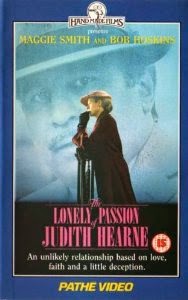
The Lonely Passion of Judith Hearne

Now for one of the greatest female performances on celluloid - up there with the very best. Maggie Smith is totally mesmerising and heart-breaking in Jack Clayton's 1987 THE LONELY PASSION OF JUDITH HEARNE where her every mood and gesture captures perfectliy the bleak existance of Miss Hearne in that Dublin of the early '50s. Let's just look at the vhs cassette blurb (there isn't a good dvd issue and what there is fetches silly money, so I had to re-connect my vhs player to play it). 

Two-time Academy Award winner Maggie Smith is Judith, a naive, abandoned spinster struggling to maintain her fragile dignity in a succession of shoddy Dublin boarding houses. Bob Hoskins is the younger man who enters her life with the apparent promise of love and companionship. But Judith's carefully constructed fantasy is shattered when her supposed suitor reveals his true motives. Falling back on the trusted escape routes of religion and alconhol only increases her desperation. Now Judith must face her "lonely passions" and in conquering them, summon up the spiritual courage to carry on. Or: A middle-aged spinster scrapes by giving piano lessons in the Dublin of the 1950s. She makes a sad last bid for love with a fellow resident of her rundown boarding house, who imagines she has the money to bankroll the business he hopes to open.

Taken from a highly-regarded novel by Brian Moore which was actually set in Belfast, but Dublin seems more appropriate here, Jack Clayton and scriptwriter Peter Nelson fashion this sad tale which stays with one, I am still moved by it today. Clayton of course has been great with actresses: Signoret in ROOM AT THE TOP, Kerr in THE INNOCENTS, Bancroft in THE PUMPKIN EATER (where Maggie Smith had that small eye-catching role...). Smith is in her element here, as the lady of slender means, whether settling into her new room, or later turning to drink, and then fearing she is losing her religion which keeps her going as she turns on the church and the priest trying to calm her. We see her life in the flashbacks, at the beck and call of her demanding aunt - the great Wendy Hiller (I KNOW WHERE I'M GOING) and being tolerated by relations like Prunella Scales (Mapp in MAPP AND LUCIA, Sybil in FAWLTY TOWERS). The boarding house is run by the great Marie Kean whom we like a lot (THE GIRL WITH GREEN EYES, I WAS HAPPY HERE, RYAN'S DAUGHTER, BARRY LYNDON, THE DEAD, THE IRISH R.M.).  We also observe the intrigues of the other boarders ...

Judith gives piano lessons, and discusses New York with Bob Hoskins who has returned from America, a man looking for money to fund his business ventures, as he takes Judith to the cinema (SAMSON AND DELILAH!) and she wants him to escort her to church - having a man by her side at mass is important to her. Once it all comes crashing down Judith hits the bottle and loses her students, spends all her savings and has a breakdown and slowly recovers, but what is she going to do now?  It is certainly heart-breaking and downbeat but also so human and mesmirising. I had thought THE PRIME OF MISS JEAN BRODIE was Smith's greatest role, but I am now sure its this unsparing portrait of a lonely spinster, one of the greatest performances I have seen. Everyone is superlative here and the period detail seems exactly right too. George Delerue did the haunting score - it its produced by George Harrison's Handmade Films company. One to keep and return to then.  I have had to order the book too - it was long mooted as a project for Deborah Kerr (who would have been fine here too in a good late role for her) and John Huston, instead we have Clayton's with a great actress at her peak. Smith then, after A PRIVATE FUNCTION and A ROOM WITH A VIEW and before Alan Bennett's TALKING HEADS (on TV again next week here for Bennett's 80th birthday tributes, but I have the dvd set) could do no wrong, either in these deeply intense roles or her camp, wrist-flapping comedy turns in CALIFORNIA SUITE, MURDER BY DEATH or EVIL UNDER THE SUN. She also tackled another serious role in 1972, but it did not quite come off ...

LOVE AND PAIN AND THE WHOLE DAMN THING. After Liza Minnelli in THE STERILE CUCKOO (or POOKIE) in 1969 and Jane Fonda as Bree in KLUTE, 1971, Alan J Pakula was THE director for actresses in fascinating films, and it is Maggie Smith’s turn here in 1972. At the time Smith could do no wrong after her MISS BRODIE hit, and stage successes at the National Theatre (HEDDA GABLER directed by Ingmar Bergman, THE BEAU’S STRATAGEM - both of which I saw twice, we saw her on the stage a lot in those 70s years) so why not an oddball romantic comedy, scripted by Alvin Sargent and directed by Alan J Pakula? 
The film though proved too oddball and I have never had a chance to re-see it until now (thanks, tim) … Timothy Bottoms (big after THE LAST PICTURE SHOW but not particularly charismatic) is the repressed young guy on holiday in Spain who wants to get away from his family of over-achievers, and she is the 37 year old repressed spinster – who may have a fatal disease. Both are kindred spirits and lonely souls, but it is rather excruciating watching them finally get together, with slapkstick scenes which do not work at all, like her being trapped in an outdoor toilet and getting toilet paper wrapped all around her legs …. At least the real Spain looks ideal here, well 40 years ago … finally, it does not end, but mercifully just stops. 
Dame Maggie has of course provided for her pension with the HARRY POTTER films and her enjoyable turns in DOWNTON ABBEY (via GOSFORD PARK), though we loathe her 'old folk' films like MARIGOLD HOTEL (there is a second one soon) and QUARTET - as per my reviews at Smith label.
Next: a great actor: Albert Finney in Huston's UNDER THE VOLCANO.

Tuesday, 8 January 2013

The Dead, 1987

John Huston's final film THE DEAD from 1987, details with loving attention to detail a Christmas dinner at the house of two spinster well-to-do sisters and their niece in turn-of-the-century Ireland, attended by friends and family. Among the visiting attendees are the sisters' nephew Gabriel Conroy and his wife Greta. The evening's reminiscences bring up melancholy memories for Greta concerning her first, long-lost love when she was a girl in rural Galway. Her recounting of this tragic love to Gabriel brings him to an epiphany: he learns how little he knows about his wife whom he loves dearly. 

"Think of all those who ever were, back to the start of time. And me, transient as they, flickering out as well into their grey world ... Snow is falling. Falling in that lonely churchyard where Michael Furey lies buried. Falling faintly through the universe and faintly falling, like the descent of their last end, upon all the living, and the dead".

John Huston's last film is a labor of love at several levels: an adaptation of one of the greatest pieces of English-language literature by one of Huston's favorite authors, James Joyce; a love letter to Ireland where he lived and his children grew up; and the chance to work with his screenwriter son Tony and his actress daughter Anjelica. Peter Viertel in his engaging memoir describes a typical weekend at the Huston home St Clerans in Galway (its a luxury hotel now) where Huston, when not away directing, living the life of the Irish country squire with his dogs and shooting and hunting ....Huston was - like Italy's Vittorio De Sica - one of those larger than life directors who gambled and hunted and acted in movies as varied as CHINATOWN, THE CARDINAL and utter tosh like DE SADE (Trash label) where he seemed to be enjoying himself hugely, as usual .... Viertel's novel  "White Hunter Black Heart" (which was filmed by Clint Eastwood) was about Huston filming THE AFRICAN QUEEN...

I was obsessed about Huston's THE MISFITS for a long time, I love his HEAVEN KNOWS MR ALLISON (Huston label) and those subsequent films THE UNFORGIVEN, NIGHT OF THE IGUANA, FAT CITY and of course his '40s triumphs like THE MALTESE FALCON and his early '50s oddities like THE ASPHALT JUNGLE, MOULIN ROUGE and MOBY DICK. Huston was such a maverick that his later oddities like THE KREMLIN LETTER in '69 are also worth seeking out. It was great to see him in person for the launch of FAT CITY at the NFT in 1972. THE DEAD set as it is on the 6th of January, is an ideal film for this time of year ...

As my friend Martin Bradley sets the scene: THE DEAD takes place on the Feast of the Epiphany in the Dublin of 1904. It is confined, largely, to one setting, the home of the Morkan sisters, and not a great deal happens in conventional 'dramatic' terms. They entertain their guests; there is singing, dancing, recitations and much small talk but watching this film you can't imagine anywhere else you would rather be than in this company.

Finally, of course, it is 'about' much, much more. It is about love, loss and regret, those stable mainstays of great drama. In the film's closing scenes the tenor Bartell D'Arcy (Frank Patterson) sings a song, 'The Lass of Aughrim' which conjures up in the mind of Gretta (Anjelica Huston) wife of Gabriel (Donal McCann) the ghost of her first and probably greatest love, a boy who died in all certainty of a broken heart at the age of seventeen, and suddenly Gabriel realises he has never really known his wife and that he has not been the great love of her life after all. Emotionally, these scenes are incredibly powerful, firstly as Gretta recounts the circumstances of her lover's death and then as the voice in Gabriel's head sums up his own feelings. This is great cinema, the monologues superbly delivered by Huston and McCann.

But then all the performances are extraordinary. This is ensemble playing of the highest order. Added poignancy is to be had, of course, from the knowledge that Huston himself was close to death when he made this film which seems to me the culmination of his life's work. Death may well be its central theme but viewing this film is a life-enhancing experience. 
There is also the great Marie Kean as Freddie Malins' waspish mother, while Donal Donnelly plays her son Freddie, the amiable drunk (both right), and the two sisters are ideally played by Helena Carroll and Cathleen Delaney; the cast also includes Dan O'Herlihy, Sean McClory and Kate O'Toole. Its a wonderful film that will leave you seeking out James Joyce's "Dubliners" collection of stories.

I shall soon be reporting on Huston's 1963 FREUD, long unseen, with Montgomery Clift and Susannah York, when discussing Montgomery Clift soon.