Dedications: My four late friends Rory, Stan, Bryan, Jeff - shine on you crazy diamonds, they would have blogged too. Then theres Garry from Brisbane, Franco in Milan, Mike now in S.F. / my '60s-'80s gang: Ned & Joseph in Ireland; in England: Frank, Des, Guy, Clive, Joe & Joe, Ian, Ivan, Nick, David, Les, Stewart, the 3 Michaels / Catriona, Sally, Monica, Jean, Ella, Anne, Candie / and now: Daryl in N.Y., Jerry, John, Colin, Martin and Donal.
Showing posts with label Rita Hayworth. Show all posts

Thursday, 16 June 2016

Blondes: Platinum or Strawberry ? Both !


PLATINUM BLONDE, this is an early talkie - 1931 - someone on IMDB said it was maybe the first romcom? The platinum blonde is Jean Harlow who is playing a rich dame, and she seems rather subdued from her usual brassy roles (as in DINNER AT EIGHT or RED DUST) and the other two leads are the marvellous young Loretta Young (whom I like a lot in her '30s films like MIDNIGHT MARY, LADIES IN LOVE etc, as per label) and the male lead is one Robert Williams, whom I had never heard of. Understandable, as he died (of peritonitis) that year, 1931, aged 34. This was in fact his last (of 6 films) and he is a rivetting presence here, and surely would have been a bigger star. It is an early Frank Capra picture too and its a real treat now. Its a must-see for several reasons. Jean Harlow is unusually cast as a straight society high-brow. Although the role could easily be played as a caricature, she brings to it appealing depth and vulnerability. 
Loretta Young is radiant. And Robert Williams delivers an eccentric modern day performance.

Williams is Stew Smith, a reporter who falls suddenly in love with rich socialite (Harlow) but soon gets bored with the rich life and wants to be back being a reporter again with Gallagher (that's Loretta) who really loves him all along and of course they end up happily together. Its a nice  snappy depression-era satire on the rich idle folk too. (Harlow of course died in 1937, aged 26 - while Loretta continued to 2000, aged 87.)

THE STRAWBERRY BLONDE (or LA BLONDE FRAMBOISE as the French DVD has it) was a pleasant memory from seeing it on television once, nice to finally get it on dvd, its one I will be returning to, more than once. Its an utterly charming comedy from 1941, by Raoul Walsh (script by Julius  J Epstein) with delightful turns from James Cagney, Olivia De Havilland, Rita Hayworth and Jack Carson, and it captures that 'gay nineties' perfectly. 

Biff Grimes is pugnacious but likable young man during the Gay 90's living with his ne'er-do-well father, noted for their scrappy personalities and quick tempers. Like every other young man in town, Biff has a crush on gorgeous and flirtatious 'strawberry blonde' Virginia Brush, who gets catcalls every time she walks past the all-male clientèle of the neighborhood barber shop. Biff is joined in his admiration by his friends, Nick Pappalis, an immigrant Greek barber, and Hugo Barnsfeld, an unscrupulously ambitious young man who doesn't let anything stand in the way of what he wants, including Virginia. Utilizing both fair means and foul Hugo sweeps Vrginia off her feet and frames Biff as the fall guy in a political graft schemee. However, every dog has his day, and eight years later Biff stands poised to take his revenge.

Cagney, in a change of pace, is the young dentist, always outwitted by pushy Carson, both fall for Virigina, the local beauty (Hayworth), but Carson wins her and they are both dis-satisfield. Olivia has a field day as the feisty feminist Amy and she and Cagney are the perfect pair, as Jimmy gets his revenge on bully boy Carson, who has a sore tooth. Alan Hale and Una O'Connor are dependable support. 
The BFI are showing it as part of their Olivia De Havilland retrospective in July, to celebrate her 100th birthday (I saw her there in person in 1972, as per label) and they say: "De Havilland shines as the free-thinking modern gal who falls for Cagney's brawling dreamer. He still yearns after Rita's flirtacious 'strawberry blonde' but its Olivia's Amy who will steal your heart in this romance that packs in comedy and drama.' The perfect 1940s Warner Bros package then. 

Wednesday, 3 February 2016

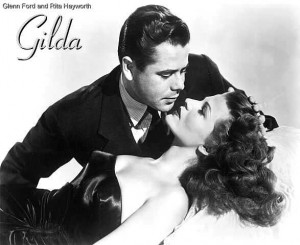
People we like: Glenn or Gilda ?

I had Glenn Ford pegged as one of those new post-war guys who came along after World War II - like Peck, Lancaster, Douglas, Mitchum - but, like his pal William Holden, Ford stole a march on them as he and Holden were in movies by the late 1930s - by 1946 Ford, after a busy time in genre movies, had worked his way up to co-starring with not one but two Bette Davis sisters in A STOLEN LIFE - then, came GILDA !

GILDA is a noir riot now - a fusion of sexual heat, jealousy, fear and hatred - terrific stuff!
Johnny Farrell is a gambling cheat who turns straight to work for sinister casino owner Ballin Mundson. But things take a turn for Johnny as his alluring ex-lover Gilda, whom he has come to hate, appears as Mundson's wife, and Mundson's machinations begin to unravel.
Ford's Johnny Farrell comes over like a sleazy punk on the make, down Argentina way, as he falls in with nightclub owner and racketeer George Macready - the two men seem to have an odd almost homoerotic relationship, and then Mundsen returns from a trip with his new wife: Gilda, an old flame of Farrell's and the sexual tensions build up, to that delirious climax. Rita is in her element here, and Glenn matches her all the way. It remains a key film noir set in that mythical 1940s world of nighclubs and casinos.

Ford has always been a person we like here, amiable (usually), unassuming, keeping busy shifting effortlessly between dramas, westerns, comedies - looking equally at home in a suit, military outfits or cowboy gear - but not in a toga or tights, like Bogart he just looked too modern for period films.  He seems curiously under-appreciated now, usually ignored by the fan mags, but was a busy actor right through the Fifties and into the mid-Sixties - and was effective as an ordindary, everyday hero.

Lang's THE  BIG HEAT in '53 and Brooks' THE BLACKBOARD JUNGLE in 1955 were two of the major dramas of the era, as well as more routine items like TRIAL, RANSOM, and the romantic INTERRUPTED MELODY. He and Gloria Graham were also back with Fritz Lang for HUMAN DESIRE in '54. His westerns included THE AMERICANO, JUBAL, THE VIOLENT MEN, 3.10 TO YUMA, COWBOY, THE SHEEPMAN, CIMARRON in 1960, and then there were comedies like TEAHOUSE OF THE AUGUST MOON (with Brando playing Japanese), two with Debbie Reynolds: THE GAZEBO and I remember IT STARTED WITH A KISS  being very funny.  He continued into the Sixties with two for Minnelli: the 1962 odd re-working of THE FOUR HORSEMEN OF THE APOCALYPSE and the charming THE COURTSHIP OF EDDIE'S FATHER in 1963. He was effective as the FBI agent in Blake Edwards' EXPERIMENT IN TERROR with Lee Remick, also 1962 - see Ford label, and the 1964 airline crash drama FATE IS THE HUNTER.  He was re-united with Bette Davis too (in a supporting role this time) in Capra's schmaltz-fest A POCKETFUL OF MIRACLES in 1961, before BABY JANE revived her career.  
I did not get a chance to see Delbert Mann's DEAR HEART in 1964, it played the lower half of double bills here, but it seems well regarded, with Geraldine Page and Angela Lansbury. (I've just had to order it ....). Ford's later westerns like THE ROUNDERS also ended up as the lower part of double features.  There were also several more with Rita Hayworth, though not quite in the GILDA class: AFFAIR IN TRINIDAD, THE LOVES OF CARMEN, and THE MONEY TRAP in 1965 - poor Rita did not last long in that one.  

Ford (1916-2006) lived to be 90, had a long career, with over 100 credits - his last major role being Superman's earth father in SUPERMAN in '78. His first wife was dancer Eleanor Powell and it seems he romanced a lot of hollywood ladies .... and was a decorated war hero too - receiving the French Legion of Honour medal.
Next: The Hardy boy .... and then "Mitchell Leisen - Hollywood Director"

Friday, 8 May 2015

Rita goes Zip

I hadn't realised how fabulous Rita Hayworth is in PAL JOEY, which I saw as a kid in 1957 and only saw bits of since, it was not on my radar as a top musical -- of course the stage show was so much better, including that London 1980s production with Sian Phillips mesmerising in Rita's role of the wealthy ex showgirl Mrs Simpson, whom Sinatra's Joey sets his sights on to fund his new nightclub ... until Kim Novak gets in the way ...
It is perhaps Rita's last good role - she is excellent but somehow out of place in SEPARATE TABLES in 1958, and she and the equally ageing Gary Cooper are touching (two of the 1930s beautiful people ravaged by time) in THEY CAME TO CORDURA in 1959. She was Claudia Cardinale's sad mother in the John Wayne circus extravaganza CIRCUS WORLD in 1964, and had a few scenes with her old co-star Glenn Ford in a forgotten thriller (it was a supporting movie here) and her later films are curious cult movies now ... but she symbolised the 1940s for many - as per this BFI 1940s season back in 1970 (as per label 1940s-A)
Rita of course will always be GILDA ... but she is perfect here too and plays Mrs Simpson with a nice teasing quality - love her shower scene!. The film at least captures One-Take-Frank at his 1950s zenith, while Kim in lavender as the vulnerable showgirl looks edible  1957 was a great year for musicals: FUNNY FACE, LES GIRLS, THE PAJAMA GAME, SILK STOCKINGS etc, PAL JOEY while fun is not quite as good. 
John Kobal wrote a terrific book on Rita: "The Time, The Place and The Woman". 

Thursday, 8 January 2015

Return to Tiffanys with Pal Joey

Apartments we love - hey, thats an idea for a post: BREAKFAST AT TIFFANY'S
Lazy afternoon on sofa, nursing a cold, with a divine double bill on television - well, it saves digging out the dvds. I can watch BREAKFAST AT TIFFANY'S any time and PAL JOEY was fairly new to me, not having seen it in years. Here's what I did on TIFFANY'S a year or two back ....
I can never resist another look at BREAKFAST AT TIFFANY'S whenever it screens, and so it was again yesterday. One can look at it for so many reasons: Audrey, the wit, romance, Capote, Blake Edwards' sure direction, its a great New York Movie etc. This time I focused on the cat -
who gets quite a bit to do in it. I wonder what this cat who lived 50 years ago made of it? He (or she) is put out in the rain, thrown around, and sits and observes. It is a great feline performance.
Who can resist that climax when Cat miows and Holly picks him up and Cat is crushed between them as they kiss in the rain and the heavenly choir soars - did two people ever look better in the rain? - they must have used glycerine or suchlike. .... 
TIFFANY'S remains one of the imperishable hits of 1961 along with THE MISFITSTWO WOMENONE EYED JACKSCOME SEPTEMBER ... That ending though: in Capote's novella Holly does go off to South America, and the gay (we understand) narrator keeps looking for the cat, and finds him one afternoon, sitting happily in the window of someone else's apartment. That is perfect too but the movie went for the softer option. Its still an iconic early '60s classic ... then there is Patricia Neal's "stylish girl" waving her chequebook and coming on like a vampiric dragon lady ... Audrey oddly reminds me a lot of Kay Kendall in her early zany scenes, waking up, getting ready to go out etc. Kendall had died 2 years previously in 1959, and she and her sister were showgirls in revues in early '50s London, as was Audrey, and I understand they all knew each other.
1957's PAL JOEY is also a sanitised version of the John O'Hara original - it was a terrific stage musical in London in the 80s with Sian Phillips dynamic in the Hayworth role and those Rodgers & Hart songs. This is 1957 though but at least Sinatra looks at his peak here as the heel with that hat and the coat slung over his shoulder. Rita Hayworth is delicious as Mrs Simpson the ex-showgirl/rich bitch who bankrolls Joey's nightclub but on her terms, while Kim Novak, nearing her zenith (as she would do next year 1958 with VERTIGO and BELL BOOK AND CANDLE) gives her showgirl a sad quality that is just right,
 and then there is that adorable pooch. San Francisco is the back-drop, Barbara Nicols is a brassy showgirl and the numbers include Kim miming "My Funny Valentine", Rita also mimes the zingy "Zip" and "Bewitched /Bothered and Bewildered" while showering - dig that ritzy shower ! Then Frank sings "The Lady Is A Tramp" and we are watching another iconic moment. Musicals veteran Charles Walters keeps it moving nicely. 1957 was a great year for musicals: THE PAJAMA GAME, LES GIRLS, SILK STOCKINGS and this .... we like them a lot.  Lots of ritzy clothes too - Kim looks edible in that lavender dress, and those gloves ! ..... while Rita sizzles in some Jean Louis creations.

Saturday, 13 September 2014

Separate Tables, 1958

Terence Rattigan's 1954 play SEPARATE TABLES is a Fifties time capsule now, capturing as it does that genteel Bournemouth hotel with its residents at their separate tables ... the play is in two acts, with the main two leads playing different characters in each act, the other residents stay the same. In the original production it was Eric Porter and Margaret Leighton. But the Hecht-Hill-Lancaster production team when they made the popular 1958 film in Hollywood, combined them both into one continuous narrative, thus 4 stars were required for the main 4 characters, who are now Burt and Rita Hayworth, and David Niven and Deborah Kerr. This required a lot of dexterous pruning of the original script, which Rattigan himself did with John Gay and an uncredited John Michael Hayes. 
In the theatre when played as two acts, the acts are 18 months apart time-wise, but in the film we are in the continuous timeframe of the first act. This means a lot of the young couple (Rod Taylor and Audrey Dalton, below right) has been removed, and new material inserted, like scenes between Sybil and Mrs Shankland (Kerr and Hayworth) (who do not meet in the two separate act orginal).
The young couple stay as we see them in the first act - but in the second act of the play (18 months later) they are now married with a baby, which takes up all the mother's time - she sides with dragon-lady Mrs Railton-Bell to get the bogus Major, who has been exposed as a fake and a pesterer of women at the cinema, expelled from the hotel. Her husband does not agree and sides with the other residents. It makes for more interesting drama, but all that has to go for the film. 

There is a lot more of Miss Cooper, the hotel manageress, too in the play, but Wendy Hiller managed to scoop Best Supporting Actress for her role in the film. Niven of course won the Best Actor, but it seems a blustering fake performance, but then he is playing a blustering fake. Kerr is marvellous as the downtrodden Sybil, who finally stands up to her bully of a mother - Gladys Cooper being very malevolent here, as she was to Bette Davis in NOW VOYAGER. Hayworth and Lancaster add the Hollywood gloss and are perfectly adequate. The film is one of 1958's big enduring ones, up there with I WANT TO LIVE!, THE DEFIANT ONESTHE BIG COUNTRY, THE VIKINGS, SOUTH PACIFIC, AUNTIE MAME etc. 

I have seen a few other productions - John Schlesinger directed that 1983 television film, long unavailable, which goes back to the two act structure, with Julie Christie and Alan Bates (ther fourth teaming) playing both sets of leads, with Claire Bloom perfect as Miss Cooper, and Irene Worth, a monstrous suburban bully, as Mrs Railton Bell. Liz Smith shines too as the racing-mad spinster and Brian Deacon (from THE TRIPLE ECHO) as the young husband. - as per my fuller review, at Rattigan/Bates/Christie labels, which also goes into another version of Rattigan's work ...

I have now seen a BBC 'Play of the Month'  production of the play from 1970 with Porter and Geraldine McEwan in the lead roles. It is perfectly satisfying but a bit low-key. It is part of the BBC Terence Rattigan boxset (a nice companion to the Noel Coward boxset, again with interesting productions which I must return to), which also includes part of another version I saw on stage in the 70s, with John Mills and Jill Bennett. (As we mentioned previously, Rattigan's original text had the major pestering men in the cinema, but that would never have played back in the Fifties... and certainly not in the film, which suggests there is a future for the Major and Sybil).  

I also saw Rattigan himself at the BFI giving an entertaining talk also in the early 70s. The 1958 film though, directed by Delbert Mann, is the version most people know and like, even though it does not do full justice to the play and Rattigan's plea for tolerance for those who are 'different'. 

Wednesday, 10 September 2014

"The High 40's"

When we think of the Forties now...
English film magazine SIGHT AND SOUND has kindly given me permission to quote from an article, "The High 40's", in their Autumn 1961 issue. It is about cinema-going in the Forties by the esteemed critic and author John Russell Taylor. Taylor (10 years older than me) wrote this when he was in his mid-20s and of course in 1961 (53 years ago!) the 1940s were just over a decade in the past (rather like us looking back at films of the 1990s now) .... so people of his age did their early cinema-going in the 40s. 
I am a '40s baby myself, born in December 1945 just after the war - but I am a child of the '50s as my movie-going began in 1954, when I was 8, as per previous posts here. John Russell Taylor makes some marvellous comments, which I wanted to share ...... as he begins:

Who went to the pictures in the Forties anyway? Well, of course, everyone did. Women in turbans heading for night shifts shouldered their way in to weep, among the sleeping soldiery, over the sufferings of Joan or Greer. Sailors on leave sat goggle-eyed, imprinting on their memories the images of Betty Grable and Alice Faye to warm the long winter evenings at Scapa Flow…… and needless to say everyone spent at least some of the time saved from dodging doodlebugs in London patiently queueing to catch the afterglow of a vanished Thirties glory in GONE WITH THE WIND...

The Forties were a woman’s world if ever there was one: the real men might be off at the war, but women were guarding the Home Front and in the front line were to be found all the great survivors, led of course by the indomitable trio of Bette, Barbara and Joan. When it came to an all-out woman’s picture none of the relative newcomers could better them, and only Greer Garson managed a look-in, largely be inventing her own genre and suffering in the cause of humanity instead of merely love or money ... There were any number of temptresses, who can forget Joan Bennett ordering Edward G. Robinson to paint her toenails in SCARLET STREET

He goes on to discuss the essential stars of the '40s - Veronica Lake with Alan Ladd in their noirs, were they as good as Bogart and Bacall? and Maria Montez, star of all those exotic sand-and-sandal movies - as essentially 40s as Betty Grable, Carmen Miranda or Hedy Lamarr. He also discusses the everyday movies audiences saw back in the 1940s, at those fleapit cinemas during wartime, as opposed to the Hollywood classics which is what most people see of the '40s now - the CASABLANCAs and GILDAs, DOUBLE INDEMNITY, MILDRED PIERCE, LAURA and CITIZEN KANE, and those "Bette Davis classics", when the Hollywood dream factory in full flow with items like MEET ME IN ST LOUIS and MRS MINIVER as the war raged in Europe where dreadful things were happening, and of course out East and in the Pacific. The Forties was perhaps the last great decade for cinema, which was popular entertainment then, before television began to make inroads in the '50s. - everyone just went to "the pictures", some several times a week as most towns had several cinemas. 

My mother particularly liked Alice Faye singing "You'll Never Know" in HELLO FRISCO HELLO (she used to sing it to us), and RANDOM HARVEST, men like Ronald Colman and Walter Pidgeon were the kind of reliable men housewives liked; she continued going to the cinema less often into the early '60s, by then television provided all the entertainment the family needed.

Taylor's article reminded me of Alan Bennett in one of his memoirs, recollecting his aunts, working career girls who modelled themselves on Bette and Joan, in their swagger coats, "consulting the mirror in their power compact" and straightening their nylon seams, as they dished out putdowns to the men who presumed on their favours ... 

The Forties now seem to fall into two distinct eras: The War Years up to 1945, and then that Post-War Era. The British cinema captured the 1940s wartime perfectly in items like 2,000 WOMEN, and that post-war era in HOLIDAY CAMP, IT ALWAYS RAINS ON SUNDAY etc (British label). It was the great era of Lean and Michael Powell and Carol Reed, as well as those Gainsborough melodramas (CARAVAN, MADONNA OF THE SEVEN MOONS, THE WICKED LADY) and Anna Neagle-Michael Wilding romances which wartime audiences lapped up. There were those new post-war leading men too as Gregory Peck, William Holden, Mitchum, Lancaster, Douglas came to the fore, as well as new girls Susan and Ava, Deborah and Jean, and Janet - who would all be leading names in the Fifties. The older stars like Gable and Stewart came back from the war and resumed their careers too - "Gable's back and Garson's got him"! while Stewart starred in the new immortal IT'S A WONDERFUL LIFE. Later films capturing that Forties British wartime were led by Schlesinger's YANKS in 1979, capturing the look and mores of wartime Britain perfectly, as did Frear's A PRIVATE FUNCTION for the post-war era. 

My own early '40s favourites included Ty Power and Gene Tierney in the South Seas in SON OF FURY, and Ida Lupino as that very hard-boiled chanteuse in ROADHOUSE (with Richard Widmark in manic mode), or Linda Darnell in any number of films, 
and those noirs with rootless drifters in those diners and rooming houses as dark secrets unfold... (which I caught up with at Sunday matinees in the '50s).

I did a piece a while back, on a season on the 1940s which the then National Film Theatre (now the BFI) ran in 1971 - again, only 22 years after the 1940s finished, and over 40 years ago now - but I still have the brochure (left) and I listed what they showed then - as at 1940s-A label. 

Mr Taylor wrote a terrific guide to THE HOLLYWOOD MUSICAL, with John Kobal, and other titles I remember like CINEMA EYE, CINEMA EAR, and books on Hitchcock and various others like Welles and Vivien Leigh. He moved to California to teach film at the University of Southern California. He was also the last editor of my favourite magazine "Films & Filming" from 1983 to its closure in 1990. There is an interesting profile on Dirk Bogarde by him, at this link:  

It has been fun going through the old editions of SIGHT AND SOUND and "Films & Filming" which I acquired recently, issues from before my time, from the 1950s an early '60s ... so much nostalgia there to recap. (SIGHT AND SOUND of course is still published every month, as the mouthpiece of the BFI - I wrote on their new Top 100 Films, a year or two ago - Hitchcock label), but "Films & Filming" ceased in 1990, as I worked there for a while and knew the owner and have a lot of back copies, I feel I keep their legacy alive...).

Soon: Back to the 1930s and GOLD DIGGERS OF 1933 - only 80 years ago ! 

Wednesday, 1 May 2013

Rita/Gilda + Stamp, York, new Pedro & Ozon ...

The BFI (British Film Institute) next turn their attention to '40s Love Goddess Rita Hayworth (1918-1887), with again, a paltry selection of her films, just 10 and the most obvious titles one could imagine ... I love Hawks' ONLY ANGELS HAVE WINGS, followed by ANGELS OVER BROADWAY, BLOOD AND SAND, YOU'LL NEVER GET RICH, YOU WERE NEVER LOVELIER, COVER GIRL, GILDA, THE LADY FROM SHANGHAI and just 2 from the '50s: PAL JOEY and SEPARATE TABLES.

Perhaps her '50s output was variable (SALOME, MISS SADIE THOMPSON etc) - compared to her contemporary Lana Turner - and she certainly did nothing much of value during the '60s and later (I endured some of her later ones a while back: I BASTARDI, and THE ROVER and ROAD TO SALINA, where she was certainly diminished).  
Back in her heyday it was of course a different story. She is perfect with Astaire, being a great dancer herself. She is terrific too in PAL JOEY, with her younger rival Kim Novak and as Sinatra sings "The Lady Is  A Tramp" to her....
I particularly liked the older Rita and Gary Cooper, two once beautiful people, showing their frailties in Rossen's THEY CAME TO CORDURA in 1959 ....
We will always though have GILDA .... one to re-view soon. Film historian and archivist John Kobal caught her perfectly in his labour of love "The Time The Place And The Woman".
Those 2 '60s boys we liked: The BFI's Terence Stamp season is now underway, as per my post on that recently (Stamp label).

Michael York has been in the news too, having confirmed he is indeed suffering from a rare blood disease, hence his recent unwell appearances on that dvd interview, and the recent CABARET reunion - as per York label. But despite the illness, which has seen York undergo a stem-cell transplant, he remains positive about his future.“I know this can be deadly, but I never gave up. I am thrilled at this reprieve and want to do as much as I can to make it better.”  We wish him a speedy recovery.
Good news for European movie fans ... the new Almodovar I'M SO EXCITED opens here this week (and seems to be his first out-and-out comedy since 1988's WOMEN ON THE VERGE OF A NERVOUS BREAKDOWN (another must re-see soon...), though it does poke fun at Spain's current economic problems, those dancing camp air stewards seem hilarious in the trailer, it is of course set on an airplane. Pedro was great value on the UK Graham Norton show last week .... early reviews though have been negative - seems the movie "is disappointing only in the way bad movies by great directors are"..and not as bitter as his previous SKIN I LIVE IN or BROKEN EMBRACES but for his 19th feature I think Pedro is entitled to have fun and let his hair down .... a good camp tonic is just what we need !
while Francois Ozon's (below) current IN THE HOUSE is currently still playing and doing good business.We are looking forward to these ...
Next up: back to those 60s dramas: 2 more Brando's: Chaplin's comedy A COUNTESS FROM HONG KONG with Loren, and Huston's REFLECTIONS IN A GOLDEN EYE with Taylor and Harris; and 2 Simone Signorets: Kramer's SHIP OF FOOLS and Lumet's THE DEADLY AFFAIR. We also have Lumet's last film: BEFORE THE DEVIL KNOWS YOU'RE DEAD, which passed us by completely ...+ Almodovar's THE SKIN I LIVE IN.

Thursday, 1 April 2010

The '40s

A quick look at some choice '40s items .... left is the programme for a season of '40s films by the London National Film Theatre in 1971 - this would have been 21 years after the '40s finished, I was 25 then so of course wouldn't have remembered the '40s (my cinema-going began in 1954 when I was 8), but for older people in 1971 looking back at the '40s must be like us recalling the films of the '80s now ... [this NFT season is itself almost 40 years old now! - how quickly decades fly by...]

Looking at the programme it aims to capture the "flavour" of the '40s - what people went to see on a regular basis, as opposed to the classics which are all we see of the '40s today - so it has ABBOTT AND COSTELLO MEET THE KILLER and SUN VALLEY SERENADE along with THE PHILADELPHIA STORY and CASABLANCA, LASSIE COME HOME as well as THE MALTESE FALCON, it celebrates Sonja Henie, Ester Williams and Carmen Miranda as well as GILDA (no LAURA or MILDRED PIERCE though...) Bette is represented by NOW VOYAGER, Joan by HUMORESQUE, Stanwyck by BALL OF FIRE, there's LADY IN THE DARK, THE ROAD TO MOROCCO, SULLIVAN'S TRAVELS, THE UNSUSPECTED, MRS MINIVER, MR BLANDINGS, ZIEGFIELD FOLLIES, THE YEARLING, GOING MY WAY, THE LOST WEEKEND, SINCE YOU WENT AWAY, FAREWELL MY LOVELY, WALTER MITTY, THE BEST YEARS OF OUR LIVES, DUEL IN THE SUN, THE GANG'S ALL HERE and A LETTER TO THREE WIVES among the 40 chosen, so I suppose its quite representative - no DOLLY SISTERS though! Here though are a few recent choice under-rated '40s items which were quite fun to see now:

ESCAPE. This 1940 melodrama seems quite unknown now - directed by Mervyn LeRoy it is one of Norma Shearer's last films and she is not really the lead here and in fact does not feature in the strong central section where Robert Taylor is trying to rescue his mother, a famous actress (played by the famous Nazimova) from a concentration camp where she is due to be executed. It must be one of the first hollywood anti-Nazi films to feature concentration camps. It gets very melodramatic as the mother has to be given a drug to make her seem dead and then the coffin has to be opened by the guards .... the Nazis are shown as a bit dim and the locals are all too terrified to help Taylor who arrives in Bavaria to look for his mother who has disappeared. Norma as the Countess initially offers to help but she too must protect herself, particuarly as her lover is German general Conrad Veidt (practically the same role he plays in CASABLANCA 2 years later) who soon suspects something is wrong. The ending seems rather rushed but its certainly engrossing now - who though is Ethel Vance whose novel it is based on is shown at the start as though it is a major work?

Other early '40s films showing the Nazi menace would include McCarey's oddity ONCE UPON A HONEYMOON in 1942 with Cary Grant having to rescue Ginger Rogers as the American married to general Walter Slezak; Lubitsch of course makes fun of the Nazis in the immortal TO BE OR NOT TO BE, MRS MINIVER shows the plucky Hollywood British, and my favourite: Borzage's THE MORTAL STORM with James Stewart and Margaret Sullavan resisting the Nazi menace in Austria in 1940. This is a real charmer and totally engrossing.

Then there is GOLDEN EARRINGS made after the war in '47 - is it a comedy, a romance or a thriller? perhaps a bit of each then as Ray Milland is on the run in Germany presumably before or during the war and has to depend on gypsy Marlene Dietrich to help him get around the country. Its actually quite amusing as directed by Mitchell Leisen and Marlene is droll in her gypsy makeup and not playing a heartless vamp for once. Bland Milland is dull - the stars did not get on - I read that Marlene sucked the eye out of a fish-head from her her stewpot during his first closeup to disconcert him. Again we get lots of comic Nazis and they do not seem to mind the gypsies roaming around or telling their fortunes - or maybe the gypsies were not being rounded up just then ! You have to laugh at the end: he comes back after the war and there is Marlene with her gypsy caravan as though he had left just a few minutes before...

One '40s routine actioner which I loved when I saw it as a Sunday matinee as a kid is the 1942 adventure yarn SON OF FURY - John Cromwell's terrific tale with Tyrone Power in 18th century England falling foul of scoundrel George Sanders and escaping to the South Seas, cue Gene Tierney at her most alluring but Ty has to return with his riches, Frances Farmer as Sanders' daughter is more interested in his pearls, Elsa Lanchester has a touching role, and there is a terrific final duel [Ty had his fatal heart attack duelling again with Sanders in 1958...]. Its all sheer delight and one of Power's best, up there with Flynn's THE SEA HAWK or pirate romps like THE BLACK SWAN or THE SPANISH MAIN.

FALLEN ANGEL - Otto Preminger's 1945 little noir was a treat recently, perfectly capturing that mid-40s Californian small town underworld of diners and rooming houses, as drifter Dana Andrews arrives at that seafront diner where young voluptuous Linda Darnell holds sway over the customers, who include a jealous Charles Bickford. Then there is Alice Faye - odd to see her in a downbeat non-musical black and white role which rather diminishes her - and her severe sister Ann Revere. Mix it all up, include a murder, sit back and enjoy.

ROADHOUSE. I was pleased to see this finally on dvd, its one noir I really liked when saw it as a revival when I was young. Jean Negulesco's 1948 drama is engrossing, tense and exciting and is one of Ida Lupino's best. She is the very hard-boiled chanteuse who arrives at the roadhouse managed by Cornel Wilde whose best pal and boss Jefty (Richard Widmark at his baddest) has hired Ida to sing. Cornel doesn't play ball - Jefty has a habit of hiring dames and Cornel has to get rid of them, but Ida is sensational. A romance follows while Jefty is away, observed by cashier Celeste Holm who of course pines for Cornel. It all gets very tense as Jefty returns and goes predictably over the top and ends with them on the run from berserk Widmark. Its a pleasing late '40s Fox film which really delivers.

The '40s though for me also includes British films - the decade would be unthinkable without those Michael Powell, David Lean or Carol Reed classics, as well as those Gainsboroughs and Ealing comedies. More on those later .... plus De Sica and the Neo-Realists.