Dedications: My four late friends Rory, Stan, Bryan, Jeff - shine on you crazy diamonds, they would have blogged too. Then theres Garry from Brisbane, Franco in Milan, Mike now in S.F. / my '60s-'80s gang: Ned & Joseph in Ireland; in England: Frank, Des, Guy, Clive, Joe & Joe, Ian, Ivan, Nick, David, Les, Stewart, the 3 Michaels / Catriona, Sally, Monica, Jean, Ella, Anne, Candie / and now: Daryl in N.Y., Jerry, John, Colin, Martin and Donal.
Showing posts with label Simone Signoret. Show all posts

Tuesday, 31 January 2017

Italian rarity: Adua & her friends - hungry for love

Another Italian rarity, one I had not heard of until recently. How could a film featuring Simone Signoret (just after her ROOM AT THE TOP success and Academy Award) and Marcello Mastroianni (just after LA DOLCE VITA) be so unknown?, and also with French actress Emmanuelle Riva (just after HIROSHIMA MON AMOUR) who died last week aged 89. It was released in the UK at the time, titled HUNGRY FOR LOVE, which must have lured in the "dirty mac brigade".

ADUA AND HER FRIENDS (ADUA ET LA CAMPAGNE) When a brothel closes because of new laws, four of the prostitutes decide to go into business running a restaurant. They discover they cannot escape their past.

This story of four prostitutes forced to fend for themselves when a new law closes the bordellos of Rome has the required gritty social realism, but there are scenes of happiness and humor too. They pool their savings to open a trattoria, but find they cannot get a license. A prominent fixer with connections obtains the license for them, on condition that they conduct their old business upstairs and pay him an exorbitant monthly fee. The women are not anxious to turn tricks for a living any longer and find joy in running the restaurant. The women long to settle down -- one (Riva) has a child, another meets a man who loves and wants to marry her. Only one  (Sandra Milo) is tempted to return to her old life. Signoret, the major character here and as wonderful as ever as the worldly-wise Adua - but she too is a fool for a no-good man. Enter Mastroianni as a glib car salesman, hustler and womanizer. While the trattoria is a success, it does not bring in the kind of money demanded by their "patron," which leads to conflict. In this genre, happy endings are rare.
The girls end up exposing their pimp who wants them to resume their old business, using the restaurant as a cover, and they are all exposed in the papers. Society does not give girls like them a second chance, The last scene,  with the girls back on the street in the rain, is suitably right and downbeat. Signoret as Adua though is so enterprising and attractive it is hard to believe her wet, bedragged prosititute would be overlooked for a younger girl.

Nicely directed by Antonio Pietrangeli, I have seen several of his lately, who died early at age 49. This one won Best Italian Film of the Year at Venice in 1961. (See I KNEW HER WELL. below).
1960 was certainly a year for prostitution in the cinema: NEVER ON SUNDAY with happy hooker Melina, BUTTERFIELD 8 and GO NAKED IN THE WORLD with Liz and Gina both taking a tumble at the end (at least Liz got that Oscar), THE WORLD OF SUZIE WONG, GIRL OF THE NIGHT, and Shirley Jones winning an Oscar in ELMER GANTRY - now there's ADUA AND HER FRIENDS!
It was of course that strange era of strip clubs and clip joints, as exemplified by EXPRESSO  BONGO, TOO HOT TO HANDLE, PASSPORT TO SHAME, THE WORLD TEN TIMES OVER, BITTER HARVEST, THE BEAUTY JUNGLE etc, and glamour girls like Diana Dors and Belinda Lee (SHE WALKS BY NIGHT, 1959) before the new permissiveness of the dawning Swinging Sixties. Bardot in Paris was mining a similar seam with steamy items like LOVE IS MY PROFESSION and LA VERITE.

Saturday, 19 July 2014

The cat's miouw !

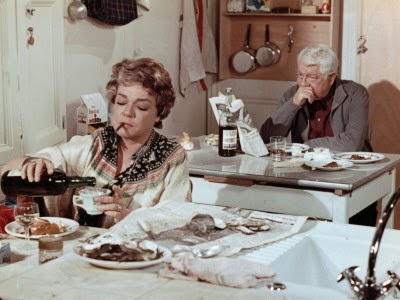
LE CHAT (THE CAT), 1971. A masterclass in screen acting from two of France’s greats: Jean Gabin and Simone Signoret in this version of a Simenon novel as directed by Pierre Granier-Deferre.  Julien and Clemence are a long-married couple who now seem to detest each other and share their house without talking – he has transferred his affections to his cat. Their state of war exists as the neighbourhood around them, in suburban Paris, is pulled down and their own house is due for demolition too. Each shops for themselves as their feud escalates. Clemence worked as a circus acrobat but now has a limp, while he becomes every more grumpy and isolated. Events come to a climax with a gun – she shoots the cat, which he puts out with the rubbish! Then he moves out to stay with Annie Cordy at her hotel but he is no happier as Clemence hangs around the streets watching him. He moves back but then tragedy strikes …. 

It is an absorbing drama with both stars note-perfect, at first I thought it was shaping up to be a savage black comedy, but then it just gets sombre and grim as we reach a very downbeat ending. Granier-Deferre (who was married to Susan Hampshire in the '60s), like Claude Miller, made several absorbing dramas and entertainments without ever getting the kudos of the Truffauts. (Trintignant and Romy Schneider are both terrific in his THE LAST TRAIN, review at French label and I have his LE VEUVE COUDERC, another Simenon, with Delon and Signoret, to watch),. This one does not disappoint either. 

Sunday, 11 May 2014

Showpeople - another batch of fab photos

I have loved WHATS NEW PUSSYCAT? since I was 19 in 1965, as per other reports here, but had not seen this group pose before ! 
Rock, Cary, Marlon, Greg Peck - what are they watching? Who is the odd one out? - Peck, no gay or bi- rumours about him!
LET'S MAKE LOVE again, with the Montands and the Millers - see previous post with Frankie Vaughan.
 Audrey and Capucine stepping out with Givenchy in 1972.
Marilyn and Elizabeth Taylor - maybe the only time they ever photographed together or in the same room - at Sinatra's concert at The Sands in 1961. Below, is another shot, with Peter Lawford on stage.
One I had not seen before: Rock and Sophia in the early 60s. He filmed with Gina (twice) and Claudia, but never with Loren ...
Sophia - smoking! -  with Greg in 1962 when she presented him with his Oscar, and in 1993 when he presented her with her second one. 
And once again, that amusing shot of them with Joan Crawford and Maximilian Schell back in 62 .... as per other reports here.
And thst glamorous Royal Film Performance lineup in 1966, with Julie Christie, Leslie Caron, Warren, Catherine Deneuve, Christopher Lee and Ursula Andress .... 
And this FUNNY LADY Royal presentation ... Barbra, Caan, with a re-united James Stewart and Lee Remick ...

Friday, 7 February 2014

'60s rarities continue: The Sea Gull

Finally, the 1968 film of Chekhov's THE SEA GULL is available (a no-frills Warner Archive all region release). This has been one of my holy grails - as it never appeared anywhere here in the last 40 years or so. Hard to fathom why, as its a Sidney Lumet film with a stunning cast of the time. James Mason, Simone Signoret, Harry Andrews and David Warner (briefly) had all appeared in his 1967 London thriller THE DEADLY AFFAIR, and here they are again for this film of the Chekhov play.

Love yearned for and love cast aisde. The powerful, all-star film version of Chehov's classic. A brilliant cast brings playwright Anton Chekov's masterpiece of the capricious power of passion to the screen. The story is set during two gatherings, two years apart, on the same Russian country estate and among six lovers, most of whom are not loved in return. Those who are hard-shelled and wordly shrug off romantic disappointment. Those who are not, cannot ... and tragedy ensues. With direction by Sidney Lumet (NETWORK, DOG DAY AFTERNOON, THE VERDICT) and the talents of James Mason, Vanessa Redgrave, Simone Signoret, David Warner, Denholm Elliot and more lights of film and stage, THE SEA GULL resonates with profound emotion.

That's the dvd blurb. I am not familar with this play, but know Chekhov's THE THREE SISTERS (Theatre label) very well, from various productions (Janet Suzman and Joan Plowright were ideal Mashas, but the best one and still vivid in my memory is a 1968 production at London's Royal Court with Glenda Jackson ideal, and the young Marianne Faithfull a radiant Irina). Also, having last seen Vanessa Redgrave as the dying wife of Terence Stamp in last year's SONG FOR MARION (review below) another of those tedious movies for the older generation, it is marvellous to go back and see her in her '60s prime here.

First of it, it looks lovely (as staged by Tony Walton, and photographed in Sweden by Gerry Fisher), set in that countryside by the lake, with the woods and the trees and that country house estate where they gather to watch the play, which the bored mother, actress Arkadina, soon interrupts. Konstantin the son (David Warner) is distraught, he loves Nina who was playing on stage, but she gets to meet Trigorin (James Mason) the companion of Arkadina (we earlier see him sleeping naked in bed, while she sits at her dressing table). Arkadina is visiting the estate of her brother Sorin (Harry Andrews), and also to hand is Alfred Lynch (WEST 11- London label) as the schoolteacher who is in love with Masha (Kathleen Widdoes, from Lumet's THE GROUP) - the one who wears black as she is in mourning for her life - daughter of the estate bailiff Ronald Radd. Eileen Herlie is the bailiff's wife, and also to hand is Denholm Elliot, a doctor, sporting an odd wig. We spend the first act watching them gather and interact as Konstantin stages the play. Vanessa's Nina is spellbinding and luminescent here, and Warner suitably intense. The last absorbing if melancholy act takes place two years later ...

Lumet had already done the highly-regarded 1962 film of O'Neill's LONG DAY'S JOURNEY INTO NIGHT, among other successes, but somehow comes a cropper here, as it all gets tedious, there are long speeches shot with few close-ups, with some odd casting choices, the chief one being that Simone Signoret with her Franch accent seems all wrong here, playing with her English brother and son. Pauline Kael's long review came to hand in her book "Going Steady" so let's quote a bit: she calls it a badly-filmed play as characters playing educated middle class and professional people - mixed with bohemians - mingle just before the turn of the 20th century. They are beset by financial problems (the schoolteacher does not earn enough), unrequited love, unrealised aspirations, they indulge in unhappiness and nostalgia and despair. Signoret's accent gives her lines the wrong shadings and emphases. Because her style isn't in tune with the others and because her lines sound heavy, Arkadina loses her charm and becomes the villainess of the piece - a selfish, stingy, son-devouring Freudian mother. And every time this monster speaks she stomps on the remnants of the fragile play. But its interesting to see actors wrestling with real roles, even when the actors are wrong for them. Simone Signoret is bad here, but she is still Simone Signoret. And THE SEA GULL is a terrible movie, but it is still a movie of THE SEA GULL". (Signoret though was terrific in SHIP OF FOOLS, GAMES, THE DEADLY AFFAIR, ARMY OF SHADOWS in those years).
Well that certainly gives one food for thought when watching Lumet's film, at least it is in circulation again. (Kael is also very pertinent on another Lumet filmed play, Arthur Miller's A VIEW FROM THE BRIDGE from 1961, which I may get around to soon too). Maybe time soon for Chekhov's other drama of loss and regret UNCLE VANYA ...

Next: Another rarity, Maximilian Schell's 1970 film of Turgenev's FIRST LOVE (more Russian costume drama angst), plus Warner & Redgrave again in MORGAN A SUITABLE CASE FOR TREATMENT in 1966, and Warner as MICHAEL KOHLHAAS in 1968, Sophia Loren as MADAME SANS-GENE with Robert Hossein in '61, and our 1962 favourite THE CHAPMAN REPORT, also finally on dvd - all more '60s rarities; plus Terry and Julie again (AWAY FROM HER and THE LIMEY) and back to Peplums with HELEN OF TROY.

Monday, 30 December 2013

Malibu party people, 1965

Roddy McDowall's Home Movies
On another wet, windy, squally bad weather end of the year day, how nice to look back at May 1965, early summer in Malibu, and all those beach people enjoying themselves, in their preppy clothes - white slacks, stripey tops, swimwear, as we join Julie Andrews on the beach with a child, Lee Remick is here several times, also James Fox and Jane Fonda (they were filming THE CHASE at the time), also Natalie Wood, Robert Redford, Ruth Gordon with Garson Kanin (they were filming INSIDE DAISY CLOVER then with co-star Roddy McDowell). Look, there's Simone Signoret and Lauren Bacall (fabulous in yellow), both holding court, also Susanne Pleshette twice, Hayley Mills, Samantha Eggar, Tony Perkins, Tammy Grimes and more. (Lauren Bacall at left, with Lee Remick, right, looking out to sea).

Yes, its Roddy McDowall's home movies (22 in all, all quite short), which are now on YouTube. The links at the side (on YouTube) bring up some more fascinating clips, as we watch Paul Newman, Ben Gazzara, Kirk Douglas, George Cukor, John Frankenheimer, George Axelrod, Domonic Dunne,  and others at play. Malibu looks nice and unspoilt then - almost 50 years ago. We knew Roddy was still busy and popular then and knew everybody - like Rock Hudson and Dirk Bogarde they knew everybody and their home movies are a blast. (Above left, Simone Signoret, right - Lee Remick).

This might have been a quiet day at the beach for these co-stars and colleagues, mixing with their own - and the Hollywood gay set - at what seems a private occasion; no internet or cell phone photos or paparazzi then - just Roddy shooting his home movies. But here they are on YouTube almost 50 years later, capturing that perfect mid 60s summer, with so many in their prime. Lee Remick (left) for instance looks marvellous here, pity there's no sound with those lingering closeups. The Malibu beach-house looks nice and informal, but must have cost millions even then - let alone now. (Right: James Fox, with Signoret in background). Its such a contrast to today's shallow celebrity culture where people have to tweet everything they do and post pictures to prove it.

Saturday, 12 October 2013

French classics - 1

2 by Max Ophuls; 2 by Roger Vadim ...

LA RONDE, 1950. Anton Walbrook is the enigmatic, omnipotent master of ceremonies (also a head waiter) guiding us through a series of amorous encounters in the Vienna of 1900. Cue Ophuls' circular, serpentine camera movements through those lush sets ... One fleeting encounter leads to the next, partners change and the dance goes on, turning like the waltz and the carousel until the final vignette brings the story full circle. Featuring some of the great names of French cinema, Max Ophuls' wonderful adaptation of Schnitzler's play won Oscar and BAFTA nominations, and seen now is a timeless classic of French cinema. Max Ophuls of course is widely regarded as one of the greatest and most revered directors in the history of cinema; his trademark array of lavish, fluid camera movements have influenced many film-makers.  Using the image of the carousel, the narrator takes us through a series of love/lust stories which by 1950 standards are at times very explicit. An interesting notion is that it is about the spread of veneral disease from partner to partner, affecting all of society, from streetwalkers and soldiers up to the gentry, but in this Ophuls vision it is pleasure not pain which is passed on.

LA RONDE starts with the wonderfully world-weary Anton Walbrook and his carousel as street-walker Signoret offers a freebie to soldier in a hurry Serge Regianni who then dallies with pert Simone Simon who then is the maid leading on young Daniel Gelin who then romances married woman Danielle Darrieux, whose husband Ferdnand Gravey covets Odette Joyeux who falls for Jean-Louis Barrault, who then dallies with sophisticated actress Isa Miranda, who knows all the ways of love, particuarly when count Gerard Philipe calls .... he then meets the prostitute (Signoret) we met at the start. As in the teasing episode between young son of the house Gelin and parlour maid Simone Simon there is no sex on view, but the teasing anticipation and suggestion of it. 
MADAME DE ..., 1953.  In the Paris of the late 19th century, Louise, wife of a general, sells the earrings her husband gave her as a wedding gift: she needs money to cover her debts. The general secretly buys the earrings again and gives them to his mistress, Lola, leaving to go to Constantinople where an Italian diplomat, Baron Donati, buys them. Back to Paris, Donati meets Louise and presents her with the earrings, which she had claimed she lost. How can she keep them and fool her husband who of course knows she had sold them
.... It is a slight tale but Ophuls invests it with a world of emotion as the foolish wife learns to her cost. Charles Boyer as the husband, and Vittorio De Sica as the Baron are perfect in their roles as is Darrieux as the flightly Madame De  ... The earrings go back and forth until the husband declines to buy them a fourth time. We then progress to a duel ... The gliding camera-work pays loving attention to the period sets while our three leads act out their roles in this sublime film.

Ophuls (1902-1957) made the 1948 classic LETTER TO AN UNKNOWN WOMAN, and that classic pair in America, CAUGHT and THE RECKLESS MOMENT, both in 1949 with James Mason. LA RONDE followed in 1950, MADAME DE... in 1953, and his 1955 LOLA MONTES is his last final masterpiece. LE PLAISIR from 1952 is another of his to seek out. 

LA RONDE, 1964. Roger Vadim created a LA RONDE for the 1960s with his colour version, featuring a round-up of European players of the time, including Maurice Ronet, Jean-Claude Brialy, Jean Sorel, Catherine Spaak, Anna Karina and  Marie Dubois, plus Mrs Vadim, Jane Fonda, and scripted by Jean Anouilh, and photographed by the great Henri Decae. Maurice Binder does a neat title sequence, the equal of his Bond titles. Updated to Art Nouveau 1914, just before World War One, it is light and undemanding and the cast look good, if rather too Sixities. 
LES LIAISIONS DANGEREUSES. Vadim's 1959, introduced by himself, looks terrific with those gleaming black and white images, with Jeanne Moreau and Gerard Philipe, plus Jean-Louis Trintignant and the latest Vadim girl Annette Stroyberg (rather a blank actually). Add in that score by Thelonius Monk.
Juliette Merteuil and Valmont are a sophisticated couple, always looking for fun and excitement. Both have sexual affairs with others and share their experiences with one another. But there is one rule: never fall in love. But this time Valmont falls madly in love with a girl he meets at a ski resort, Marianne.

 
Moreau is sensational here as the evil woman with designs on others and wanting her revenge (which of course backfires on her) for a perceived slight. This was considered sensational time, from the De Laclos novel, updated to the 1950s with that smart Parisian set and was heady stuff for the arthouse crowd in 1959 with those decadent parties, and all that jazz .... there is that last great line about Juliette: after her face being burnt, that she is now wearing her soul on her face!

Gerard Philipe died that year, more on him at label, as Moreau was coming into her great era, as was Trintignant. It is as fascinating as the later Glenn Close-John Malkovich version by Stephen Frears in 1987.  

Friday, 17 May 2013

Simone Signoret: Ship of Fools / The Deadly Affair

Based on the novel by Katharine Anne Porter, 1965's SHIP OF FOOLS is set on board a liner sailing from Mexico to Bremerhaven in Germany in 1933 - a significant date. Among the many passengers (who represent society at large then) are divorcee Mary Treadwell (Vivien Leigh in her final role) and La Condesa (Simone Signoret) a drug-addicted Spanish noblewoman being deported as a political prisoner. Leigh and Signoret are both marvellous here - Signoret in particular having a doomed romance with ship's doctor Oscar Werner (who has a heart condition...) - these two are tremendous together. Leigh (who died in 1967) has some stunning moments too, an older Blanche Du Bois or Mrs Stone, surveying her ageing appearance in the mirror, suddenly bursting into a frantic charleston as she walks along the corridor, she is desperate for love and affection and certainly knows how to work a feather boa, she also attacks Lee Marvin who stumbles into her cabin thinking it is that of one of the women selling their favours in Jose Greco's flamenco troupe. 
Marvin is an ageing alcoholic athlete here - also on board are artists George Segal and Elizabeth Ashley (looking like a very 60s modern miss) who have a love-hate relationship, Michael Dunn as a dwarf who addresses us the audience, Jose Ferrer as an obnoxious German spouting his anti-Jewish verbiage without thinking and is a budding Nazi in the making, well-meaning captain Charles Korvin, and a cross section of Germans including Lilia Skala and her dog, Heinz Reuhmann who cannot believe bad of his fellow Germans, teenager Gila Golan and her parents, and the lower decks are full of refugees and extras. We follow their interweaving stories as this particular ship of fools head towards Germany and their destiny ... which foreshadows the holocaust to come, showing a microscosm of a world on the verge of war and worse, as we glimpse a swastika on arrival in Germany ...

Social Significance and Big Issues were always Stanley Kramer's forte and his big ponderous pictures were popular then, whether dealing with racial intolerance (THE DEFIANT ONES), the end of the world (ON THE BEACH), the war trials (JUDGEMENT AT NUREMBURG), teaching (INHERIT THE WIND) etc. SHIP OF FOOLS, scripted by Abby Mann, is more of the same (the naive German Jew returning to Germany says: "there are one million Jews in Germany alone. What are they going to do -- kill all of us?") but it is quite entertaining as well, particuarly when the leads are on view - much more satisfying than the 1976 all-star plodder VOYAGE OF THE DAMNED which was too stuffed with names to involve one ("look, there's Julie Harris with Wendy Hiller..." etc), Oscar Werner was in that too, married to Faye Dunaway in her jackboots).
SHIP OF FOOLS was one of  the year's big ones - but the look of the film is all over the place, only the two leads make any attempt at a period look, the others - particularly Segal and Ashley - look as it they walked in off the street in 1965; it is though interesting to see again as I had not seen it since 1965 when I was 19, at one of my favourite cinemas, the Notting Hill Coronet, which thankfully is still there, though it comprises smaller cinemas now. (Segal of course was heading into his busy years then, with THE QUILLER MEMORANDUM, KING RAT (review below) and so many others). 
Signoret and Leigh must surely have had some interesting conversation about Marilyn Monroe, who of course worked with both their husbands Olivier and Montand, Signoret also starred with Olivier in TERM OF TRIAL....

THE DEADLY AFFAIR: Sidney Lumet's 1966 downbeat thriller has another fascinating role for a rather deglamorised Signoret, and has the perfect casting of James Mason, Harry Andrews, Maximilian Schell, Harriet Andersson and Lynn Redgrave, with lots of familiar faces: Roy Kinnear, Robert Flemyng and others.

Based on a John Le Carre novel THE DEADLY AFFAIR is a cold war thriller centred in the world of espionage. When Foreign Office official Samuel Fennan and his wife (Signoret) are anonymously accused of Communist affiliations, their world is turned upside down. Fennan is subsequently found dead from an apparant suicide, although Secret Service agent Charles Dobbs (Mason), suspects otherwise. When Dobbs' suspicions hit a dead end with his superior officer, the veteran agent decides to resign his government post and join forces with retired CID inspector Mendel (Andrews). As the two men continue their pursuit of the truth, their investigation unearths a spy ring and much more than they ever expected along the way.

This is a satisfying convoluted thriller, rather like that other Le Carre, THE SPY WHO CAME IN FROM THE COLD (Mason is George Smiley in all but name), with offbeat London locations - the cast excel, good to see Ingmar Bergman actress Harriet Andersson here, Signoret is suitably enigmatic, and there is a murder in a London theatre (the Aldwych actually where David Warner is playing EDWARD II on stage..., and Lynn is a dippy stagehand). It combines elements of film noir, magnificent cast, understatement, gritty realism, even a touch of humor now and then among the glum events. Signoret in just 4 scenes (2 of them silent) excels, the intrusive score by Quincy Jones seems out of place though.

Mason, Signoret and Warner joined forces again for Lumet's impossible to see now THE SEAGULL in '68. We do though have another Signoret to watch: THE WIDOW COUDERC from 1971 with Alain Delon, plus Ophuls' 1950 LA RONDE to re-visit. She is also terrific and glamorous in 1967's GAMES, that quirky thriller by Curtis Harrington, see review at Signoret label.

More Kramer soon - his 1969 'comedy' THE SECRET OF SANTA VITTORIO one of several Qunns to see (THE LOST COMMAND, THE GREEK TYCOON), also Lumet's last film BEFORE THE DEVIL KNOWS YOU'RE DEAD; more Lee Marvins too: THE KILLERS, POINT BLANK, HELL IN THE PACIFIC, PRIME CUT.