Dedications: My four late friends Rory, Stan, Bryan, Jeff - shine on you crazy diamonds, they would have blogged too. Then theres Garry from Brisbane, Franco in Milan, Mike now in S.F. / my '60s-'80s gang: Ned & Joseph in Ireland; in England: Frank, Des, Guy, Clive, Joe & Joe, Ian, Ivan, Nick, David, Les, Stewart, the 3 Michaels / Catriona, Sally, Monica, Jean, Ella, Anne, Candie / and now: Daryl in N.Y., Jerry, John, Colin, Martin and Donal.
Showing posts with label Bergman. Show all posts

Tuesday, 6 September 2016

Ingmar - a round dozen

My friend Mike in San Francisco (my oldest pal, we were penfriends when we were 17 - what people did before the internet and Facebook) and I have been ruminating on Ingmar Bergman films. Hard to believe now but when I was first in London, aged 18 in 1964, we went to a screening of Bergman's THE SILENCE, an arthouse hit then (which we followed by going to see the routine THE CHALK GARDEN). 
It seems inpossible now that teenagers would go and see a sombre black and white Swedish film with sub-titles, but back then arthouse movies were part of the general movie scene, with several crossover hits and every reasonable size city had one or two for the trendy folk to go to. (There was a more exotic or erotic arthouse cinemas for those looking for something more explicit than what the local Odeon or ABC served up..."the dirty mac brigade").  Of course there were less distractions then, just 2 television channels here in the UK, in black and white; no internet or cellphones. Mike was saying his students would not even watch an old Greta Garbo movie now. 
Of course THE SEVENTH SEAL was stunning on a first view, we had seen nothing like it, as it later became an arthouse cliche, and his lovely film of Mozart's THE MAGIC FLUTE is still a perfect opera film. 
Anyway to Bergman, a list of my favourites:
  • THE SEVENTH SEAL
  • SMILES OF A SUMMER NIGHT
  • WILD STRAWBERRIES
  • THE MAGICIAN
  • THE SILENCE
  • PERSONA
  • CRIES AND WHISPERS
  • AUTUMN SONATA
  • THE MAGIC FLUTE
  • FANNY & ALEXANDER
Theres also the early SUMMER WITH MONIKA, and THE VIRGIN SPRING, THROUGH A GLASS DARKLY, WINTER LIGHT and those unsparing Liv Ullmann dramas FACE TO FACE and SCENES FROM A MARRIAGE. I have not seen the 1964 comedy NOW ABOUT THESE WOMEN, or the later THE SERPENT’S EGG.

Bergman (1918-2007) directed a total of 67 films, and died on the same day as Michelangelo Antonioni – which was quite a surprise for us in 2007, but the movies go on and continue to resonate with us. 
We were also fascinated by his troupe of actresses: Thulin, Lindblom, Ullmann, Bibi and Harriet Andersson, Eva Dahlbeck ... and Ingrid having a late career swansong with that SONATA. 
I went twice to his 1970 London theatre production of HEDDA GABLER - a very intense staging with actors in black on a red stage (rather like CRIES & WHISPERS) - with Maggie Smith (right) giving one of her best stage performances. 
I have written more on some of these at Bergman label, but must return to them and review some more over the winter months. (Above, the two Bergmans on AUTUMN SONATA). 

Saturday, 27 December 2014

Night music ....

Finally, the 1977 film of Stephen Sondheim's musical A LITTLE NIGHT MUSIC, and what a laughably awful film it is.- however, I saw three great stage productions of it.  The hit show of course was based on Ingmar Bergman's 1955 classic SMILES OF A SUMMER NIGHT, which is a delightful movie. The broadway show featured a favourite of ours, Glynis Johns (now in her 90s) for whom Sondheim wrote "Send In The Clowns" to suit her voice (I had the original cast album and have just re-ordered it on cd). 
I saw the London production in 1975 with Jean Simmons as Desiree and Hermione Gingold reprising her broadway role as her mother, with her great number "Liaisons". Then I saw a late 80s production with Dorothy Tutin, Peter McEnery, Susan Hampshire and Lila Kedrova as Madame Armfeldt - all people I like and it was a satisfactory version of the original. Then of course came the great National Theatre production in the 90s, with Judi Dench and Sian Phillips and Patrica Hodge. A friend had a friend working there and managed to get preview tickets - the great man, Sondheim, was sitting just one seat away from us, scribbling furiously throughout. 
There was also the 1977 film directed by theatre director Harold Prince, and no wonder it was little seen at the time and sank into well-deserved obscurity, as they absolutely ruined it, the film is a clunking piece, set (maybe for financial reasons) in Austria - not Sweden - so the references to long summer nights have no meaning. Two of the best numbers are gone: the lusty maid's song that she is going to marry "The Miller's Son" and Madame Armfeldt's lament "Liaisons", at least the film has Hermione Gingold in the role, but without her main number, precious little to do - though I did like her barbed comment to her daughter Desiree.

Elizabeth Taylor plays Desiree and by 1977 her bruised vulnerability should be ideal for the role of the actress tired of "the glamorous life" and wanting to settle down, but Taylor's looks and weight vary from scene to scene and the minnie mouse singing voice she is dubbed with, are all at sea here. 
Diana Rigg comes off best as Charlottle, while Lesley-Anne Down plays the vapid  virgin young bride vapidly. Len Cariou as Fredrik (he played it on Broadway) and Laurence Guittard as Count Carl-Magnus are equally unimpressive and almost interchangeable here - Guittard played Fredrik in the Old Vic Judi Dench production. 
Fredrik Egerman goes to see his old flame, touring actress Desiree Armfeldt, whose daughter stays with her mother, retired wealthy courtesan Madame Armfeldt. Complications arrive when her other love Count Carl-Magnus arrives. His wife, Charlotte, is trying to make their marriage work despite his indifference to her. Meanwhile Fredrik's young wife Anne is still a virgin and his son from a previous marriage is falling in love her. The mismatched lovers arrive for that "weekend in the country" at Madame Armfeldt's estate, which has been arranged by Desiree, trying to sort out these complications. The old courtesan surveys the tangled relationships and sings that song "Liaisons" about what affairs of the heart were like in her day, while Desiree muses "Send in the clowns" as the long summer night smiles ...

It all works on stage, but this version is a poor substitute. Taylor - so perfect in the 50s and 60s is past her best here and the film is clumsily directed. Prince's other film, the very gay 1970 black comedy SOMETHING FOR EVERYONE (also scripted by Hugh Wheeler) is a cult favourite which we liked at the time (well, there were not many gay black comedies then) with favourites Angela Lansbury and Michael York - see review at Lansbury/York/Gay Interest labels. 

A feast of Sondheim for 2015: INTO THE WOODS is just about to open, I saw the trailer and I am hearing good things about Chris Pine and Billy Magnussen,  and of course Meryl; I am also going to see the current production of ASSASSINS in Feburary when a friend who wants to see it is coming over from Ireland, and I have just got  a pair of tickets (very expensive, but it is a big show) for the highly praised new production of GYPSY coming into London from its initial run at Chichester in April, where Imelda Staunton got rave reviews for her Mamma Rose - I saw her in GUYS AND DOLLS at the National over a decade ago, so I know how great she will be.  So Sondheim continues to be in favour in his eighties, shame about the film of his NIGHT MUSIC ! 
Other Sondheims we loved are the 1962 film of GYPSY, FOLLIES (Eartha Kitt played Carlotta when I saw it, which also had Diana Rigg and Julia McKenzie), the 1985 FOLLIES CONCERT with Lee Remick, Elaine Stritch, Barbara Cook and more; the score for PACIFIC OVERTURES, and of course SIDE BY SIDE BY SONDHEIM which I saw twice,
 and I got taken backstage too to meet Julia McKenzie and Millient Martin in their dressing-gowns, by Pamela, a friend whose mother was Julia McKenzie's agent at the time. Then of course there's COMPANY, SWEENEY TODD in its many incarnations, and the short-lived but cult item ANYONE CAN WHISTLE, the 1964 cast  album with Remick and Lansbury is a must, etc. 

Wednesday, 10 December 2014

A classic year: 1975

IMDB 's Classic Film Board has a thread on the best films of 1975. I submitted my 1975 top twenty - I didn't realise it was such a classic year! and of course in that pre-video, pre-internet world we had to see all those films at the cinema (and London still had plentiful arthouse and revival circuit chains) and read the movie magazines to keep up with them ...  I have written about several of these here, as per labels.

THE PASSENGER - Antonioni 
BARRY LYNDON - Kubrick 
LOVE AND DEATH - Woody Allen 
NASHVILLE - Altman
HISTORY OF ADELE H. - Truffaut 
FOX AND HIS FRIENDS - Fassbinder 
SEVEN BEAUTIES - Wertmuller 
DOG DAY AFTERNOON - Lumet 
THREE DAYS OF THE CONDOR - Pollack 
THE STEPFORD WIVES - Forbes 
THE MAGIC FLUTE - Bergman 
INDIA SONG - Duras 
JEANNE DIELMAN, 23 QUI DE COMMERCE, 1080 BRUXELLES - Akerman 
THE ROCKY HORROR PICTURE SHOW - Sharman 
TOMMY - Russell 
ROYAL FLASH - Lester 
SHAMPOO - Ashby 
PICNIC AT HANGING ROCK - Weir 
MONTY PYTHON & THE HOLY GRAIL - Gilliam. 

Dreadful but compulsive (for Lee Remick, Barbra Streisand fans!): HENNESSEY / FUNNY LADY. 

In the IMDB poll on 1975, JAWS topped the list, but THE PASSENGER (PROFESSIONE: REPORTER) made a respectable 7th on the top 20, with BARRY LYNDON in second place, and NASHVILLE third followed by ONE FLEW OVER THE CUCKOO'S NEST, and also respectable placings for ADELE H and SEVEN BEAUTIES. 

A fascinating year in the mid-70s then, CHINATOWN was the year before, and the following year 1976 had TAXI DRIVER, OBSESSION and Visconti's L'INNOCENTE to fascinate us, while 1977 and beyond took us into CLOSE ENCOUNTERS, ANNIE HALL, NEW YORK NEW YORK and the rest ... not a bad decade at all, the 70s are up there with the 50s and 60s - great to have lived through them as cinema changed and developed so much.

1975 was of course also a great year for music - on those vinyl gatefold albums, like this Joni Mitchell favourite: "The Hissing of Summer Lawns".
Other classic years here, as per labels: 1954, 1957, 1959, 1960, 1962, 1963, 1966, 1970

Friday, 15 August 2014

In the mood for summer repeats

Rapture! - In the mood for IN THE MOOD FOR LOVE again ... (as per review last year, 2000s label). 
Our heatwave seems to be finally over, as rain and cooler weather arrive,with that autumn nip in the air already! I won't have to be drinking too many cool Italian lagers or Belgian ciders then .... but we often get a good warm late summer here in the British Isles, and over on the West coast of Ireland, where I spend time too, right on the edge of Europe ...

Meanwhile, those summer repeats keep on coming. I have a stack on recent releases to watch: THE WOLF OF WALL STREET, DALLAS BUYERS CLUB, INSIDE LLEWYN DAVIS, THE GREAT BUDAPEST HOTEL, CAPTAIN PHILLIPS, SAVING MR BANKS, THE GREAT BEAUTY etc. as well as been entranced by Visconti's THE LEOPARD now even more stunning on Blu-ray (see post below), as is Lean's LAWRENCE OF ARABIA, but instead its more repeats of favourites on tv: ROBIN AND MARIAN, Channing's THE EAGLE and boxsets like LOVE/HATE, HOUSE OF CARDS, WHITE COLLAR etc, as well as vintage boxsets on Lee Remick as JENNIE (Churchill) and Francesca Annis as LILLIE (Lily Langtry, which also has Peter Egan as an exquisite Oscar Wilde).. See labels here for more on all these:
ISLAND IN THE SUN was on again, from 1957. Nice to look at, thats a perfect Caribbean island, from that best-selling novel and Fox gave it the plush treatment. I love Joan Fontaine's outfit for meeting her sort of lover Harry Belafonte (Joan received hate mail for appearing in scenes with the handsome Harry, meanwhile it was the other Joan - Collins - who was getting intimate with Belafonte..) but her white gloves and pink pencil halter top dress ensures she looks great; the above is a posed shot - they never touch in the film, apart from where he helps down from the bus ! 
meanwhile starlets Joan Collins and Stephen Boyd romance in the surf and Dorothy Dandridge is marvellous with John Justin (whom I have seen quite a bit lately, in 1943's THE GENTLE SEX and those '70s Ken Russell farragos, as reported below). James Mason is also here, married to Patrica Owens, and he kills Michael Rennie in a fit of jealousy as  policeman John Williams puts two and two together ... delirious stuff, I loved that theme song as a kid.


I can never resist another look at RAIDERS OF THE LOST ARK, now, like BODY HEAT (also scripted by Lawrence Kasdan) one of the key movies of the '80s. It all works perfectly here, from that perfect opening sequence with Alfred Molina to the high-jinks in Nepal before going on to Egypt .... This and Harrison's AIR FORCE ONE may well be my favourite popcorn movies. Amusing touches here too, like the (male) pupil with an apple for teacher .... with Denholm Elliot and Paul Freeman sterling support and Karen Allen as that very spunky heroine.
Two years ago we had a Hitchcock summer here, as the BFI showed all his films, and canonised VERTIGO as the best film of all time, in their "Sight & Sound" magazine (see details at Hitchcock label) - now our Film4 channel starts a 'frightmare' season with PSYCHO and THE BIRDS. I never tire of THE BIRDS and that marvellous interplay between the characters, its a very witty screenplay, Rod Taylor and Tippi Hedren are ideal - particularly as she dials the telephone with her pencil - and Suzanne Pleshette is ace too.
PSYCHO continues to amaze me, one notices new things - the opening titles tell us its December 12th, but the only sign of christmas is one shot showing street decorations as Janet drives out of town, and of course its the first time a toilet was flushed in a mainstream American film! Janet Leigh is simply astounding here, and should surely have been nominated for an Award.....
Our Sky Arts channel has discovered Ingmar Bergman's THE SEVENTH SEAL which they are showing frequently, maybe most people's introduction to those foreign arthouse movies. It has of course been parodied many times, but it still has the power to mesmerise us as Death plays chess with the Knight, and the family of simple folk make their escape - the unforgiving medieval world is essayed here as the young witch is burned and people flagellate themselves to hopefully avoid the Black Death ..... its still a stunning film full of indelible images, even simple shots of the sea and the waves and the rocks have a stark power of their own. On his return from the Crusades, a Swedish knight, Antonius Block (Max Von Sydow in his signature role), is accosted by Death but staves off his demise by challenging him to a game of chess. Ingmar Bergman's best known early film is not all existential gloom. Well, all right, it is, but is alleviated by the film's inventiveness and audaciousness, and Death is hilariously sardonic. Pity the doomed souls being led away at the end, dancing on the skyline .... 

THE ELEPHANT MAN, 1980.  Nothing new to say about this apart from that I was stunned and mesmerised all over again. It has to to be one of the most powerful films ever made and David Lynch’s keeper. All the elements are there: that Victorian industrial background, the stunning black and white photography capturing it all, and the superlative cast – did John Hurt and Anthony Hopkins do anything better?, with sterling support from John Gielgud and Wendy Hiller, not to mention Freddie Jones, and that perfect ending as we clear away our sobs. Its still a key 80s movie.
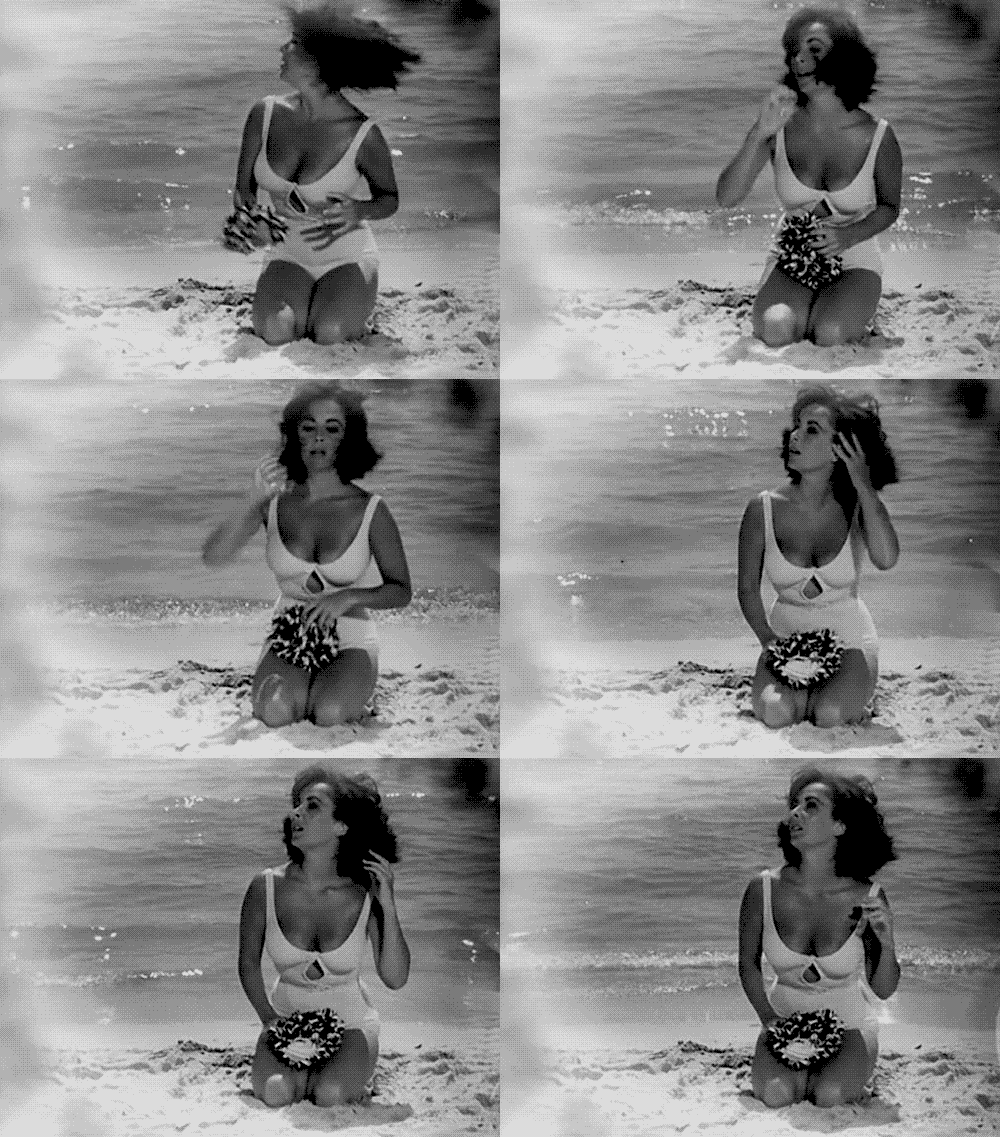
SUDDENLY LAST SUMMER remains deliriously over the top too, as Katharine Hepburn's Mrs Violet Venable descends in her elevator to persuade doctor Montgomery Clift to lobotomise her niece Elizabeth Taylor to remove what she saw happen to Sebastian last summer .... poor Monty seems to be sleepwalking through this as Taylor (in that white swimsuit which was "a scandal to the jaybirds") and Hepburn go head to head ...

And then a large helping of cheese: GUESS WHO'S COMING TO DINNER .....  I tried to avoid it but looked in before the end. It seemed even worse than I remembered, but how we loved it back in 1967. I remember friends and I going to a late night show at 11pm – not so common in London then! Watching it now one can see all the glaring faults – its shot like a tv sitcom, that house full of art and the view over San Francisco are laughably opulent and fake now, and that ghastly score.
Thankfully I missed that excruciating scene at the drive-in ice cream parlour where Tracy comes across as just old and doddery and annoying. The daughter of course is an airhead, and Dr Prentice (Poitier) seems a living saint and they just have to rush to Geneva as he has to work for the World Health Organisation so both sets of parents have to give their approval right away for their union. The black servant ("part of the family") still has to serve dinner though – and don’t get me started on this wealthy liberal family who are not Catholics, with their pet priest (dear twinkly Cecil Kellaway) who is Irish and likes that whiskey !  But of course one has to see it in the context of its time:  race relations were still very problematic then and this sugar-coated pill (along with Poitier's other hits that year IN THE HEAT OF THE NIGHT (which I loved) and TO SIR WITH LOVE) may have helped things along. At least it revitalised Katharine Hepburn’s career (while her contemporaries were mired in cheap guignol flicks, and Kate was even bigger the next year when THE LION IN WINTER was such a hit, winning her another Oscar) – there she was on the cover of LIFE magazine and standing on her head, as a whole new generation fell in love with her - she had really been off the screen since 1959's SUDDENLY LAST SUMMER, Lumet's LONG DAYS JOURNEY INTO NIGHT in 1962 was not widely seen at the time despite winning awards at Cannes, in fact I didn't see it until the dvd became available). I love her costumes and little hats in this film which she breezes through, particularly the great scene where she fires the art gallery assistant. Like all Kramer’s films of the time, it seems hopelessly overdone now.   below: Visconti's sumptuous 1963 THE LEOPARD, once again.

Tuesday, 28 December 2010

Autumn Sonata

I find Ingmar Bergman a very polarising director - while I yield to no-one in my admiration for a dozen or so of his films, a lot of his other ones I simply had no interest in seeing at all! So for all those favourites like THE SEVENTH SEAL, WILD STRAWBERRIES, SMILES OF A SUMMER NIGHT, THE SILENCE, PERSONA, CRIES AND WHISPERS, AUTUMN SONATA or FANNY AND ALEXANDER there are others like THE SERPENT'S EGG or those Liv Ullmann psychodramas like FACE TO FACE or SCENES FROM A MARRIAGE that I just did not want to see, (highly regarded though they were), not even his one with Elliott Gould THE TOUCH! His opera film of THE MAGIC FLUTE is sheer delight though, one I liked a lot, and it was also good to see THE MAGICIAN from '58 recently (as per review on that), and I keep meaning to catch up with those other early '60s ones THROUGH A GLASS DARKLY and WINTER LIGHT (which with THE SILENCE - which I first saw aged 18 when new in London in 1964 - form a trilogy). Then of course there are his earlier ones from the early '50s of which I have only seen SUMMER WITH MONIKA. Ingmar certainly had a prodigious output. One stage production of his which I saw in 1970 (in fact I went to it twice) was his HEDDA GABLER with Maggie Smith at her most intense, set as it was in red rooms with black dressed characters - very austere.

I also remember going to see AUTUMN SONATA twice during its initial run in 1978, as I found it endlessly fascinating. This of course sees Ingrid Bergman back in Sweden and it provides her with a last great cinema role - I felt at the time that she and Liv Ullmann should have jointly won the best actress Oscar as they are both mesmerising and give towering performances. Bergman at this stage was already battling cancer. Her last performance was as Golda Meir for television in 1980, where she had no vanity at all as the Israeli leader.

Here she is Charlotte a well-known musician endlessly on tour who deigns to spend a few days with the daughter she has not seen in 7 years. Both women are initially uneasy in each other's company as Charlotte settles in and is horrified to discover that her other, severely disabled daughter whom she had consigned to an institution and forgotten about is also at the house as Eva (Ullmann) has taken her in and is caring for her.

Charlotte is a very talented, but completely self-absorbed woman. Eva has in her wretched state turned herself into a frump and does not seem to realise how much her pastor husband loves her. We now come to the stunning sequence where Charlotte asks her daughter to play for her and we watch mesmerised as every emotion, from pain to acceptance and maternal love, flickers over the mother's face as the daughter plays badly - then the artist in Charlotte takes over and she has to demonstrate how the Chopin piece should be played while we focus of Eva in closeup seething with rage and hated at her once adored mother, highlighting her own painful shame of inadequacy and mediocrity . A long night of the soul follows as mother and daugher accuse and lash out at each other - while the other unloved disabled daughter (Lena Nyman) also cries out in her pain and distress. It's Liv's cruelty toward her mother in that unforgettable late night diatribe that grips as the film unfolds to a kind of resolution. (It must have been harrowing for Ingrid Bergman, having the comparisions as it does with her first failed marriage and her leaving her daughter Pia, during her Rossellini period, though mother and daughter were later reconciled).

It all adds up to a beautiful and devastating film that I admire, and in the Bergman canon seems closest to CRIES AND WHISPERS in it's textures, the warm reds and the close-ups of the faces of wounded souls, as photographed by Bergman regular Sven Nykvyst (who went on to Woody Allen's rather similar INTERIORS next). The film is bleak (obviously) but not depressing and the resolution is slightly hopeful as Eva walks in the local cemetry loving observed by her husband, and Charlotte - her composure and public facade restored - continues on her tour, chatting to her agent (Gunnar Bjornstrand) on the train about those ordindary people going about their evening tasks, preparing meals etc in the houses they pass, as she goes to her next concert engagement, but perhaps she and Eva can get closer now and know more about each other, or will they never see each other again? It could be a hopeful optimistic conclusion, and a key '70s film.


Ingrid Bergman appeared several times on the London stage (A MONTH IN THE COUNTRY in '65 was an enormous hit, and I also saw CAPTAIN BRASSBOUND'S CONVERSION) and she was always very pleasant to meet and chat to, and I also saw her at a screening of CASABLANCA at the National Film Theatre where she was very informative on the film's production and answered everyone's questions. Despite the dramatics her sense of humour is also there in AUTUMN SONATA. Ullmann remains the best known of the Bergman actresses (Thulin, Harriet and Bibi Andersson etc) but her English speaking films are woefully dismal (POPE JOAN, THE ABDICATION, the widely derided remake of LOST HORIZON etc).

Wednesday, 18 August 2010

People We Like: Ingrid Thulin


Ingrid Thulin [1926-2004] is the glacial Nordic blonde of several of Ingmar Bergman’s most austere films, and is perhaps seen as his most 'intellectual' actress, the others being considered more earthy?. She also had a varied international career ending up in Italian films of varying quality as she spent her later years in Rome. Her striking looks and voice are unusual – though for some reason she was dubbed by Angela Lansbury in her first Hollywood movie! Like Jeanne Moreau she can look beautiful, plain, serene, intense or agonised at will.

The other Bergman muses also had international roles of varied quality: Harriet Andersson in THE DEADLY AFFAIR, Bibi Andersson in Huston’s THE KREMLIN LETTER and a lesser Altman, QUINTET with Paul Newman; Eva Dahlbeck in THE COUNTERFEIT TRAITOR, and, most popular of all, Liv Ullmann - though most of her English speaking films were odd choices to say the least: anyone for FORTY CARATS, POPE JOAN, THE ABDICATION or the toe-curling remake of THE LOST HORIZON ? She was better served with Jan Troell in THE EMIGRANTS and THE NEW LAND and a welcome return to form with both Bergmans in AUTUMN SONATA and later in Ingmar’s last film SARABAND, as well as her own writing and directing efforts. There is a brilliant Ingmar Bergman site: http://bergmanorama.webs.com/repertory.htm which contains a wealth of material on Bergman and his main players [including Thulin], with photos, comments etc.

Ingrid began in Swedish films in the late 40s. I first saw her in the 1956 thriller FOREIGN INTRIGUE when I was a child and she stayed in the memory as a mysterious blonde in this Robert Mitchum thriller, which also featured Genevieve Page. WILD STRAWBERRIES in 1957 is of course her breakthrough movie and one of Ingmar Bergman’s most fascinating works. I have just had another look at it and it is as mesmerising as ever. Thulin is Marianna, the daughter-in-law accompanying the ageing professor in this very moving symbolic tale of an old man's journey from emotional isolation to a kind of personal renaissance. One does watch this though with a whole different perspective when in one's early 60s than one did when in one's twenties !

I have not seen her following films with Bergman: BRINK OF LIFE or WINTER LIGHT in 1962 but their reputations suggest they will be worth eventually catching up with. THE MAGICIAN from 1958 was spell-binding when I saw it recently, as per my review. A detour to Hollywood followed in 1962 with Vincente Minnelli’s odd film the remake of THE FOUR HORSEMEN OF THE APOCALPYSE with Thulin as Glenn Ford’s romantic interest and, I only found out later, dubbed by Angela Lansbury.

As it happens one of the first films I saw when I moved to London aged 18 in 1964 was Bergman’s THE SILENCE, rather a notorious film at the time due to some implied lesbian content between the two sisters, but Thulin as the ill Ester is certainly emotionally wrenching in her isolation in a hotel in a strange city while her sultry sister Anna – Gunnel Lindblom, another Bergman regular – picks up a man and tells her sister about it afterwards while the little boy wanders around the hotel.

RETURN FROM THE ASHES is a brilliant thriller by ever-dependable J Lee Thompson in 1965 which had been out of circulation for a long time, so it was good to re-see it recently. Thulin scores as the woman returning from a concentration camp, it also features Maximilian Schell and Samantha Eggar, and there is a great bathroom scene … definitely one to watch out for. Two of Thulin’s from 1966 that I unaccountably missed are Resnais’s LE GUERRE EST FINIE (the War is Over) where she is Yves Montand’s mistress, and also Mai Zetterling’s directing debut NIGHT GAMES. Two more (unseen!) Bergmans followed: HOUR OF THE WOLF in 1968 and THE RITE in 1969.

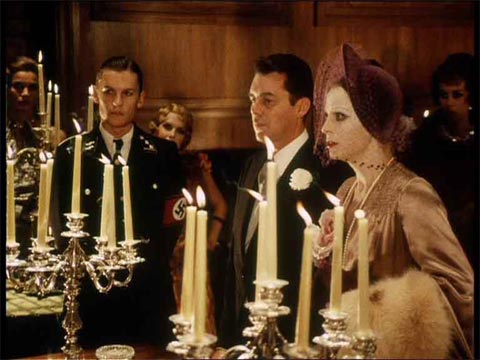
Visconti’s THE DAMNED in 1969 was a major international hit, maybe for the wrong reasons, but we all flocked to this chunk of Italian-German decadence which had some striking sequences among the more sensational: Helmut Berger in drag for starters! Thulin is little more than a waxwork as his mother, particularly at her wedding to Dirk Bogarde as the nazi’s take over, Charlotte Rampling makes a vivid impression and its all still tremendously watchable.

An Italian giallo thriller SHORT NIGHT OF THE GLASS DOLLS in 1971 is a fascinating example of the genre: Jean Sorel is found apparently dead in a Prague park and brought to the morgue, but he is still alive but paralysed as he tries to remember what happened to him and his missing girlfriend and that strange club where other girls go missing. Medics try to revive him but time is running out as he is wheeled to the autopsy room …. Thulin is under-used here as a fellow journalist and ex-lover of Sorel, but sports a chic line of headscarfes.

In 1972 came the searing experience that is Bergman’s CRIES AND WHISPERS, emotionally powerful at the time I have not seen it since but it remains one to re-see. Here, Harriet Andersson is the dying sister in turn of the century Sweden. Her two sisters try to care for her but she finds more solace with the devoted maid Anna. It is of course about pain, death, love, lust, hate, and self-loathing - Liv Ullmann the sensual sister and Thulin the icy control freak who cannot bear to be touched – even mutilating herself with glass to keep her husband away. Like Ingmar Bergman’s stage production of HEDDA GABLER (with Maggie Smith, which I saw in London in 1970) it is set in red rooms with people clad in black. A film of powerful images and emotions.

She was Miriam in MOSES THE LAWGIVER, a tv mini-series in 1974, with Burt Lancaster as Moses. SALON KITTY in 1976 is a Tinto Brass confection about the seedy goings-on at Madame Kitty's Berlin brothel during WWII, and was a film that movie buffs like me didn’t bother with at the time, but I may actually put it on my wanted list now, as it should at least provide some amusement, if the comments on imdb are any guide – ““Cabaret” on acid” being one comment!. Thulin of course is Kitty, with Helmut Berger again, though not playing her son this time!

THE CASSANDRA CROSSING also in 1976 was a lot of fun, one of the last of the 70s disaster movies this was set on a train going across Europe which some terrorists who have picked up plague germs from a botched robbery have boarded. The authorities led by ruthless officer Burt Lancaster have to keep the train moving and re-route it to an unsafe bridge in Poland…. It’s a great all star cast of the time headed by Sophia Loren and Richard Harris, with Ava Gardner having a choice time with toyboy Martin Sheen. Even O C Simpson and Lee Stransberg are on board, others like Alida Valli or John Philip Law are in little more than walk-ons. Ingrid thankfully is not on the doomed train but back in Geneva at World Health HQ as she argues with Burt about rescuing the passengers – they do manage to rescue a dog who does recover but Lancaster is determined there shall be no survivors …..

Thulin’s 9th and final Bergman film AFTER THE REHEARSAL was in 1984 for tv, again its an unseen item as are several more until her last credit in 1988. She died in 2004. She had been married to Harry Schein, head of the Swedish Film Institute.

Its an interesting international career, her Bergman films will be watched and re-watched as long as we watch movies.

Sunday, 27 June 2010

Back to art house ...

Time to catch up with those art house classics I had been meaning to watch, or in the case of Visconti's SANDRA see again after a gap of 45 years .... its been a dim memory since I saw it aged 19 in 1965, so (again) its been terrific to track down a copy now. [It was on YouTube in segments with Japanese subtitles!]. Its original title is VAGHE STELLE DELL'ORSA or OF A THOUSAND DELIGHTS as it was titled for the UK, and it now seems to be titled SANDRA (much easier all round) and now plays like a classic Visconti drama. Sandra Dawson (Claudia Cardinale) and her husband Andrew (Michael Craig) travel to her hometown, the Etruscan city of Volterra for a homage of the locals to her father, a prominent scientist who died in a concentration camp. The long drive in the car during the credits is fascinating. The couple are welcomed by the servant Fosca, and Andrew becomes fascinated with the house. Sandra has issues over the estate with her stepfather and her mentally ill mother (Marie Bell) and misses her brother Gianni (Jean Sorel), who is an aspirant writer. When Gianni appears in the house out of the blue, Andrew unravels a shadowy secret from the past of the siblings. It is Greek tragedy really in the shape of Electra and Orestes... it unfolds as if a dream, (or a typical '60s art movie), interesting seeing Visconti tackle a "small" film here, before moving on to those more opulent titles like THE DAMNED, DEATH IN VENICE, LUDWIG and that final L'INNOCENTE. His follow-up to SANDRA, a 1967 adaptation of Camus's THE OUTSIDER with Mastroianni, is also a very lost title, I don't think we even got a chance to see it in London...

"Vaghe Stelle dell'Orsa..." ("Bright star of the Bear", a poem that is referred to in the text) has a plot about a once incestuous brother and sister (though he wants to resume their illicit relationship) which in the hands of another director could have become a melodramatic soap-opera, but Visconti explores the sensuality and beauty of Claudia Cardinale [often in close-up, and that amazing voice of hers] to deliver an intriguing and quite erotic family drama, peopled with beautiful leads in their mid-60s perfection. The set decoration, as usual, is another piece of art, supported by a classical music soundtrack by Cesar Franck. Good to see English actor Michael Craig here too - five years earlier he was the star of a British comedy UPSTAIRS AND DOWNSTAIRS and Cardinale had a small part, her first in English probably, as one of the servants!
To add in the next few days: first looks at Antonioni's IL GRIDO, Bergman's THE MAGICIAN, Truffaut's LE PEAU DEUCE...

Hardly a likeable film or one which one would want to return to right away, Antonioni's IL GRIDO has be one of the bleakest views of the human condition ever, more so than say UMBERTO D or AU HASARD BALTHASAR, as it shows the downward spiral of Aldo, the workman abandoned by the woman he loves. It is though totally compelling to see now, Antonioni's last before L'AVVENTURA and those films showing the ennui of the Italian monied classes. Here we are, comparatively speaking, in the lower depths of society - workmen and women in rundown towns along the muddy banks of the Po river.

Aldo has lived with Irma the woman he loves for 7 years and they have a daughter, he thinks they will get married when news arrives that her husband, working in Australia all these years, is killed - but for Irma (Alida Valli) it is over - she may even have a new man already. Uncomprehending Aldo (Steve Cochran, the playboy and tough guy of American films, ideally cast here) after beating her in public takes to the road with their daughter Rosina in tow, as they wander from town to town. First he returns to Elvira (Betsy Blair) his previous love who would take him back, but not when she discovers he only came back because Irma threw him out ... then he takes up with Virginia (the oddly named Dorian Gray, who it seems was dubbed by Monica Vitti, her first association with Antonioni) who runs a petrol pump station. Aldo and the daughter settle for a while but this too peters out, as he moves on to prostitute Andreina. He sends the daughter home to Irma and is now on his own as he seems to give up on life and has no interest in living. The film comes full circle as he returns to the factory where he used to work, sees the daughter entering a strange house so he looks through the window and sees Irma with a new baby. She sees him and follows as he enters the factory and climbs the tower. The cry of the title IL GRIDO is Irma's scream as Aldo walks towards his destiny .... there are the usual Antonioni touches with landscapes, the spaces and lack of communiation between people (Irma can hardly articulate her feelings why she does not want Aldo any more and he can only resort to violence). Its powerful and affecting and certainly paved the way for the films which followed....


Ingmar Bergman's THE MAGICIAN is a baroque tale of a bizarre troupe of travelling players in the Victorian era led by a mute Max von Sydow who may be a magician, or a hypnotist, or even just a charlatan. This is a Bergman film I had not seen before - my Bergman canon includes THE SEVENTH SEAL, WILD STRAWBERRIES, SMILES OF A SUMMER NIGHT, THE SILENCE, PERSONA, CRIES & WHISPERS, AUTUMN SONATA and his wonderful 1975 opera film THE MAGIC FLUTE (we loved that back in the '70s) and FANNY AND ALEXANDER. [I had no interest at the time for his other '70s films like THE TOUCH, SCENES FROM A MARRIAGE or THE SERPENT'S EGG, but I liked his 1970 London production of HEDDA GABLER with Maggie Smith so much that I went to it twice - it was dazzling theatre with the cast clad in black against those red walls...]
THE MAGICIAN (or THE FACE) is a fascinating puzzle from 1958 with terrific photography like those shots of the carriage emerging from the forest with the light shining through the trees... Vogler (Sydow) and his wife Ingrid Thulin (who dresses as a man, as part of the act), and the old crone who may be his grandmother and their florid manager arrive in a new town and are halted by some petty officials who see an evening's entertainment in making the entertainers do their act to see if they are suitable for the public. They certainly get more than they bargained for, particularly Gunnar Bjornstrand as Dr Vergerus, the officious medical advisor who is fascinated with hypnotism and magic rituals and would dearly love to perform an autopsy on Vogler to examine his brain, eyes etc. There is an old drunk whom they pick up en route, who finally dies. Bjornstrand gets to do his autopsy but surely would have realised which body he was examining? Vogler's face is a mask - once the wig, beard and make-up are removed the real Von Sydow emerges, and is an interesting contrast with the silent brooding Vogler in that this new persona is just a money-seeking actor. Other characters also change: the serving wench Bibi Andersson joins the party as the manager stays behind. The town official and his wife, mourning their lost child, also re-discover each other, and Vergerus gets the biggest surprise of all .... its brilliantly photographed, Sydow and Thulin shine as ever, and the Bergman players are a pleasure as usual. The ending seems rather rushed though - certainly a Bergman worth seeing but maybe not one of his key works - it could almost be marketed as a superior horror film. Next on my list will be THROUGH A GLASS DARKLY...