Dedications: My four late friends Rory, Stan, Bryan, Jeff - shine on you crazy diamonds, they would have blogged too. Then theres Garry from Brisbane, Franco in Milan, Mike now in S.F. / my '60s-'80s gang: Ned & Joseph in Ireland; in England: Frank, Des, Guy, Clive, Joe & Joe, Ian, Ivan, Nick, David, Les, Stewart, the 3 Michaels / Catriona, Sally, Monica, Jean, Ella, Anne, Candie / and now: Daryl in N.Y., Jerry, John, Colin, Martin and Donal.

Tuesday, 23 March 2010

Rex: The Constant Husband

Nice to see a new dvd release of the 1955 Sidney Gilliat film THE CONSTANT HUSBAND - mid-50s England in aspic really as amnesiac Rex Harrison wakes up in Wales with no idea of who he is or how he got there. Its amusingly put together as with the help of jolly psychiatrist Cecil Parker his past is slowly unravelled as he ends up in court, presided over by judge Michael Hordern, charged with being a serial bigamist. It turns out of course that the women - all 7 of them - would all take him back - and even his defence barrister, a very dry Margaret Leighton, also falls for those legendary Rex charms. Its a perfect role for Harrison, coming into his own here, just before taking on the role of Henry Higgins.

The interest here now though are the women. Not only Leighton and Nicole Maurey (and her hilarious Italian restaurant family) but Kay Kendall at her most divine as Monica, the society photographer. Harrison was still married to Lilli Palmer when starting this, but you can see this is where he and Kendall began, she is obviously entraced with him, and she looks lovely here - as she does in GENEVIEVE and SIMON AND LAURA, before that make-over by MGM for her following films QUENTIN DURWARD, LES GIRLS, RELUCTANT DEBUTANTE and ONCE MORE WITH FEELING. Splendidly entertaining then.

Friday, 19 March 2010

Showpeople: Girls night out

Three girls about town and their pal [if not gay best friend] out having cocktails, in January 1959. I love this photo of Vivien Leigh, Kay Kendall, Lauren Bacall and Noel Coward - 4 quintessential showpeople - stepping out in '59. Kay died later that year, Bacall [the woman who knew everyone] is still with us, 50 years later, in her 80s. More on Kay later ... (photo from 'The Brief Madcap Life of Kay Kendall' by Eve Golden and Kay's sister Kim Kendall, Kentucky Press.]

Monica Vitti - art-house comedienne

It is rumoured that Monica has Alzheimers now, and has not been seen for some time - but back in the '60s she had that unique face, voice and manner, that certainly registered with me. She was the latest in that line of great Italian actresses with stunning looks.

The Antonioni films of course have been endlessly written about and analysed since the 60s, so I am only mentioning them in relation to Vitti's roles. L’AVVENTURA set the pace in 1960 and was of course the sensation of the Cannes Film Festival and together with Fellini’s LA DOLCE VITA and Visconti’s ROCCO AND HIS BROTHERS ushered in the new age of Italian and then international cinema. One could almost say modern cinema began in 1960 with both Hitchcock and Antonioni making films about a woman who vanishes and the people looking for her. We find out what happens to her in the Hitchcock, but we don’t in Antonioni’s vision of the indolent rich at play as they sail around Southern Italy ending at that bleak dawn (often where Antonioni films end, as in LA NOTTE and BLOWUP) at the hotel in Taormina where her Claudia accepts the limitations of love.

LA NOTTE in 1961 is really Mastroianni and Moreau’s film as the married couple visiting a dying friend in Milan and whose marriage is failing, with another less-optimistic dawn reconciliation after an all night party. Vitti is featured as Valentina, the daughter of the host of the party, who flirts with Mastroianni, but realises it is not going anywhere as they surrender to the boredom of modern life.


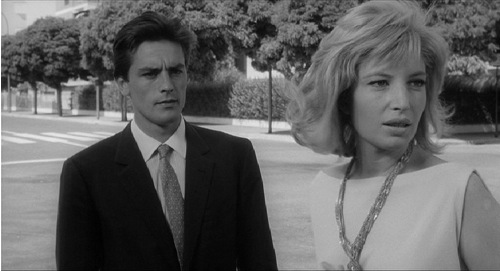
L’ECLISSE in 1962, seen as the final part of this trilogy, sees Vitti at her peak as Vittoria and the film is all about her and her reactions to the people and events around her. Her solitude, ending with one lover, the Rome financial markets as her mother gambles on the stock exchange, how she follows a man who has lost huge amounts, her pleasure in the air flight among the clouds, and getting involved with the brash young stockbroker, Alain Delon, who has no problems at all, apart from the drunk driving his car into the river. Individual sequences like where she and neighbours play at being in Africa and that well-known final sequence as the camera turns up at the lovers’ meeting place but they do not as life goes on and we study inanimate things like street lights, are endlessly fascinating. There is a sense of dread, as this is the early 60s and the nuclear age. There is so much in these films that one can’t really gloss over them, but Monica is marvellous here and is really the epitome of early 60s chic. It’s a timeless look and the film is an enduring classic. As ever Antonioni’s use of space and landscape and how characters move and fit in it repays several viewings. Sound plays an important part too – the wind rattling the railings here is as evocative as the wind sighing among the leaves of the park in BLOW-UP.

A 1963 film CHATEAU EN SUEDE surfaced only here in the UK on BBC television but it was an interesting oddity by Roger Vadim with Vitti leading an interesting cast which also included young pop singer Francoise Hardy in this Francoise Sagan story set in – yes – a castle in Sweden.

After several more movies came her fourth Antonioni – IL DESERTO ROSSO, or THE RED DESERT, and it’s a pleasure to see it newly released on dvd. Vitti looks wonderful here with red hair as she grapples with a very bored Richard Harris (who did not get on with Antonioni at all and in fact he walked off the picture). Vitti is Guiliana who may be driven to a breakdown by the industrial nightmare of Ravenna with its factories spouting pollution and her indifferent husband, hence her fling with Harris, all loving photographed in Antonioni’s first color feature, with locations and objects painted (as they would in BLOW-UP) to reflect the heroine’s mood: the red room, and grey fruit on a market stall.

She was of course the art-house goddess of those Antonioni films which we all flocked to then, and are still relevant and endlessly discussed today. But Monica wanted to be a comedienne. She brought a lot of fun to Losey's MODESTY BLAISE which is a very misunderstood film, but in Italian comedies like her sketches in LE BAMBOLE, LE FATE or THE SCARLET LADY she is very funny and deadpan. It is lovely now seeing her being glamorous and funny wearing fabulous clothes in those Italian comedies, but a lot of them did not get international release. One that did was the very funny PIZZA TRIANGLE with her and Mastroanni and Giannini. It was nice seeing her contributing to that BBC series 'Hollywood England' a dozen or so years ago which disucssed all those key British films of the '60s, where she, Bogarde, Stamp and others discussed MODESTY BLAISE and others. Cannes Film Festival poster for 2009 was a nice tribute to her and L'AVVENTURA...

My full IMDb appreciation on Monica is at:
http://www.imdb.com/name/nm0900143/board/nest/131550690?d=131550690#131550690

Thursday, 18 March 2010

Faye on Facebook !

I have just left a message on Faye Dunaway's wall on Facebook! - a friend of mine on there (thats you, Martin Bradley) had become a fan, so I clicked on her page.*

Faye of course has been one of my icons, she is a movie star in the grand tradition - since the late 60s (when I had a still of her goddessy looks then from De Sica's A PLACE FOR LOVERS on my wall) - we loved her as Bonnie and her Vicki Anderson in THE THOMAS CROWN AFFAIR (the film may be flashy 60s now, but its still a great performance) and she goes the distance in Kazan's THE ARRANGEMENT. I also liked her French thriller for Rene Clement, but it was thrown away here as a the lower part of a double feature (THE HOUSE UNDER THE TREES). Her Milady in Lester's MUSTETEERS films is very ripe and she looks sensational, particularly with that other blonde Michael York. CHINATOWN is as much her's as it is Nicholson's, her Evelyn Mulwray should have won her an academy award. Her Joan Crawford is also amazing, if only the film had been worthy of her. I saw her on stage in London in the '86 run of CIRCE AND BRAVO. Her biography "Looking for Gatsby" is also a great read, and O'Neill's post-oscar photo of her is a classic.

All careers that endure for decades have peaks and troughs and Faye's is no exception. It would be nice if there was another great part for her (like Julie Christie got with AWAY FROM HER - which should have got Julie her 2nd oscar 40+ years after her first; Julie and Faye though embody the '60s and '70s).

It was good seeing Faye getting on famously with Jonathan Ross on his TV show [its on YouTube] here in the UK last year, [unlike the interviewer who needled her about Polanski], Ross is another admirer of hers, but as usual before she could steer the conversation around to the film she was promoting then [whatever happened to that?] she had to go through, once again, how great it was to work with Newman, Redford, McQueen, Nicholson, Brando etc. Most 'civilians' don't have to recall what they were doing or who they were working with 40 years ago or be constantly reminded of their brilliant younger selves (or indeed have their rants on the telephone broadcast worldwide, as per that YouTube clip). Its tough being a working actress in your '60s these days...

[I remember watching Olivia De Havilland at London's National Film Theatre in 1972 watching herself and Erroll Flynn riding in the forest in their 1938 ROBIN HOOD while waiting to go on, and saying how difficult it was to appear before us after that scene, 34 years later. Of course now more than 34 more years have passed and Olivia is still with us in her '90s!]

I now have an early Faye to watch: Otto's long-unseen HURRY SUNDOWN. Faye will be marvellous as usual.
I don't suppose Julie is also on Facebook ....

* presumably if famous people are on Facebook its probably done by their PR people as a publicity marketing tool to keep their names out there - I don't imagine Faye sits at home in the evening reading people's messages ...

Tuesday, 16 March 2010

Romy Schneider trio

SISSI - 1954. I liked this when I saw it as a kid. There are 3 SISSI films, all made in Germany in the '50s, all are saccharine, sentimental confections, very chocolate box cover with pretty dresses, rural scenes, and court intrigue about the early life of Empress Elizabeth of Austria, and seeing them now they are just as enjoyable as ever – the interfering mother-in-law is a particular delight. All 3 are edited into one compilation FOREVER MY LOVE which is fine for seeing the best of them. Romy returned to the role for Visconti in his monumental LUDWIG in 1972 where Helmut Berger is just right as Ludwig, and Trevor Howard and Silvana Mangano are also right as the Wagners. Romy brings a lot of brittle humour and insight to the role this time around.

A considerable hit in 1975 though was Claude Chabrol’s thriller INNOCENTS WITH DIRTY HANDS, a valentine to Romy really as its all about her coping with her devious husband Rod Steiger, and her lover as we find out who is plotting to kill who, as bumbling policemen (very Chabrol) try to unravel the plot’s many twists. Romy looks terrific here in a variety of looks and hair-dos, from the moment a kite descends from the sky at the start to land on her naked derierre as she sunbathes on the lawn. A lovely mid-70s treat now.

1980 brought Bertrand Tavernier’s LA MORT EN DIRECT or DEATHWATCH a considerable success where Romy has one of her best roles as the dying woman whose last days are being recorded by Harvey Kietel with a camera planted in his brain for a reality series in this sci-fi set in unusual downbeat locations (Glasgow and Scotland). Its all rather prescient actually now following the death of English reality star Jade Goody who lived out her last days on camera. Back in 1980 however Romy is well supported by the likes of Max Von Sydow and Harry Dean Stanton. It deserves to be much better known. She really gives an astounding performance here, 2 years before her untimely death following personal tragedies.

Like Jean Seberg, its a career that ended too soon. Romy remains one of the most international of stars, having periods of stardom in German, American, French and English films.
The recent release of the uncompleted Clouzot 1964 film INFERNO has led to revival of interest in Romy with retrospectives on her in London, Berlin and other cities. There are several biographies in French or German - we need one in English!

Paris Match cover of their issue covering her death, 1982 / Zulawski's THE MOST IMPORTANT THING LOVE is a very intense 1975 French title, co starring Fabio Testi, Klaus Kinski.
My full appreciation on Romy is on imdb at:
http://www.imdb.com/name/nm0002769/board/nest/136933622?d=136933622#136933622

Jean Seberg trio

IN THE FRENCH STYLE is a charming entry in the American Girl in Paris stakes by Robert Parrish in 1963, from Irwin Shaw stories. Jean Seberg is quite charming here going from naïve young girl to sophisticated woman of affairs before giving it all up for domesticity with an American doctor (played by one of my favourite writers James Leo Herlihy, author of All Fall Down and Midnight Cowboy, among others). Stanley Baker is one of her lovers so cue lots of meetings at airports and a decadent party that prefigures the one in DARLING. Its an interesting American take on the international film scene of the early '60s and Seberg's iconic place in it.

MOMENT TO MOMENT in 1965 is a glossy romantic thriller by old hand Mervyn Le Roy (his last film in fact) set in the South of France and is a fabulous treat to see now at this remove. The first half is lushly romantic as Jean drives around Nice in her snazzy red sports car, sporting a Yves St Laurent wardrobe that would still be the height of chic today - she is a bored wife whose (dull) husband Arthur Hill is away on business, and she gets romantically involved with a sailor on the loose - Sean Garrison, a bit wooden but does what is required of him, ie - he fills out his uniform nicely. Jean resists at first but ... add in Honor Blackman [just after her stint as Pussy Galore with James Bond] as the maneater next door and the stage is set for some fireworks. Then it turns into a Chabrol-like thriller with a missing body, police on the prowl, the return of the husband and the missing body. It is though all nicely worked out, a lot of it studio bound, but nice locations too. Jean is perfect here and its a perfect mid'60s treat. Great Henry Mancini score too .... it deserves to be much better known and would be a much better chick flick now than some of the current examples.

THE ROAD TO CORINTH (LA ROUTE DE CORINTHE) is real Chabrol - an amusing thriller in sunny daylight as Jean looking lovelier than ever and Maurice Ronet chase after some McGuffin all over Greece, in 1967. It is nice to see Jean at this period, after BREATHLESS and LILITH before things darkened for her.

Jean was "the girl from Marshalltown, Iowa" as I remember reading as a child, when discovered by Otto Preminger for ST JOAN, she is marvellous as Cecile in BONJOUR TRISTESSE (my comments on it are a few posts back here), now if one could only see missing items like her husband Romain Gary's THE BIRDS COME TO DIE IN PERU.... Like Romy Schneider's, Jean's is one of the more fascinating careers in international cinema.

People We Like: David Hemmings

What an extraordinary life and career he had. The boy soprano for composer Benjamin Britten - he was the first to play Miles in his opera of THE TURN OF THE SCREW when 12 - until his voice broke; then a jobbing young actor bobbing up in films like THE SYSTEM in 1964; and then, to the chagrin of Terence Stamp, becoming the image of the '60s for Antonioni in BLOW-UP. When I first saw it aged 21 it was like watching oneself on the screen - that was how we looked and dressed. His Nolan in Richardson's CHARGE OF THE LIGHT BRIGADE is also iconic, I had a poster of him in that hussar uniform on my wall then [see below, with that timeless BLOWUP image].

A varied career followed of highs and lows, marriage to Gayle Hunnicutt (ended by his affair with Samantha Eggar), he romanced Kim Novak when they were both on EYE OF THE DEVIL (before she left and was replaced by Deborah Kerr), and then directing television series in America, such as "The A Team" and the like. There were drink problems and other marriages. He then directed the very intriguing (on paper - its actually a very dull film) JUST A GIGOLO in Berlin in '78, notable for being Marlene Dietrich's final screen appearance, with David Bowie, Kim Novak, Maria Schell, Sydne Rome, Curt Jurgens. Bowie (in Berlin) and Dietrich (in Paris) were intercut quite well but it is obvious they are not in the same shots, its certainly one of the more intriguing Euro-puddings. Hemmings then went back to acting in middle age, with it seems no vanity at all, with that extra weight and those eyebrows! in films like Scorsese's GANGS OF NEW YORK, Scott's GLADIATOR and LAST ORDERS [with that cream of English talent: Courtenay, Hoskins, Caine, Winstone, Mirren - it must have been fun on set].

David died suddenly in 2003 on location. It was certainly a fully lived life, luckily he completed his engrossing biography in time and he appeared in an interesting documentary on Benjamin Britten, looking back warmly to that part of his life. An early girlfriend of his, actress Jane Merrow, was someone I knew slightly back in the mid '60s. He will always though be the guy with the camera ...

People We Like: Stewart Granger

Back in the '70s the London National Film Theatre ran an occasional series "People We Like" being mini-retrospectives on varied performers, which was always a treat. Here is their Stewart Granger one. [click images to enlarge]

Stewart was of course marvellous in those '40s Gainsborough melodramas like MADONNA OF THE SEVEN MOONS (you need a certain elan to carry off that ritzy harlequin costume...) and CARAVAN - there is a terrific 12 disk boxset of these '40s roles. The swooning romanticism of SARABAND FOR DEAD LOVERS with Joan Greenwood in 1948 is also a choice item. Then of course after the move to Hollywood with wife Jean Simmons came those MGM staples like SCARAMOUCHE, THE PRISONER OF ZENDA, KING SOLOMON'S MINES and the like, with westerns like THE LAST HUNT and the great MOONFLEET for Fritz Lang. I like him in the routine programmer GREEN FIRE (where Grace Kelly is very tailored down in the South American jungle) and Cukor's BHOWANI JUNCTION with Ava - he, Ava and Niven must have had fun making the dreary LITTLE HUT in '57. He and Simmons both play against type in the thriller FOOTSTEPS IN THE FOG. Granger always disparaged his work but must have provided as much fun as Flynn or Power at their peak. He and Wayne guy their images and have a lot of fun in Hathaway's NORTH TO ALASKA, and he hit the Euro trail in the '60s, SODOM AND GOMORRAH being particuarly choice. He and pal Michael Wilding also had that feud with Hedda (or was it Louella?) - his biography "Sparks Fly Upward" is as good as any by Niven. They just don't make them like that anymore.

Some other choice '50s movies

Before moving on from the ‘50s here are some other recent viewing pleasures, some ramping up the camp factor:

NO SAD SONGS FOR ME – Margaret Sullavan’s last film in 1950 is curiously unregarded now, but is a nice little drama set in a mining town where she is the suburban wife who goes to the doctor and finds she has terminal cancer, which seems untreatable back then. She goes into denial but eventually comes to terms with it and plans her husband's and daughter’s future without her. Husband though is dependable Wendall Corey (dull as ever) as the engineer - enter the young Viveca Lindfors as hubby’s new assistant and Margaret sees they are attracted to each other and she also gets on with the incessantly chattering daughter, young Natalie Wood. It’s a weepie then, but not in your face and the ending is rather nice. In accordance with films of this era she has a large comfy house and a black servant, husband and wife of course have separate beds. A curious choice for action director Rudolph Mate.

THE ACTRESS – another low key film, from 1953, and directed by George Cukor. This should be much better know but seems to have been thrown away by MGM who reduced its running time. Its based on the memoirs of actress Ruth Gordon about when she was young and becoming fascinated by the theatre. It’s a nice picture of small town life with Jean Simmons in one of her key roles. She is perfectly enchanting here. Spencer Tracy for once is quite bearable as the father and Teresa Wright is mother. Anthony Perkins has his first role as a young admirer, and it of course encapsulates Cukor fascination with theatre and role playing.

THE STAR – another low key black and white 1953 item from Warner Bros, with Bette Davis startlingly effective as the star in decline and hitting the bottle: “Come on Oscar, let you and me get drunk”, as she handles the humiliations piled on her with the sale of her effects, looking for work, having to deal with grasping relatives and – the indignity! – having to work in a department store where she is recognised by customers. Bette flounces through it but its rather at the start of her dumpy period. Apparantly the star they had in mind was a kind of Joan Crawford shallow star. Sterling Hayden is the man who could rescue her and young Natalie Wood again plays daughter. A fascinating oddity now.

TORCH SONG – Joan herself stars in this ’53 ”musical” which I never saw until last year, and its certainly up there with the other camp classics. Its deliriously designed in lurid colours (particularly her blackface number “Two Faced Woman” with orange wig) and I like her yellow dressing gown matching her bedroom décor, and that party with only men in attendance. Joan is the Helen Lawson-like dragon Broadway star who drives everyone away, except her new pianist, Michael Wilding, but then he is blind (yes, really). Romance eventually triumphs but not before Joan has a field day chomping the scenery and supporting cast. Gig Young plays her beau but drops out half way through. There is one hilarious scene where as she exits the theatre she is swamped by children demanding her autograph! Charles Walters directs at full tilt and even dances with Joan in her opening number, as the chorus boy who keeps getting it wrong, spoiling Joan’s line.

A Crawford double bill: FEMALE ON THE BEACH / AUTUMN LEAVES. FEMALE in ’55 has Joan as the wealthy but lonely woman moving into a new beachside apartment, where the previous wealthy but lonely female owner [Judith Evelyn] died in mysterious circumstances. Enter Jeff Chandler as the idle beachboy who attemps to move in on Joan. [He: “How do you like your coffee?”, she: “Alone”]. There are also 2 seedy neighbours who it seems are pimping young men to lonely wealthy women, these are deliciously played by Cecil Kellaway and Natalie Schafer. They try to introduce Joan to muscle-guy Ed Fury when she does not rise to Jeff’s bait. Jan Sterling scores as the realtor who keeps hanging around. It all ends in delirious melodrama as helmed by Joseph Pevney, an old hand at this kind of tosh: can Joan trust Jeff or are his motives too dubious?

AUTUMN LEAVES is the Robert Aldrich melodrama from ’56 where Joan is the lonely typist in a modest apartment who becomes entangled with younger Cliff Robertson. They marry but she begins to fear his irrational moods. Enter Vera Miles as his ex-wife and Lorne Greene as his overbearing father. Joan has a great scene as she confronts their deceit, and then Cliff goes loony and throws the typewriter at her. Joan wonders if he still loves her, as she has him committed for mental treatment. Will he still need her when he is cured? Joan as ever emotes while her face resembles an Aztec mask.

THE STORY OF MANKIND – Producer Irwin Allen’s 1957 “all star” telling of a heavenly court [a long way from A MATTER OF LIFE AND DEATH], presided over by Cedric Hardwicke, deciding the fate of mankind as the human race is on the brink of the atomic age. Does mankind deserve to survive? This long-unseen tosh, with intercut stock footage, was just a vague memory but its enormous fun now, as the highlights of mankind are unspooled: Virginia Mayo as Cleopatra, John Carradine as a Pharoah, Peter Lorre as Nero, Groucho Marx buying Manhattan from the Indians, Hedy Lamarr as Joan of Arc, young Dennis Hopper as Napoleon with Marie Windsor as Josephine, Marie Wilson as Marie Antoinette merrily quipping that the peasants should eat cake, Agnes Moorehead as a splendid Elizabeth I, need I go on? Best of all is Vincent Price as the devil while Ronald Coleman (what possessed him?) is the voice of reason representing mankind. Its trash, its delirious, its delovely.

THE FEMALE ANIMAL – another Hedy Lamarr, in fact her last film in 1957, and a very lost film until a friend acquired a copy recently. It’s a very Albert Zugsmith (schlockmeister supreme) production, and would in fact make a great double feature with FEMALE ON THE BEACH, with which it has certain similiarities. Here Hedy is the ageing movie goddess who picks up with studio bit player George Nader, very wooden, and she installs him in her beach house, but George also meets her daughter Jane Powell – rather old for the part, but everyone’s career is in decline here – who drinks a lot. Add in Jan Sterling again, as a rival actress and has-been cougar in a ratty wig and mink coat, always with a young gigolo in tow, who has some amusing lines and would like to get George for herself. Its mercifully quite short at 80 minutes but each one packs a punch. I am saving a second look at it for a nice rainy day.

THE MONTE CARLO STORY – it was a real treat to find this recently as it was just a dim memory of seeing it when about 12. This Italian Titanus co-production is of note only for the teaming of Marlene Dietrich and Vittorio De Sica in 1957, and yes those Monte Carlo locations. They are both con artists and gamblers and both are looking for a good catch but fall for each other. When they realise they are both poor they set their cap at rich Americans Arthur O’Connell as Homer Hinckley and Natalie Trundy as his daughter (who is though far too young for Vittorio). The backdrops are lovely, the Riviera in the ‘50s, Marlene sings and is dressed by Jean Louis, Vittorio is a joy as ever. Hard to believe that director Dino Risi had a hand in the silly script.

Unseen since I saw it 50 years ago as a child, it was fascinating to see Michael Anderson's SHAKE HANDS WITH THE DEVIL (1959) again recently, a muddled IRA story set in Ireland in the 20s it featured James Cagney in one of his last ferocious roles as a misguided IRA supporter, Don Murray as the young lead and Dana Wynter, lovely as usual, as the romantic interest. Glynis Johns has a good role and it features, inevitably, young Richard Harris, with splendid cameos by Dame Sybil Thorndike and Michael Redgrave.

Finally, one we like a lot, and back to Joan Crawford: Jean Negulesco’s THE BEST OF EVERYTHING, from the hit Rona Jaffe novel and another of those Fox 3-girls-sharing-an-apartment-looking-for-love movies. The three are Hope Lange, Diane Baker and model Suzy Parker; it should have been 4 as in the book but Martha Hyer’s role was practically snipped out in the editing to reduce it to 3, with of course Joan Crawford billed “as Amanda Farrow” – the terror of the typing pool. It’s a fascinating look now at office life in the 50s and has great views of Manhattan back then, and of course that great theme tune. Stephen Boyd is Lange’s romantic interest and there are some nice moments of them walking along. There is a lovely moment at the start as Lange exits from the subway and the breeze blows up her little jacket showing the nice pattern on the lining. The drama comes from Lange aspiring to Crawford’s role, Baker getting pregnant and Parker falling for a theatre director (Louis Jourdan) and not being able to handle rejection. It all plays out perfectly and is one of the great enduring soaps of the year along with A SUMMER PLACE and IMITATION OF LIFE. And now for the ‘60s.