Dedications: My four late friends Rory, Stan, Bryan, Jeff - shine on you crazy diamonds, they would have blogged too. Then theres Garry from Brisbane, Franco in Milan, Mike now in S.F. / my '60s-'80s gang: Ned & Joseph in Ireland; in England: Frank, Des, Guy, Clive, Joe & Joe, Ian, Ivan, Nick, David, Les, Stewart, the 3 Michaels / Catriona, Sally, Monica, Jean, Ella, Anne, Candie / and now: Daryl in N.Y., Jerry, John, Colin, Martin and Donal.
Showing posts with label David Warner. Show all posts

Thursday, 10 April 2014

'70s British gangster movies

London is such an expensive (practically unaffordable), flash metropolis now that its a real delight to re-visit that seedy city of the 1970s - which I remember from my 20s then - with its cheap rooms and jobs where spivs and various grubby lowlifes ruled - from Burton's gangster in VILLAIN - made the same year 1971 as Caine's GET CARTER, to essential thrillers like THE LONG GOOD FRIDAY. Here we look at VILLAIN, THE SQUEEZE, SITTING TARGET, HENNESSY, PERFECT FRIDAY, and a Trash 70s classic THE LEGACY - giving employment to a lot of our favoutires and stuffed with all those British character actors earning a crust here.   These are all as good as our '70s Brit favourites like Steiger and Lee Remick in the IRA drama HENNESSY or that amiable John Wayne western set in 70s London: BRANNIGAN. The seedy early 70s London is also caught in ALL COPPERS ARE - a recent discovery - all at London/Trash labels - along with GOOBYE GEMINI and cult trash classic DORIAN GRAY

VILLAIN,1971. Vic Dakin, a sadistic gang leader and a mother-obsessed homosexual modeled on real-life gangster Ronnie Kray, is worried about potential stool pigeons that may bring down his criminal empire. Vic, who enjoys playing at rough trade with his sidekick Wolfe, plans a payroll robbery and directs the blackmailing of Members of Parliament with a taste for unorthodox sex. Scotland Yard Police Inspector Matthews, playing Javert to Vic's Jean Valjean, is moving in on him and the gang. Gang-member Edgar is hospitalized for an ulcer, and Inspector Matthews might be able to make him sing. Will Edgar spill the beans to the coppers before Vic can silence him?
Richard Burton seems to be having a lot of fun here, Cathleen Nesbitt again plays his doting old mother (as in 1969's terrible STAIRCASE) whom he takes on day trips to Brighton, and there is a great gallery of supporting faces. Burton's boytoy Ian McShane also gets it on with '60s dolly bird Fiona Lewis (topless again) - though unlike the same year's SUNDAY BLOODY SUNDAY there are no intimate scenes between the men, Vic usually punches Wolfe, maybe thats their foreplay (below) .... Nigel Davenport and Colin Welland (a PC Plod type) are the cops closing in, Donald Sinden is ideal as the corrupt Member of Parliament, Joss Ackland and T.P. McKenna flesh out Vic's associates, as do James Cossins, Tony Welby and Del Henney - the rapist from that year's STRAW DOGS).  
VILLAIN holds its own in the violence stakes, the payroll robbery is botched and things start to go wrong for our beleagured Villain. Its a prime contender for a great 70s crime drama.  Michael Tuchner directs from a script by comedy writers Dick Clement and Ian la Frenais who later gave us their own more comic Swinging London thriller OTLEY in 1968 with Tom Courtenay and Romy Schneider and another gallery of supporting players, including yes Fiona Lewis again.  

SITTING TARGET, 1972, by contrast is nasty and brutal with no redeeming features - Oliver Reed is in his element as he snarls and seethes through this brute force crime thriller, ably directed by Douglas Hickox (ENTERTAINING MR SLOANE, THEATRE OF BLOOD). Olly is uber-thug Harry Lomart who easily breaks out of prison with his sidekick Birdy (Ian McShane again)  and they go on the run, Olly though wants to track down and kill his faithless wife (Jill St John) who has told him she wants a divorce and is pregnant by another man. 
This is all grimly realistic with authentic South London locations - those tower blocks around Battersea and Victoria (as in ALL COPPERS ARE) though St John is hilariously miscast here as the Battersea housewife, with June Brown (Dot Cotton from EASTENDERS) as her next-door neighbour. This is a role that cries out for Carol White or Billie Whitelaw who would be ideal here dishing up greasy breakfasts with a cigarette dangling from their lips. The violence and the shootups continue in this cold, drab London until the climax and the wife's secret lover is revealed .... Edward Woodward, Frank Finlay, Freddie Jones are able support.

THE SQUEEZE from 1977, long unseen here, is however the real deal. I like this one a lot, and it will be due for a rewatch. Tough and brutal yes, but stylish too as a great cast go head to head, as directed by Michael Apted (TRIPLE ECHO, THE WORLD IS NOT ENOUGH, COAL MINER'S DAUGHTER and still directing now). This is back to 70s London with a vengance, that city of cheap clothes and cheap cars, and grubby rooming houses. Stacey Keach is terrific as Jim Naboth, the shambolic shambling alcoholic ex-cop whom we first see drunk falling down the escalator of the underground - he is as memorable as he was in Huston's FAT CITY. His sidekick who looks after him is, oddly, comedian Freddie Starr, playing it straight here.
A vicious gang kidnaps a woman and her daughter (plus dog) to extort money from her rich husband. He and her down on his luck ex-husband who's an ex cop, decide to try to deal with the kidnappers themselves.
The kidnap scene is nicely handled in the park. The seedy underworld is nicely served up by Stephen Boyd as a frightening mobster - this was Boyd's last main role, he died that year aged 45 and again when playing nasty (as in BEN HUR or GENGHIS KHAN) he ramps it up to the max. 
The main hood is oily David Hemmings, in a good late role too. Edward Fox for once is lively and the kidnapped wife is Carol White, that ill-fated one of the new British girls of the 60s who went from being a child actress (CARRY ON TEACHER) to hits like CATHY COME HOME, UP THE JUNCTION, POOR COW, a foray to Hollywood and dying aged 48 in 1991. The most difficult scene here is where the bored kidnappers force her to strip for their amusement, to a Stylistics song and we see the character's desperation and humiliation, and perhaps the actress's too, it is all brutally unerotic. Keach too is stripped and humiliated by Boyd and his henchman and has to return home stark naked, not even left his grubby underwear. 
The sleaze seems piled up here as the drama unfolds and of course all goes wrong. THE SQUEEZE remains an eye-popping revenge thriller capturing 70s London perfectly (gritty locations, a cigarette smoke-fugged London Underground, dismal pubs and Soho 'massage parlours', and a pre-gentrified Battersea and Clapham - expensive areas now) with a dynamic cast, with several of our favourites here.

HENNESSEY, 1975. A fascinating view now. This thriller was barely seen back in the ‘70s and not at all here since, dealing as it does with the IRA and 'the Troubles' in Northern Ireland. I imagine it was too close for comfort then, and the preposterous plot about blowing up the Houses of Parliament during The Queen’s State Opening ceremony, would hardly have been met with approval. This American-International title though keeps one engrossed, they certainly cast it well, from the opening riot in Belfast – scenes we were familiar with at the time, hardly “entertainment” though. 
The story – by actor Richard Johnson, playing a hard-boiled detective here – features Niall Hennessy, whom Rod Steiger plays in regular scenery-chomping mode, like where he sees his wife and daughter (young Patsy Kensit) killed accidentally in that riot as he falls on his knees in the street and howls like an animal. His revenge involves blowing up The Royal Family and the Houses of Parliament, as the IRA, led by diehard Eric Porter, begin to realise and have to follow him to London to stop him, as the consequences if he succeeds would be unimaginable. 
Enter Lee Remick in a thankless role as the Irish widow of a friend, who puts him up without realising what he is up to. Trevor Howard enjoys himself as the chief of Scotland Yard, and others involved include Peter Egan, Margery Mason. Don Sharp’s direction keeps it tight and engrossing as we watch Steiger preparing for his mission, as he impersonates a Member of Parliament. The State Opening is from an actual documentary cleverly intercut with the film, which almost convinces one it is the real thing. It is odd seeing a younger Royal Family here and real political figures like Ted Heath and Mrs Thatcher. It is all quite fascinating now and amusing too, apart from seeing Remick wasted in a thankless role - she and Steiger were a lot more fun in NO WAY TO TREAT A LADY in 1968..

PERFECT FRIDAY in 1970 seems tame and genteel by comparison, one of (Sir) Peter Hall's cinema forays at the time. A bank robbery caper, it captures the flavour of the era - particularly as Ursula Andress and Stanley Baker get out of their clothes. He is the timid deputy under manager of the bank where Lady Britt Dorset and her aristocrat husband David Warner require loans to prop up their lifestyle. Our deputy bank manager though has a plot of it his own and needs the impoverished toffs to carry it out, so who is going to doublec-cross who? Baker, Warner and Andress are all highly watchable - in our out of clothes - and it is an amusing forgettable trifle but pales in comparison with those brutal thrillers that came along later in the Seventies .... amusing now too to see that pre-"computer says no" world of banking with real managers who know their clients! 

and now for a 70s Trash classic: THE LEGACY. This schlock horror film from 1978 has it all - Katharine Ross (sort of reprising her STEPFORD WIVES role) and her real-lifre husband Sam Elliott as the Americans in England and being forced to stay at a spooky country pile, stuffed with odd characters: Margaret Tyzack as that creepy nurse, The Who's Roger Daltry as a rock star, Charles Gray and John Standing, Lee Montague, Hildegarde Neil and more .... what power is keeping them there?
SPOILERS AHEAD: (It turns out they are the descendents of a 17th century witch who was burnt at the stake and who are gathered at an English country house in the hope of receiving part of the family legacy, but why is Katharine included? We wonder until she sees that portrait of the witch from centuries before and she realises she is the chosen one... Then all those nasty deaths - one consumed by flames, another chokes on a chicken bone, a mirror shatters and the fragments impale another, and theres that fatal tumble down the stairs ... to say any more would be too much ! 
Sam too takes a naked walk to the shower where the water suddenly gets too hot to handle and he has to break the glass to get out, more blood ... This kind of thing (from a Jimmy Sangster story) was lapped up by audiences back in the 70s, usually as part of double bills, dabbling with the supernatural, or in this case a version of Agatha Christie and who gets killed next? 
(Pop star Fabian too choked to death in that 1965 version of Christie's TEN LITTLE INDIANS, a camp favouirite of ours, so Roger should have known where his part was going ...). Ross's unique glamour and all that hair are agan well used here, if only the material had been better, still its quite entertaining of its type. Still, I dare say they had a lot of fun making it. Directed by Richard Marquand.

Thursday, 13 February 2014

'60s David Warner double bill

Of all the new actors to emerge in England in the '60s, the most unusual must surely have been David Warner, tall and gangly and with that odd face, he was as individual as posh boy James Fox, among those working class new boys Albert Finney, Alan Bates, Tom Courtenay, Terence Stamp, David Hemmings, Michael York or the very individual Peter O'Toole. Warner was a sensational HAMLET in the early '60s (wish I had seen him, he would have been a choice addition to those other Hamlets I have seen: Peter McEnery, Michael York, Alan Bates, Jonathan Pryce, Stephen Dillane, David Tennant's understudy).
David was soon in films with his amusing creep Blifil in TOM JONES in '63 and then came his star-making role in MORGAN in 1966, which also launched Vanessa Redgrave, the same year as her mystery woman in BLOW-UP (below). They were also together in Lumet's film of Chekhov's THE SEA GULL in 1968 - as per recent review below.
MORGAN is a black comedy by Karel Reisz, it and GEORGY GIRL were the two must-see British films that summer. Morgan Delt is a failed and irresponsible left-wing artist whose Communist parents own a fish and chips shop in downmarket London. He is also an aggressive and self-admitted dreamer, a fantasist who uses his flights of fancy as refuge from external reality, where his unconventional behavior lands him in a divorce from his wife, Leonie, trouble with the police and, ultimately, incarceration in a lunatic asylum. Morgan also is obsessed about animals, gorillas in particular, even dressing up in a gorilla suit to wreck his wife's new marriage reception, a wildly funny sequence, and we also gets extracts from Tarzan films and the original KING KONG. Written by David Mercer and with a John Dankworth score, it presses all the right buttons. 

Vanessa is radiant again as Leonie, that posh girl with that fabulour house (she was nominated as Best Actress at the Oscars, as was her sister Lynn for GEORGIE GIRL, a first since the DeHavilland/Fontaine sisters). Robert Stephens is her oily boyfriend (as uctious as he was in A TASTE OF HONEY), and Irene Handl is of course perfection as Morgan's defiantly working-class mother. Morgan and his zany antics could get rather trying, but the film mixed all the elements perfectly, as we leave Morgan tending his flower patch at the hospital, with its hammer and sickle flower pattern, as a very pregnant Leonie laughs. Somehow it captures that perfect mid-60s moment perfectly, like the scene with Leonie and new boyfriend in the car - careful with that scarf, Vanessa - this isn't ISADORA

Warner went on to lots more films and in fact, despite a hiatus in the '70s, has hardly stopped working and is still going now. IMDB lists over 200 credits as he has been in everything from TITANIC (two Titanics actually, also a tv movie) to episodes of MURDER SHE WROTE and TWIN PEAKS. Sam Peckinpah used him several times, in CABLE HOGUE, STRAW DOGS, CROSS OF IRON. Other films of the time included THE BOFORS GUN, WORK IS A FOUR LETTER WORD, THE FIXER. I saw him on stage in a production of I CLAUDIUS as the stammering lead, in the '70s. Then there was THE OMEN, Resnais's PROVIDENCE in '77, an AIRPORT movie - the CONCORDE one, Losey's A DOLL'S HOUSE, and his Edward II meeting that grisly end on stage in THE DEADLY AFFAIR ... We particularly liked his chilling Jack The Ripper in another '70s favourite, TIME AFTER TIME, where he and Malcolm McDowell are perfectly pitched together, this is due for a re-look and review sometime soon now. David is certainly one of the "People We Like".
Another oddity of his, never seen now, is the 1968 German film MICHAEL KOHLHAAS by Volker Schlondorff (we reviewed his SWANN IN LOVE from 1984 a while back), which is oddly fascinating.
It's medieval times. Michael Kohlhaas is a horse dealer. When going to the local fair to sell his horses, he is forced by a nobleman to leave him part of the merchandise as payment for traveling through his land, promising to give the horses back when the fair is over. When he returns, the horses are almost dead, and the man refuse to respond, so Kohlhass begins to fight unsuccesfuly against the injustice. He becomes a folk hero but cannot defeat the system. It ends with him broken on a wheel, even though he has won,and dying in agony as he sees his horses running free in the distance. 
Life in 16th century Europe was short and brutal and brutalising it seems, and here is more proof. Schlondorff though piles on the agony and the brutality, as even our hero's wife - Anna Karina - is trampled to death. Others are trapped in burning buildings and meet all kinds of nasty ends, as Kohlhaas wages war on tax collectors and judges. The unrelenting detail gets rather too much. It all looks perfectly in period though as it shows how a man can be consumed by revenge - is Michael Kohlhaas a tragic hero or simply a fool who cannot adopt and survive?   
Mads Mikkelsen has also played Kohlhaas in a recent 2013 production. 
Next: Terry and Julie - but not together ...

Friday, 7 February 2014

'60s rarities continue: The Sea Gull

Finally, the 1968 film of Chekhov's THE SEA GULL is available (a no-frills Warner Archive all region release). This has been one of my holy grails - as it never appeared anywhere here in the last 40 years or so. Hard to fathom why, as its a Sidney Lumet film with a stunning cast of the time. James Mason, Simone Signoret, Harry Andrews and David Warner (briefly) had all appeared in his 1967 London thriller THE DEADLY AFFAIR, and here they are again for this film of the Chekhov play.

Love yearned for and love cast aisde. The powerful, all-star film version of Chehov's classic. A brilliant cast brings playwright Anton Chekov's masterpiece of the capricious power of passion to the screen. The story is set during two gatherings, two years apart, on the same Russian country estate and among six lovers, most of whom are not loved in return. Those who are hard-shelled and wordly shrug off romantic disappointment. Those who are not, cannot ... and tragedy ensues. With direction by Sidney Lumet (NETWORK, DOG DAY AFTERNOON, THE VERDICT) and the talents of James Mason, Vanessa Redgrave, Simone Signoret, David Warner, Denholm Elliot and more lights of film and stage, THE SEA GULL resonates with profound emotion.

That's the dvd blurb. I am not familar with this play, but know Chekhov's THE THREE SISTERS (Theatre label) very well, from various productions (Janet Suzman and Joan Plowright were ideal Mashas, but the best one and still vivid in my memory is a 1968 production at London's Royal Court with Glenda Jackson ideal, and the young Marianne Faithfull a radiant Irina). Also, having last seen Vanessa Redgrave as the dying wife of Terence Stamp in last year's SONG FOR MARION (review below) another of those tedious movies for the older generation, it is marvellous to go back and see her in her '60s prime here.

First of it, it looks lovely (as staged by Tony Walton, and photographed in Sweden by Gerry Fisher), set in that countryside by the lake, with the woods and the trees and that country house estate where they gather to watch the play, which the bored mother, actress Arkadina, soon interrupts. Konstantin the son (David Warner) is distraught, he loves Nina who was playing on stage, but she gets to meet Trigorin (James Mason) the companion of Arkadina (we earlier see him sleeping naked in bed, while she sits at her dressing table). Arkadina is visiting the estate of her brother Sorin (Harry Andrews), and also to hand is Alfred Lynch (WEST 11- London label) as the schoolteacher who is in love with Masha (Kathleen Widdoes, from Lumet's THE GROUP) - the one who wears black as she is in mourning for her life - daughter of the estate bailiff Ronald Radd. Eileen Herlie is the bailiff's wife, and also to hand is Denholm Elliot, a doctor, sporting an odd wig. We spend the first act watching them gather and interact as Konstantin stages the play. Vanessa's Nina is spellbinding and luminescent here, and Warner suitably intense. The last absorbing if melancholy act takes place two years later ...

Lumet had already done the highly-regarded 1962 film of O'Neill's LONG DAY'S JOURNEY INTO NIGHT, among other successes, but somehow comes a cropper here, as it all gets tedious, there are long speeches shot with few close-ups, with some odd casting choices, the chief one being that Simone Signoret with her Franch accent seems all wrong here, playing with her English brother and son. Pauline Kael's long review came to hand in her book "Going Steady" so let's quote a bit: she calls it a badly-filmed play as characters playing educated middle class and professional people - mixed with bohemians - mingle just before the turn of the 20th century. They are beset by financial problems (the schoolteacher does not earn enough), unrequited love, unrealised aspirations, they indulge in unhappiness and nostalgia and despair. Signoret's accent gives her lines the wrong shadings and emphases. Because her style isn't in tune with the others and because her lines sound heavy, Arkadina loses her charm and becomes the villainess of the piece - a selfish, stingy, son-devouring Freudian mother. And every time this monster speaks she stomps on the remnants of the fragile play. But its interesting to see actors wrestling with real roles, even when the actors are wrong for them. Simone Signoret is bad here, but she is still Simone Signoret. And THE SEA GULL is a terrible movie, but it is still a movie of THE SEA GULL". (Signoret though was terrific in SHIP OF FOOLS, GAMES, THE DEADLY AFFAIR, ARMY OF SHADOWS in those years).
Well that certainly gives one food for thought when watching Lumet's film, at least it is in circulation again. (Kael is also very pertinent on another Lumet filmed play, Arthur Miller's A VIEW FROM THE BRIDGE from 1961, which I may get around to soon too). Maybe time soon for Chekhov's other drama of loss and regret UNCLE VANYA ...

Next: Another rarity, Maximilian Schell's 1970 film of Turgenev's FIRST LOVE (more Russian costume drama angst), plus Warner & Redgrave again in MORGAN A SUITABLE CASE FOR TREATMENT in 1966, and Warner as MICHAEL KOHLHAAS in 1968, Sophia Loren as MADAME SANS-GENE with Robert Hossein in '61, and our 1962 favourite THE CHAPMAN REPORT, also finally on dvd - all more '60s rarities; plus Terry and Julie again (AWAY FROM HER and THE LIMEY) and back to Peplums with HELEN OF TROY.

Wednesday, 23 October 2013

3 by Losey, 2 Doll's Houses & 1 Severed Head

DON GIOVANNI - the 1979 film of Mozart's opera by Joseph Losey - subject of many posts here, as per label: THE SERVANT, BLIND DATE, my cult favourite MODESTY BLAISE, ACCIDENT, etc. One of the most individual American directors who had settled in England in the 1950s ...
Screen adapatation of Mozart's greatest opera. Don Giovanni, the infamous womanizer, makes one conquest after another until the ghost of Donna Anna's father, the Commendatore, (whom Giovanni killed) makes his appearance. He offers Giovanni one last chance to repent for his multitudinious improprieties. He will not change his ways So, he is sucked down into hell by evil spirits. High drama, hysterical comedy, magnificent music!
First thing to say is it looks - and sounds - marvellous ! The baroque visual style of Losey would seem the ideal choice for filming Mozart's opera. I must say I did not know this opera before, being more of a MAGIC FLUTE and COSI FAN TUTTE person, or Bizet's CARMEN or Puccini's TURANDOT. It looks sensational filmed at those locations around the Palladian Veneto of Venice (though apparantly it is set in Seville!), in those period costumes. The cast is pretty sensational too - Ruggero Raimondi as the seductive and sinister libertine Don, and Kiri Te Kanawa as Donna Elvira (above), plus delightful Theresa Berganza. The sublime music is performed by the Paris Opera, conducted by Lorin Maazel.
My favourite opera film before this was Ingmar Bergman's delightful 1975 THE MAGIC FLUTE, but Losey runs him a close second. Is the Mozart opera an attack on the aristocracy and its immoral behaviour? We are on the eve of the French Revolution and Mozart was a freemason ...whatever, it is all as gloriously visual as AMADEUS. Masterful opera singers, stupendous sets and costumes, the magnificent setting of a 16th century estate, Mozart's music and Losey's direction of it  all makes this opera film a triumph, and one to relish again.

STEAMING, 1985. Vanessa Redgrave, Sarah Miles and Diana Dors star in Losey's film of Nell Dunn's feminist comedy play. 
As the manager of the council's women-only steam baths, Vi (Diana) finds herself acting as den mother to the walking wounded who come to the baths - including 2 middle-class ladies - abandoned wife Nancy (Redgrave) and ex-hippie now lawyer  Sarah (Miles). There is also older Brenda Bruce and her mentally challenged daughter. The baths is a place where they can escape the world - and their men - as they talk about their humdrum lives, vicious boyfriends, money worries and dead end jobs. Then the Council want to close it down and build a new leisure centre, as these type of communal baths are now obsolete, and it does frankly look like it has seen better days. The girls get together and fight back and succeed in keeping it open .... a fantasy ending I am sure. The feisty Josie  (Patti Love) is the one with the abusive boyfriend and she is often bruised .... Love played the part on the stage and still seems to be playing to the back of the gallery, as she seems far too loud compared to the others. During one long monologue one begins to wish for her to shut up. 
Losey and Sarah Miles
Brenda Bruce & Diana
Vanessa and Bruce stay covered up, Sarah strips off frequently as do the other women in the background. Dors is marvellous here, in her last role, like Losey she had cancer too ... it is a quiet, odd film for Losey to bow out with, scripted by his wife Patricia, after that tremendous opera DON GIOVANNI and those Bogarde, Baker, Burton classics from his great era the '60s and '70s. Nell Dunn also wrote those '60s classics UP THE JUNCTION and POOR COW.Sarah Miles of course was back with Losey 21 years after THE SERVANT, which it was good to see back on a cinema screen earlier this year - (Miles, Losey, Bogarde, Fox labels).
One Losey I have not seen is his 1974 THE ROMANTIC ENGLISHWOMAN where Glenda and Helmut also strip off .... (below). 
A DOLL'S HOUSE, 1973 had two versions of Ibsen's A DOLL'S HOUSE, which suddenly became a feminist tract then, as Nora slams that door and walks out on her husband ... 
Nora Helmer has years earlier committed a forgery in order to save the life of her authoritarian husband Torvald. Now she is being blackmailed lives in fear of her husband's finding out and of the shame such a revelation would bring to his career. But when the truth comes out, Nora is shocked to learn where she really stands in her husband's esteem. 

Fonda & Seyrig
The Losey version, by David Mercer, re-structures the play, making more of the subsidiary characters Kristina and Krogstad (Delphine Seyrig and Edward Fox), with Jane Fonda as Nora and David Warner as Torvald, and Trevor Howard as Dr Rank, that ailing doctor. Anna Wing is the faithful servant/nurse (before she became that matriarch Lou Beale in tv series EASTENDERS).  It looks great, filmed in Norway, but Fonda's overall manner is too contemporary for a 19th Century wife - whereas she was incredible as Bree Daniels in KLUTE two years earlier. Film critic Alexander Walker mused that it was like Torvald had an American babysitter in the house. Losey's version though was not widely seen at the time, and is an interesting contrast with the other version ... it starts with an invented scene between Nora and Kristina, out having coffee by the lakeside and Nora discussing her forthcoming marriage to Torvald and they part affectionately, but the film retains the moment where in the next scene, Nora does not recognise Kirstina when she turns up at her house 10 years later at the start of the play!   (I saw Losey in 1970 with the Burtons, as per Losey label).

A DOLL'S HOUSE, the Claire Bloom version, as directed by Patrick Garland and produced by Bloom's husband of the time, Hilyard Elkins, is the more traditional reading of the play, as scripted by Christopher Hampton, and is overall the better and more engrossing film. This too has a great cast: Bloom is terrific as Nora, a part she was playing on stage then, with Anthony Hopkins as the uncomprehending husband, Ralph Richardson is a terrific Dr Rank, aware of his impending mortality; Anna Massey is Kristina, and Edith Evans has a few glorious moments as the nurse and servant. Nora here realizing that her marriage to Torvald (Hopkins) is a sham, that he only wants his wife to be his little "squirrel" and not meddle in their family affairs, she has to be cunning and seductive to deceive him; he will not let her have any money of her own as she will only let it run through her fingers. 
She gets more and more desperate to keep that forgery she is being blackmailed about, secret from him, and then witnesses his fury and fear when it is found out as the facade of their happy marriage crumbles. She sees he is no longer the man she loved and is prepared to leave him and that home ... Denholm Elliott is the rather seedy, sleazy yet pitiable blackmailer, while Hopkins captures all of the pompous, arrogant and authoritarian husband's manner, oblivious of his insensitivity to his wife's feelings and needs.  It was of course quite shocking back then for a wife to walk out on her husband and children, but seems to have struck a chord with feminists back in the '70s. This is the more engrossing production.

A SEVERED HEAD. 1970 British comedy based on Iris Murdoch's novel and hit play.

Antonia, the pampered wife of Martin an upper class wine merchant, tells her husband that she is in love with their best friend, the psychiatrist Palmer Anderson, and she wants a divorce. Palmer and Antonia want to deal with the situation in a civilized way, by remaining friends with Martin. Meanwhile Martin tries to keep his mistress, Georgie Hands, a secret, but Palmer's sister, Honor Klein, who taught Georgie at Oxford, tells Palmer and Antonia about her. Furthermore, Honor introduces Georgie to Martin's womanizing brother, Alexander. This is just the beginning of the various liaisons .... 
This is frankly a rather tiresome, dated comedy, but the 1970 look of it all looks rather seductive now. The cast is the thing here, with Lee Remick and Attenborough very droll - they were also in the film of that other hit play, Orton's LOOT, that year - I must get back and re-see that, Remick is a scream as the devious Irish nurse, with that accent!  Claire Bloom is also fascinating here. Directed by Dick Clement (OTLEY, THE LIKELY LADS). (Lee Remick was living in London then, I met her that year 1970 at her BFI appearance - as per NFT, Remick labels).

Soon: Brush Up Your Shakespeare: All those HAMLETs and THE MERCHANT OF VENICE ... plus more Ibsen with Ingrid Bergman's HEDDA GABLER, a BBC production from 1965. 

Sunday, 18 March 2012

Those black and white '60s

It was the era when movies changed over to colour, but black and white movies were still regular until the mid-60s. Sometimes colour just would not be right - imagine if PSYCHO was in colour with all that blood in the bath ... or those men in drag in SOME LIKE IT HOT ! Black and white distances it, and makes period films seem even more remote from us .... here are a handful I like:


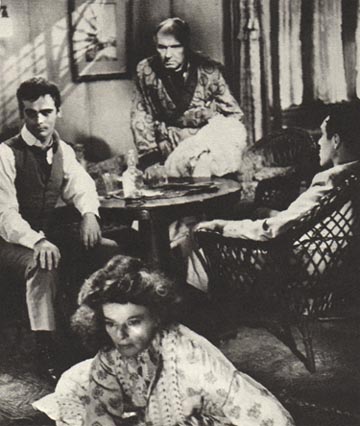
So, a quick canter through those favourites I have written about here a few times, as per labels: Monica Vitti in L'AVVENTURA, the blonde Jeanne Moreau in Jean Rabier's glittering black and white photography in Jacques Demy's BAY OF ANGELS, '63; Rita Tushingham in those early '60s black and white 'kitchen sink' dramas like A TASTE OF HONEY, the hit Richard Lester comedy THE KNACK in '66, and with Lynn Redgrave in Desmond Davis's THE GIRL WITH GREEN EYES in 1964 as 'Country Girls' Kate and Baba in Ireland and making the transition to London (as I did myself at the same time), Sarah Miles and Sean Caffrey in another Irish/London tale also by Edna O'Brien: I WAS HAPPY HERE in 1966 (after which Sarah went on to her unhappy stint on Antonioni's BLOW-UP before heading back to County Kerry in Ireland for the extended shoot on RYAN'S DAUGHTER); Sarah Miles and James Fox in one of those mirror shots from Losey's THE SERVANT, 1963; Julie Christie and gay photographer pal Roland Curram eyeing the dishy Italian waiter (they both got him) in Schlesinger's DARLING, 1965; David Warner as MORGAN - more on this soon - in 1966. Stateside we have Jack Lemmon and Lee Remick in a favourite moment from DAYS OF WINE AND ROSES in '62, Marilyn in Huston's THE MISFITS, 1961 which Russell Metty made look marvellous; Brandon De Wilde and Warren Beatty in that other '62 favourite Frankenheimer's ALL FALL DOWN; and the ensemble from Lumet's long unseen LONG DAY'S JOURNEY INTO NIGHT (its now on dvd), also 1962: Katharine Hepburn, Ralph Richardson, Dean Stockwell and Jason Robards; and Natalie Wood and Steve McQueen in Mullian's LOVE WITH THE PROPER STRANGER, 1963. Back to Europe with Sophia Loren and Tony Perkins in Litvak's FIVE MILES TO MIDNIGHT in '62, Jean Sorel and Gina Lollobrigida in the hilarious LE BAMBOLE (THE DOLLS) in 1965, and Sorel with Claudia and Michael Craig in Visconti's SANDRA, also 1965. Then we have Antonioni's L'ECLISSE (written about here several times: Antonioni, L'Eclisse,Vitti labels); Malle's LE FEU FOLLET in 1963, Milos Forman's A BLONDE IN LOVE in 1965 and Bresson's AU HASARD BALTHAZAR and Bergman's PERSONA in '66. After that, it was pretty much colour all the way ...